
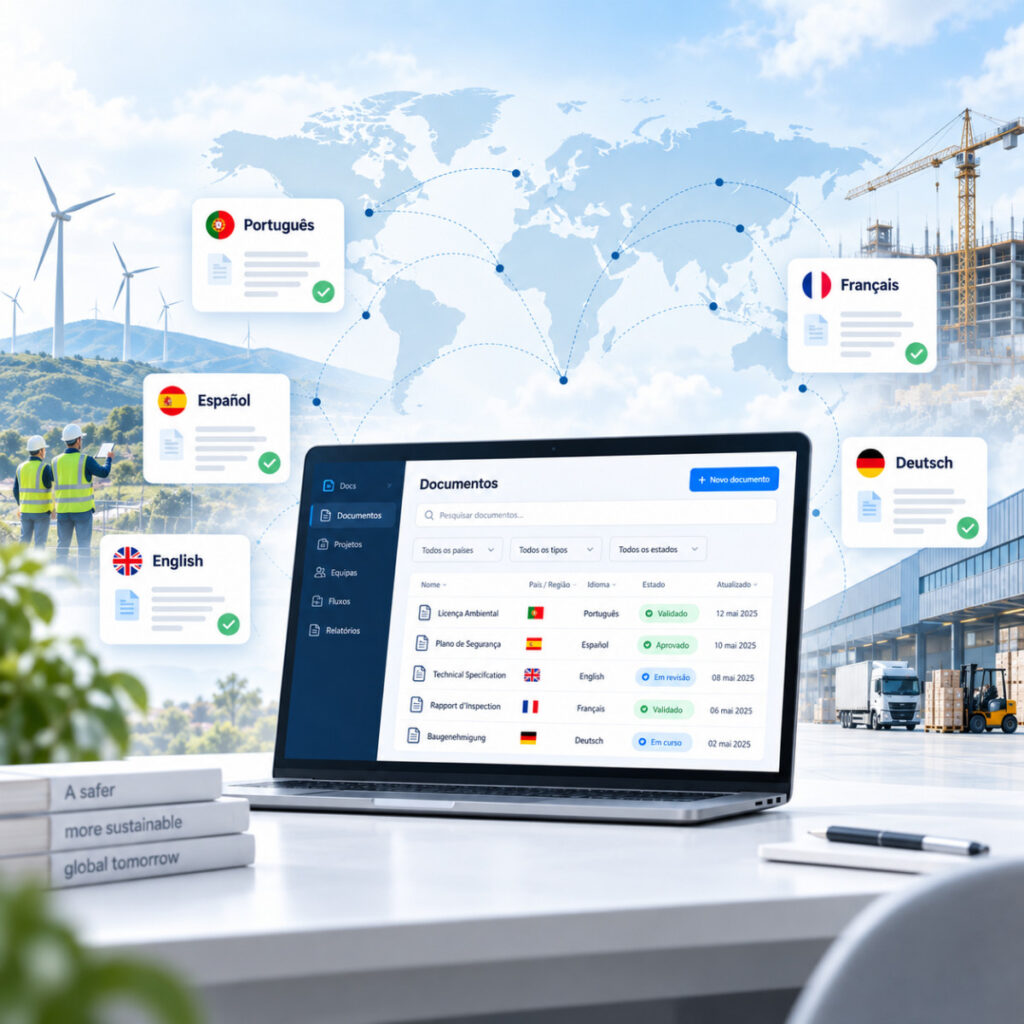
The internationalisation of companies has brought new opportunities, but it has also significantly increased the complexity of document processes and made multilingual documentation management essential.
Today, an organisation may work at the same time with Portuguese companies, Spanish workers, German manufacturers, French suppliers or technical teams from different regions.
As a result, the documentation needed to authorise companies, workers, equipment or activities may arrive in several languages, formats and structures.
For example, Portuguese, Spanish, English, French or German may coexist on the same project.
In this context, multilingual document management is no longer just a convenient feature.
Instead, it becomes an important condition for ensuring consistency, scalability and operational control.
The challenge is not just understanding the language
When we talk about international documentation, it is easy to reduce the problem to translation.
However, in a document management process, translating a document is only part of the issue.
You need to understand what the document shows and relate that information to the requirement it must meet.
For example:
• which worker, company or piece of equipment it belongs to;
• who the issuing body is;
• what the validity period is;
• which qualification or competence it proves;
• which activity it authorises;
• whether there are limitations or restrictions;
• whether the document applies to the work the team will carry out;
• whether other associated requirements also apply.
Indeed, a single word, condition or exclusion can change the document decision.
That is why translating information is not the same as interpreting compliance.
When different countries use different processes, complexity grows
One of the difficulties for international organisations arises when each country, project or team starts developing its own way of managing documentation.
Soon, you find:
• different Excel sheets;
• different naming conventions;
• different validation criteria;
• parallel systems;
• email-dependent processes;
• local folders;
• manual translations;
• different ways of classifying the same requirements.
As a result, document management becomes fragmented.
Besides increasing the administrative workload, this fragmentation hinders global oversight. It also makes it harder to see whether every region actually applies the same criteria.
A single platform makes it possible to reverse this logic.
One platform, different regions
Document management designed for international environments should centralise processes without forcing every region to work in exactly the same way.
However, the goal should not be to eliminate local specificities.
Rather, it should be to manage them within a common architecture.
An organisation may have different document requirements depending on:
• the country;
• the client;
• the project;
• the type of activity;
• the associated risk;
• the contractor company;
• the worker’s profile;
• the equipment used.
The platform should reflect those differences while keeping a global control structure.
In this way, you can work across different regions without losing traceability or creating parallel systems for each situation.
The role of artificial intelligence in multilingual documentation
Artificial intelligence is also changing how organisations can handle international documentation.
Instead of relying solely on manual reading and data entry, technology can support different stages of the document process.
These include:
• identifying the document type;
• reading documents in different languages;
• extracting names, dates and entities;
• identifying validity periods;
• recognising qualifications and references;
• automatically structuring information;
• helping compare document content with defined requirements;
• flagging missing or potentially inconsistent information.
In addition, this capability is especially relevant for organisations that receive large volumes of documents from different countries.
The goal should not simply be to “translate documents with AI”.
The real value lies in turning international documentation into structured, usable information within the document management process.
From reading the document to making the decision
A multilingual platform should go beyond storage.
Ideally, the process should move from the document received to a structured sequence:
Document → reading → interpretation → requirement → validation → decision → operation
This link is particularly important in HSE contexts.
A certificate may be formally valid and still not prove the qualification needed for a given task.
A training record may exist but not cover the specific activity the worker will perform.
Likewise, an authorisation may contain a restriction.
A declaration may apply only to a specific piece of equipment or worker.
This is precisely where document management stops being an administrative activity and becomes part of the organisation’s operational control system.
Consistent criteria regardless of language
Another challenge of working with international documentation is ensuring consistency.
If different teams review similar documents in different languages, the decision criteria should not change just because the document’s language has changed.
The platform should let you structure requirements and rules centrally, helping to ensure that decisions follow the criteria the organisation defines.
In this way, you can reduce dependence on each user’s individual knowledge and make the process more uniform.
The goal is simple:
Different documents, different languages, but the same control criterion.
Greater autonomy for international teams
Centralisation also improves collaboration between teams.
When requirements, documentation, statuses and decisions are available on a common platform, different regions can work on the same information structure.
As a result, teams no longer need to swap files by email, keep parallel sheets or constantly ask each other for clarification.
Each participant can consult the information relevant to their process, while the organisation keeps a consolidated view.
For international structures, this capability is particularly important.
Document management should grow with the organisation without a proportional increase in administrative complexity.
Multilingual documentation should not mean parallel processes
A company operating in five countries should not need five separate document systems just because there are linguistic or regulatory differences.
Similarly, an organisation that receives documents in several languages should not depend permanently on manual translation and interpretation.
Technology makes a different approach possible:
A single platform, multiple regions, different languages and configurable requirements.
This architecture is what turns document management into a truly scalable infrastructure.
From local document management to a global view
The larger the organisation, the more important it becomes to turn thousands of individual documents into a consolidated view.
The platform should help answer questions such as:
• How many workers are compliant on documents?
• Which documents are about to expire?
• Which suppliers have the most pending items?
• Are critical requirements still unmet?
• Which projects show the highest document risk?
• Where do most rejections occur?
• Are there significant differences between regions?
• What documentation is preventing workers from entering or work from going ahead?
Once a common platform structures the information, the organisation stops managing just documents.
Instead, it manages information, risk and decisions.
Example: A project with teams from four countries
Consider the construction of a wind farm in Portugal with a Portuguese main contractor, a Spanish assembly company, German technicians from the turbine manufacturer and a French commissioning team. Each company sends certificates, insurance and equipment documentation in its own language and formats.
Without structured management of multilingual documentation, every foreign document requires translation, help from colleagues or case-by-case decisions. As a result, one work front may accept a training certificate that another rejects. By contrast, with centrally defined requirements and support for reading documents in several languages, teams apply the same criterion to everyone. In addition, the organisation can demonstrate that consistency in an audit.
Frequently asked questions about multilingual documentation
Should we require translation of all documents? Not necessarily. However, the contract should define the accepted languages and the cases where translation is mandatory, especially for safety-critical documents.
Can AI decide on foreign documents on its own? As a rule, no. Technology helps read and structure the information, but decisions on critical requirements still need human validation.
How can you ensure that every region applies the same criteria? Define the requirements and acceptance rules once, on the platform, and allow only the local variations the organisation approves. In addition, indicators by country, such as the rejection rate or review time, quickly show where criteria are diverging.
What information should you record for translated documents? The original document, the translation used, who produced or validated it and the date. In this way, the organisation preserves the original evidence and can explain its decision, even years later.
Multilingual documentation management for international organisations
Internationalisation has made document processes more demanding.
More companies and workers.
More regions, languages and requirements.
And much more information.
Responding to this reality with more Excel sheets, more emails or more manual processes simply shifts the complexity onto teams.
The alternative is to build document processes designed from the outset to work in an international context.
At AISP, we structure and develop document management processes adapted to different organisations, projects and regions, combining document expertise, technology and new artificial intelligence capabilities.
Together with technology solutions such as Glartek, organisations can move towards more configurable, integrated document management models that are ready for international operations.
Because different countries may have different requirements.
Documents may come in different languages.
But control must remain centralised, structured and consistent.
To go further: Document management: The complete guide for companies.
See also: Documents in different languages: Why this is no longer just an administrative issue.
Finally, for international reference standards on information management, visit ISO.