
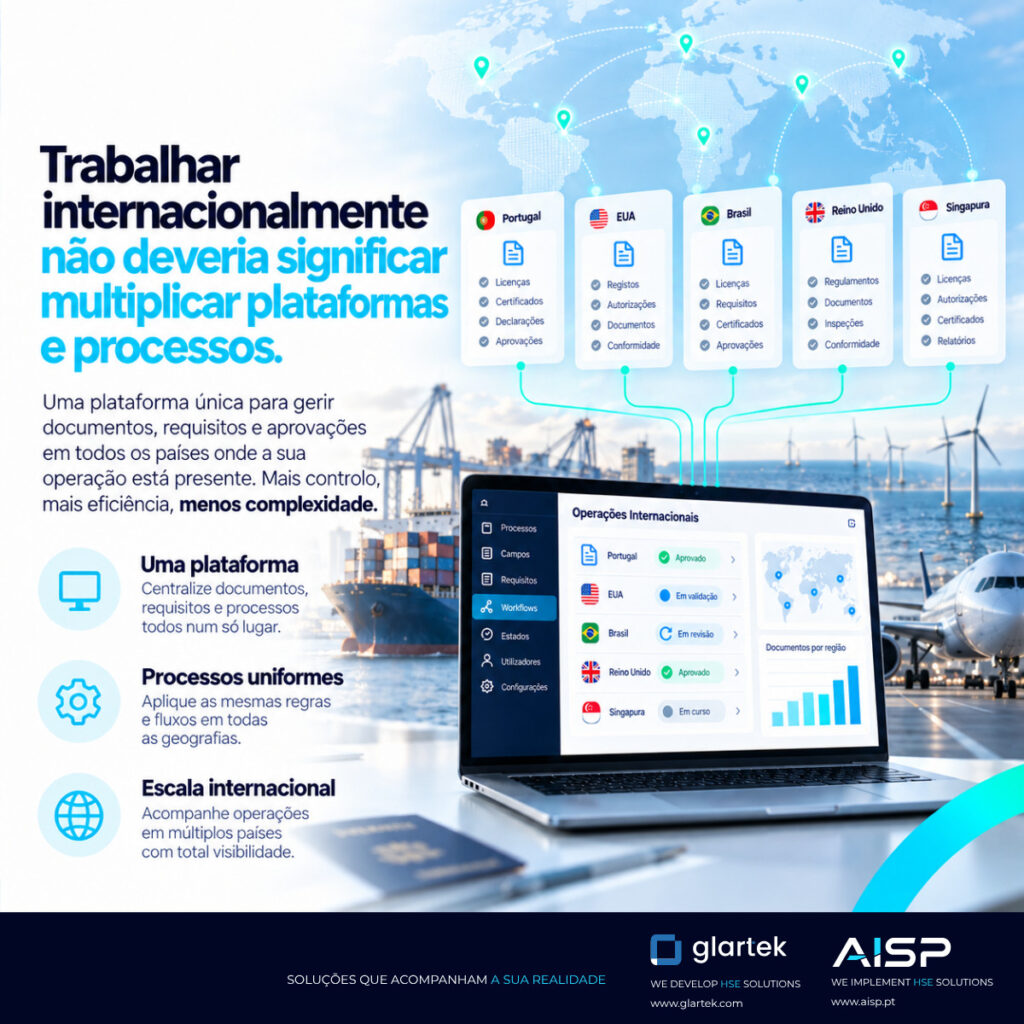
Internationalisation brings growth, new opportunities and access to different markets. However, international operations also add complexity.
New countries mean new requirements, new teams, new suppliers, different languages, different legal frameworks and, often, new ways of working.
The problem arises when teams solve each new situation with yet another tool, another Excel sheet, another folder, another email thread or even a new platform.
As a result, what started as a local solution quickly turns into a fragmented architecture.
And the more the organisation grows, the harder it becomes to keep a global view.
More regions should not mean more systems
In fact, it is common to find organisations where different countries or projects use separate document processes.
Each team creates its own structure.
In turn, each project adapts its own files.
Each region develops its own criteria.
At some point, the organisation ends up with:
• several platforms;
• different control sheets;
• separate databases;
• email-dependent processes;
• inconsistent document criteria;
• different naming conventions;
• duplicated information;
• little ability to consolidate.
Individually, each solution may seem adequate.
However, when we look at the organisation as a whole, the result is a structure that is more complex, harder to manage and less scalable.
Operational complexity grows faster than the organisation
Multiplying tools also means multiplying points of failure.
For example, teams may have to enter the same information several times.
A document may be up to date in one system and out of date in another.
In addition, different teams may interpret the same rule differently.
A global report may require manual consolidation of information from several sources.
And a simple question can become hard to answer:
How many workers are compliant across all projects?
Which documents will expire in the coming days?
Who are the companies with the most pending items?
Which equipment is currently on hold?
What requirements are preventing work from starting?
Which region shows the highest document risk?
When information sits in many places, the answer often depends on several people, files and platforms.
Centralising international operations does not mean eliminating differences
However, a single platform does not mean forcing every region to work in exactly the same way.
Each country may have specific requirements.
Likewise, each client may set its own rules.
Each project may require certain documents.
Finally, each activity may have particular conditions.
In other words, the point is to manage those differences within a common architecture.
A platform ready for international operations should let you configure requirements according to:
• country;
• project;
• client;
• activity;
• company;
• worker;
• equipment;
• risk level;
• language;
• applicable document framework.
In this way, the organisation keeps local flexibility without losing global control.
A common architecture lets you grow without losing traceability
When all document management sits within a common structure, the organisation can work with different realities without creating parallel processes.
This makes it possible to maintain:
• structured control criteria;
• decision traceability;
• document history;
• centralised information;
• uniform statuses;
• consolidated indicators;
• greater visibility for HSE, Procurement, Operations and Management.
As a result, the organisation is better able to grow without a proportional increase in administrative workload.
The role of configurability in international operations
In addition, internationalisation requires flexibility.
A rigid platform often forces organisations to create external processes whenever a different need arises.
By contrast, a configurable platform lets you adapt:
• document types;
• requirements;
• fields;
• statuses;
• workflows;
• access profiles;
• validation rules;
• notifications;
• organisational structures.
This is especially relevant for organisations that operate in several regions.
Therefore, the platform should keep pace with the company as it evolves.
It should not force the company to keep adapting to the platform’s limitations.
International operations: Different languages, the same control structure
On the other hand, linguistic diversity is another important dimension.
An international organisation may receive documentation in Portuguese, Spanish, English, French, German or other languages.
Creating different processes just because the language has changed increases fragmentation once again.
Document management must be ready to handle multilingual information within the same process.
With the support of Artificial Intelligence, organisations can also improve how they read, extract and structure document information, reducing part of their dependence on manual tasks.
In other words, the aim should be to keep the same control principles regardless of the document’s original language.
Integration instead of isolation
Moreover, interoperability is another critical factor.
Document management should not work in isolation from the rest of the organisation.
Information on companies, workers, equipment, projects, access or activities may already exist in other systems.
When platforms do not talk to each other, the organisation creates duplication again.
APIs and integrations therefore reduce manual data entry, avoid repeated information and connect document management to other operational processes.
In an international organisation, this capability becomes even more relevant.
The greater the volume of information, the less sustainable it is to rely on manual processes between systems.
Technology should reduce complexity, not digitise it
One of the most common mistakes in digital transformation is simply reproducing processes that were already too complex in digital form.
For example, digitising five different processes still means managing five different processes.
Similarly, moving several Excel sheets into several applications does not necessarily solve the problem.
Effective digital transformation should aim to simplify the architecture.
Eliminate duplication.
Centralise information.
Automate repetitive tasks.
Structure criteria.
Create a shared view.
And let the organisation grow without constantly increasing the number of systems it needs to stay in control.
One organisation, several regions, a global view
Working internationally means accepting differences.
Different countries will have different requirements.
Likewise, different projects will have different rules.
Different operations will have different levels of risk.
However, these differences do not force the organisation to create a separate technology structure for each situation.
A document management platform designed for international operations should combine local flexibility with global control.
At AISP, we structure and develop document management processes for organisations with different projects, regions and levels of complexity.
Together with technology solutions such as Glartek, we can develop more configurable, integrated and scalable models that keep pace with organisational growth without needlessly multiplying processes and systems.
Because growing internationally should increase the organisation’s capacity.
Not its administrative complexity.
See also: Multilingual document management: How to manage international documentation on a single platform.
Finally, for international reference standards, visit ISO.