
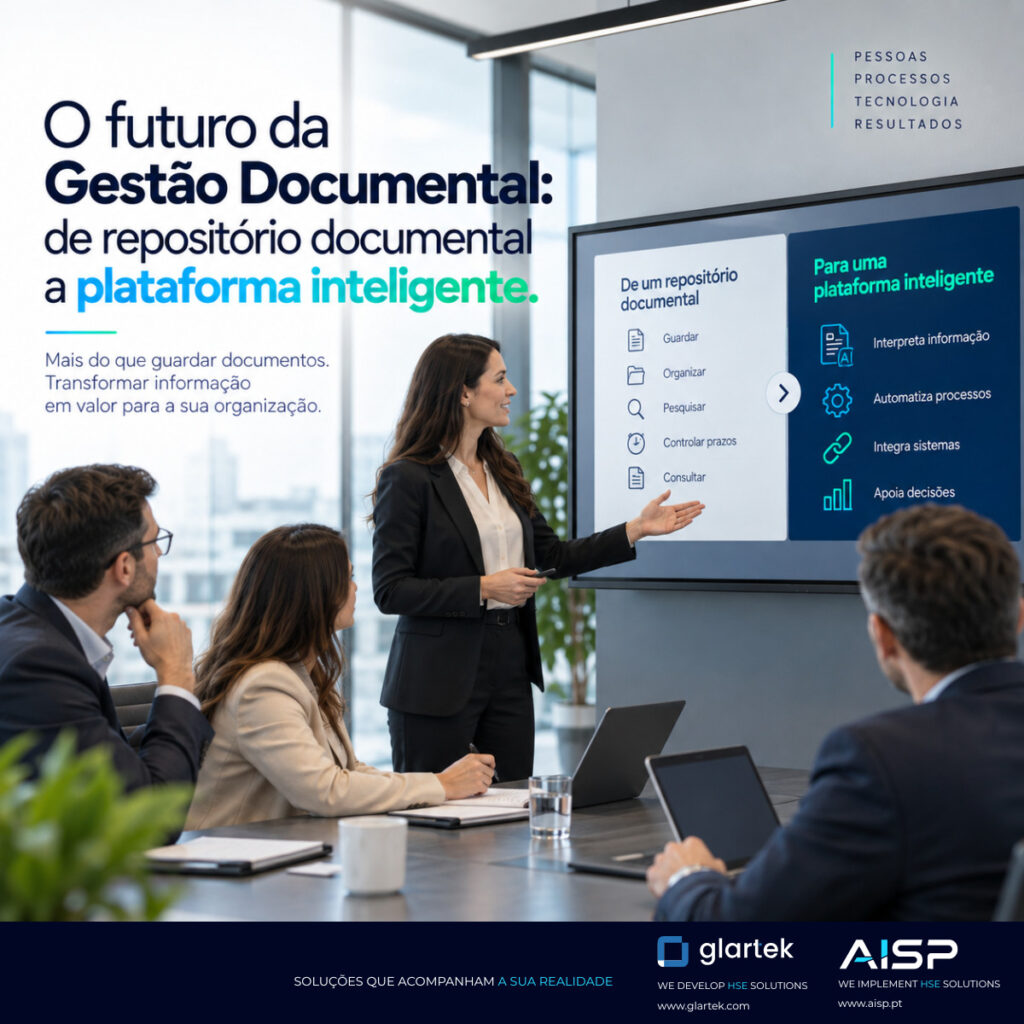
For many years, the evolution of document management focused on one essential goal: replacing paper with more organised, searchable and controllable digital processes. However, the future of document management demands more than that.
In fact, it was a decisive transformation.
As a result, documents became centralised. In addition, it became possible to control versions, manage deadlines, set permissions, track statuses and find information much faster.
But what was a huge step forward a few years ago is now starting to fall short.
Today, however, organisations no longer just need platforms where they can store documents.
They need platforms that can understand the information those documents contain, turn it into structured data, automate processes and provide relevant information to support decisions.
This is the shift that is redefining the future of document management.
In this way, the focus is gradually moving away from the file.
It now lies in the information.
Storing documents is no longer enough
Documents rarely exist just to sit in an archive.
For example, a certificate may contain an issuing body, an expiry date, a qualification and information about a worker.
Likewise, a licence may contain validity periods, references, conditions and responsible entities.
A technical data sheet may also include equipment characteristics, specifications, requirements or values.
Finally, a report may contain conclusions, statuses, non-conformities, evidence or actions.
For many years, organisations stored these documents digitally, but the information essentially remained “trapped” inside them.
So, to use it, someone had to open the file, read it, interpret it and manually enter the necessary data somewhere else.
In other words, the document was digital, but the process remained largely manual.
However, it is precisely this logic that is changing.
From file to data: The future of document management
One of the biggest advances in the new generation of document management is the ability to turn document information into usable data.
In addition, with artificial intelligence, the platform can support reading, identifying and extracting the information that documents contain.
We are talking, for example, about dates, entities, references, values, statuses, expiry dates, requirements, identifiers and other elements relevant to the process.
Once structured, this data no longer depends solely on someone consulting the document manually, and the organisation can use it directly.
It can feed:
databases;
reports;
indicators;
dashboards;
validation processes;
workflows;
alerts;
control mechanisms;
decision-making processes.
In other words, the document still exists.
But it is no longer the only place where the information lives.
Artificial intelligence applied to real processes
Talking about artificial intelligence in document management only makes sense when we can translate it into operational results.
Organisations should not adopt technology just because it is new.
Above all, it must solve problems.
One of them is obvious: the amount of manual work involved in reading and processing documents.
Imagine, for example, an organisation that manages hundreds of contractor companies, thousands of workers and a wide set of document requirements.
Someone may need to receive each document, classify it, link it to the right entity, analyse it, compare it with a given requirement, validate, reject or approve it, and monitor it throughout its validity.
When a significant part of this process depends on manual work, the impact on productivity is high.
That is why artificial intelligence can support some of these tasks and reduce the effort needed to turn documents into usable information.
But there is an important point: AI does not mean a lack of control.
In critical processes, technology should support teams, strengthen consistency and speed up information processing, while keeping validation mechanisms suited to each organisation’s reality.
The real breakthrough lies in combining AI and automation
Extracting information is only part of the transformation.
The real potential appears when the extracted data starts triggering processes.
Imagine, then, that a platform automatically identifies an expiry date.
Next, that information can update a field.
The field can feed a rule.
As a result, the rule can generate an alert.
The alert can start a task.
The platform can then assign the task to the person responsible.
If nobody renews the document, its status can change.
And that change can affect a contractor approval or access process.
This is the point at which document management stops being just about documents.
It becomes about processes.
Workflows that move information forward
That is why an intelligent platform must be able to turn information into action.
You can build approvals, notifications, task assignment, status changes, validations and conditional rules into workflows.
As a result, this reduces one of the most common problems in organisations: the need to track every step of the process manually.
Who has to validate?
Who is waiting?
Which document was rejected?
Which task is overdue?
And what is the next step?
Which requirement is pending?
When these answers depend on emails, spreadsheets or individual tracking, the process becomes vulnerable.
In contrast, a well-structured workflow makes the process more predictable, traceable and consistent.
The platform should not force the organisation to work in a particular way
There is, however, a risk in automation.
Automating a rigid process does not necessarily make it better.
That is why the next generation of document management cannot just be intelligent.
It also has to be configurable.
In fact, no two organisations work in exactly the same way.
Differences include:
approval routes;
responsibilities;
access levels;
statuses;
requirements;
document types;
rules;
task sequences;
control models.
As a result, a platform that forces every organisation to use the same model often ends up creating parallel processes.
In other words, the company adapts to the platform.
When the opposite should happen.
No-code and operational autonomy
This is where the no-code approach becomes relevant.
Teams should be able to configure fields, forms, workflows, statuses, permissions and rules with greater autonomy, without turning every change into a new development project.
This capability has a direct impact in three areas.
First, on speed.
The organisation can respond faster to new requirements.
Second, on autonomy.
Teams no longer depend permanently on the technology provider.
Finally, on evolution.
The platform can keep up with operational changes without repeated rebuilds.
In the future, organisations will judge a platform less and less by the number of features it offers.
They will also judge it by how well it adapts.
From isolated systems to connected information
Another fundamental change lies in integration.
For years, many organisations built their digital ecosystems by accumulating systems.
For example, an ERP, a human resources platform, a document management solution, an HSE platform, a maintenance system, a business intelligence tool, one app for inspections and another for audits.
Individually, each system may work well.
The problem arises when information does not flow between them.
When that happens, teams end up:
entering the same data more than once;
exporting and importing files;
keeping parallel spreadsheets;
reconciling information;
manually checking whether the systems are aligned.
In other words, digitising isolated systems does not necessarily create a truly digital operation.
APIs, integrations and interoperability
That is why the next generation of document management must be ready to communicate with the organisation’s technology ecosystem.
APIs and integrations let platforms exchange information.
Interoperability goes further: it aims to ensure that different systems can use that information consistently within their own processes.
The goal is not necessarily to replace every existing tool with a single platform.
It is to allow systems to work better together.
When information flows between systems, you can reduce duplication, improve traceability and create a much more integrated view of operations.
The impact on HSE and OHS
This evolution is particularly relevant in HSE and OHS contexts.
In fact, documents often relate directly to operational processes.
A contractor company can have its own workers.
In turn, workers may have document requirements and mandatory training.
They may also use equipment.
Equipment may require documents and inspections.
Inspections may generate non-conformities.
Non-conformities may lead to action plans.
Action plans may require evidence.
None of this really happens in isolation.
That is why technology should also bring these processes closer together.
In this way, document management can become part of a much broader HSE ecosystem, where document information and operations work together.
From document control to decision support
Perhaps the most interesting evolution happens when we start looking at document information as a whole.
An intelligent platform should not just say whether a given document is valid.
It should also help you understand what is happening in the process.
For example:
Which requirements generate the most rejections?
Which document types need the most corrections?
Where are the most delays?
Which suppliers have the longest approval times?
How many documents expire in the next 30 days?
Which processes involve the most manual work?
Where are the bottlenecks?
Which indicators are getting worse?
In this way, these questions transform document management.
We are no longer just controlling files.
We are using document information to understand operations better.
Structured data in the future of document management
When data breaks free from documents, it becomes easier to analyse.
It can feed dashboards and support cross-analysis.
In addition, you can compare it over time and use it to support decisions.
And it can help identify patterns that would be hard to see by looking at documents one by one.
This is one of the reasons why the future of document management depends more and more on data quality.
That is why having digitised documents is not enough.
You need to be able to turn the information they contain into knowledge.
The future of document management: Multilingual by nature
In addition, the internationalisation of operations adds another challenge.
Companies, workers and suppliers operate in different geographies.
Consequently, documents reflect that reality.
For example, a single project may involve documents in Portuguese, English, Spanish, French or other languages.
That is why a future-ready platform must be able to support multilingual operations without creating parallel processes.
The ability to interpret documents in different languages, combined with standardised data and workflows, can be especially relevant for international organisations.
Languages change, but the need for control, traceability and consistency remains.
An intelligent platform does not replace your teams’ knowledge
There is an important difference between automating and removing human involvement.
Not every decision should be automatic.
Likewise, not every document should skip human review.
And not every process fits the same approach.
That is why an intelligent platform should help teams work better.
It should reduce repetitive tasks, highlight relevant information, support checks, improve consistency, provide data and automate what makes sense to automate.
However, technical knowledge, critical analysis and decision-making remain essential.
Technology should therefore enhance that knowledge, not ignore it.
Choosing a document management platform with the future in mind
There is also another principle we consider important.
When an organisation chooses a platform, it is natural to compare what each solution can do today.
But a document management platform tends to stay with a company for several years.
That is why a technology decision should not only look at the present.
Processes will change.
Requirements will evolve.
In addition, new systems will emerge.
Artificial intelligence will also keep developing.
Organisations may enter new markets.
Finally, ways of working may change.
That is why configurability, interoperability, integration architecture and the capacity to evolve are increasingly important.
Buying features is not enough.
You need to choose a platform that is ready to evolve.
The future of document management: From repository to intelligent platform
This is, in essence, the transformation under way.
Yesterday, the question was:
“Where is the document?”
Today, it may be:
“What does the document tell us?”
Next, it will also be:
“What should happen with this information?”
And after that:
“What can we learn from the accumulated data?”
This sequence is what turns a repository into an intelligent platform.
Document, information, data, process and decision.
The future of document management has already begun
Document management will still need to organise, validate, protect and provide access to documents.
Those functions do not disappear.
But they no longer mark the limits of the platform.
The next generation adds new capabilities:
document interpretation;
artificial intelligence;
data extraction;
automation;
configurable workflows;
no-code;
integrations;
interoperability;
multilingual capability;
analytics;
decision support.
At AISP-GEDOC, in partnership with Glartek, this is the evolution we consider essential: combining real experience in document processes with technology that makes document management more intelligent, more integrated and closer to operations.
Because the future is not about storing more files.
It is about making better use of the information inside them.
And turning that information into simpler processes, more autonomous teams and better-informed decisions.
See also: The next generation of document management and Fewer isolated systems. More connected information.
Finally, to learn about European digital transformation policies, visit the European Commission.