
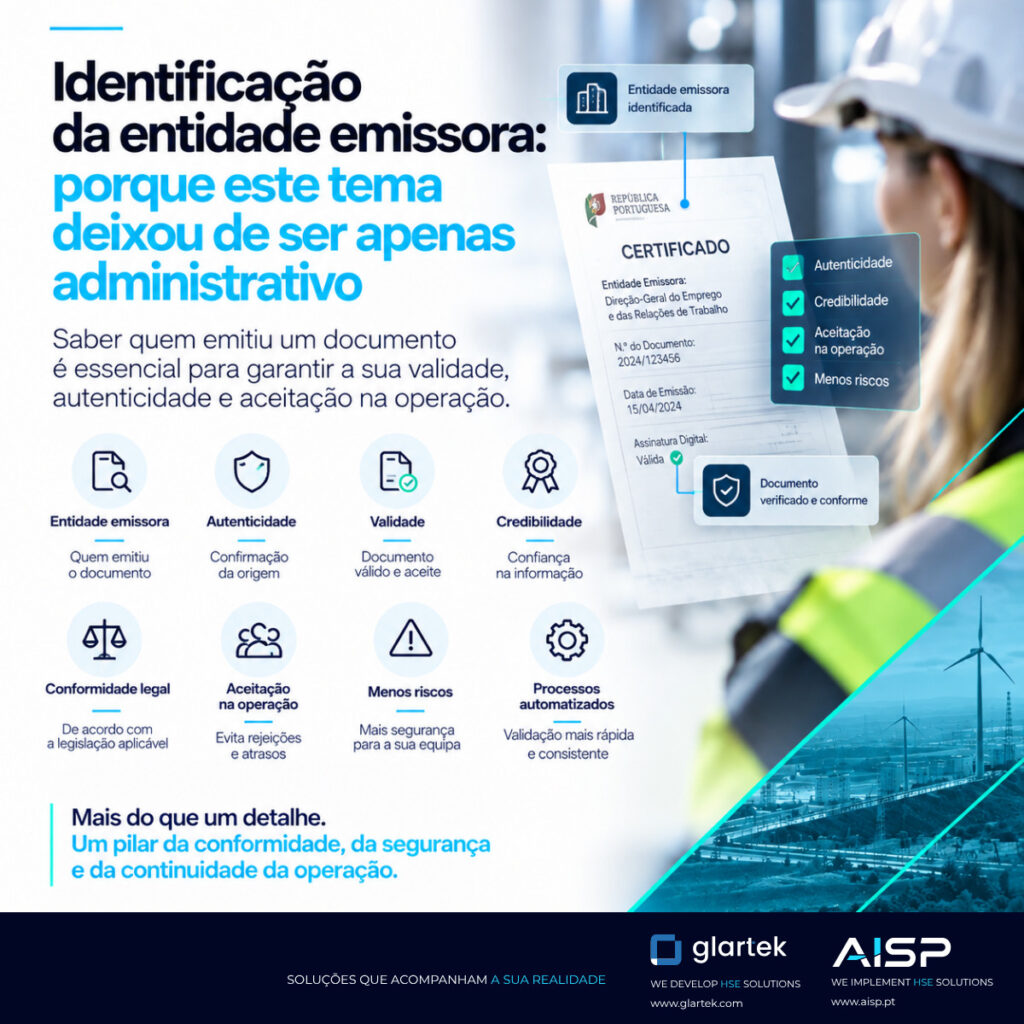
Document review should not stop at checking dates, names, signatures or expiry dates while leaving out the step of identifying the issuing body.
In many processes, there is another element that can be decisive in assessing whether a document is suitable evidence: the issuing body.
Knowing who issued a given certificate, declaration, report or authorisation can be essential to understanding its origin, framework and suitability for the requirement under validation.
A valid document may not be enough
Imagine, for example, a certificate that contains all the elements that seem necessary.
It identifies the worker correctly. The date is within the validity period. The document contains a signature and consistent information.
Even so, one fundamental question is missing:
Is the body that issued this document suitable for the requirement we are validating?
This question shows why document compliance should not come down to a formal analysis of the file.
The document is evidence. And you need to analyse that evidence in the context of the requirement it aims to demonstrate.
Why identifying the issuing body matters
In fact, the origin of a document helps to frame the information it presents.
Depending on the type of document, the requirement, the applicable legislation, the client or the organisation’s internal rules, you may need to identify clearly who issued it. You may also need to check whether that origin matches what you expect.
This can be particularly relevant for documents such as training certificates, inspection reports, declarations of conformity, licences, authorisations, insurance, technical certificates or documentation from external bodies.
From reading the document to interpreting the evidence
In a traditional process, the review may consist only of reading the document manually.
In a more structured document process, the platform can extract and relate the information automatically.
The platform can identify the issuing body, the document type, the holder, the dates, the applicable requirements and other relevant elements.
But the real evolution happens when we stop analysing this data in isolation.
The question then becomes:
Is this body, for this type of document, a suitable source to prove this requirement in this specific context?
It is this relationship, therefore, that enables more consistent document review.
The role of AI in identifying the issuing body
Artificial intelligence can help identify and extract the issuing body from the document itself.
It can also help structure that information and compare it with requirements configured in advance.
However, automation must rest on clear rules.
When the system cannot identify the body, the information is ambiguous or there is not enough evidence for a safe decision, the process must be able to send the document for human verification.
This combination of automation and control therefore reduces repetitive tasks without turning uncertainty into automatic approval.
More context, better decisions
Document management evolves when it stops asking only:
“Is the document valid?”
And also starts to consider:
“Who issued it?”
“Which requirement does it aim to prove?”
“Is that origin suitable?”
“In what context will we use it?”
Identifying the issuing body is therefore no longer a simple administrative detail.
It becomes part of the quality of the document evidence and of the compliance decision itself.
More document context means a greater ability to make consistent, traceable and safe decisions.
Read also: The problem with treating compliance as a property of the document and The information is already inside the documents. AI can help extract it.
To learn about the international standards that apply to certification, visit the ISO website.