
Internal documentation is one of the foundations of how any organisation works, which is why internal document governance matters.
Policies, procedures, work instructions, regulations, forms, records and documentary evidence support decisions, define responsibilities and guide how people should carry out activities.
But having documents in storage does not necessarily mean having a controlled document process.
Genuine document governance starts when the organisation can clearly answer questions such as:
Who created this document?
Who approved it?
Which version is currently in force?
When is it due for review?
Who can change it?
Which version was in force on a given date?
Which requirements justified a particular change?
It is this ability to answer that turns a document archive into a true governance system.
More than storing documents
In a traditional model, document management may do little more than organise files by folders, departments or categories.
But this approach falls short as the organisation grows.
As the number of documents, departments, users and processes increases, so does the need to ensure consistency.
A document may exist and still be out of date.
It may sit in the right folder yet remain accessible to people who should not change it.
Similarly, a new version may exist while some teams keep working with an earlier one.
That is why document governance must control not only the document but also its entire life cycle.
What a robust process should control
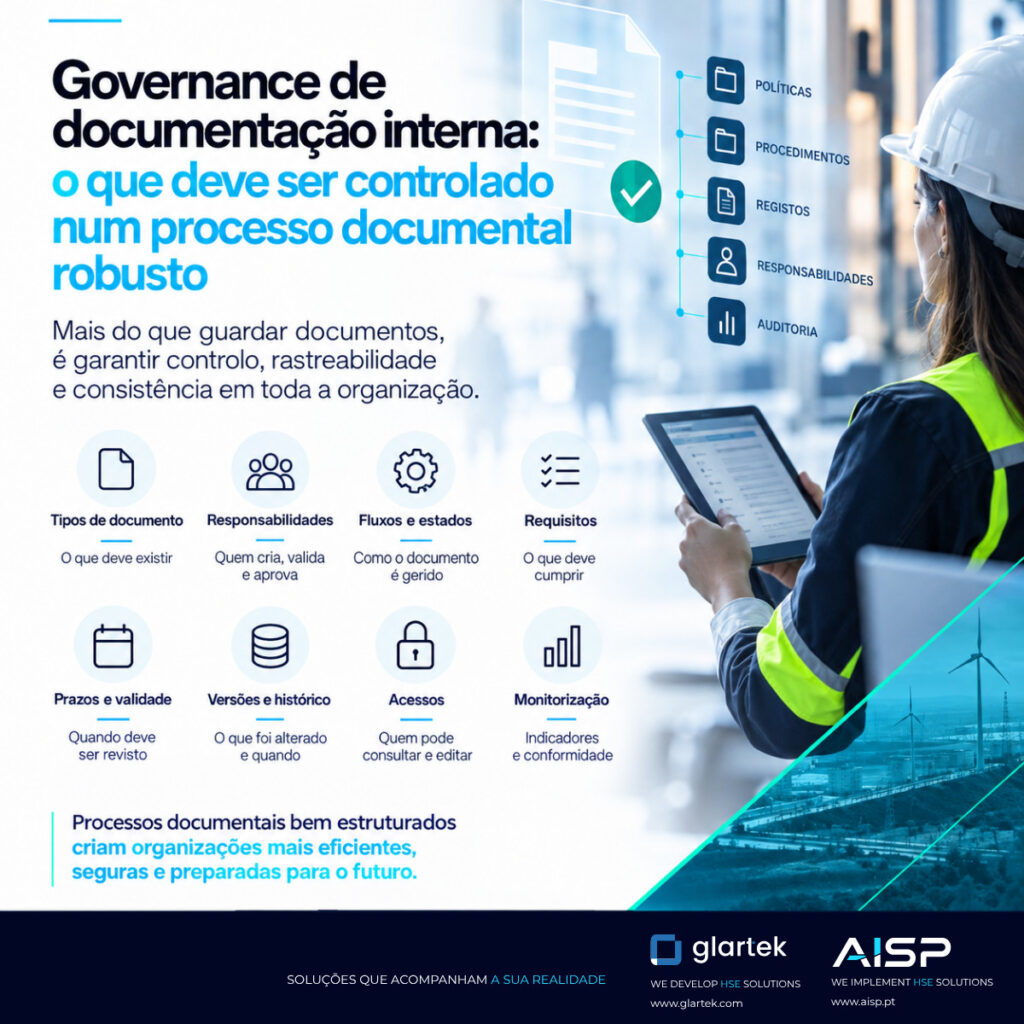
A robust document process should bring together different dimensions of control: document typology, responsibilities, requirements, approval flows, deadlines, validity, version history, access and monitoring.
The organisation should know exactly which documents exist and why they exist.
It should also be able to define who is responsible for creating, reviewing, validating and approving them.
Documents should follow flows suited to how critical they are, and they may go through different statuses before they come into force.
Controlling deadlines and reviews is also essential.
For example, a procedure may not have a formal expiry date like a certificate, but that does not mean it should go indefinitely without review.
The platform should therefore let you set review intervals, alerts and owners.
Version control is essential
One of the most critical areas of internal document management is version control.
When a policy or procedure changes, it should be possible to see:
what the previous version was, what changed, when the change happened, who made it and who approved the new version.
This traceability is particularly important in audits, investigations, certification processes or incident analysis.
Showing the current document is not enough.
Instead, you need to be able to demonstrate how the document has evolved over time.
Access does not mean permission to change
Another key element is access control.
Different users may need different levels of permission.
Some should only view documents.
Others can propose changes.
A third group can review or approve them.
When nobody defines these levels clearly, the risk of improper changes, lost information or the use of incorrect versions increases.
Monitor to improve
Document management should not stop once a document receives approval.
A mature organisation should be able to track indicators such as documents pending review, out-of-date documents, upcoming deadlines, average approval times or areas with the highest volume of changes.
As a result, this information helps identify weaknesses and continuously improve processes.
From documentation to internal document governance
The evolution of internal document management depends precisely on this change of perspective.
The goal is no longer just to store documents.
Instead, it is to ensure that each document has a controlled life cycle, defined owners, a preserved history and appropriate use.
The more complex the organisation, the more important this structure becomes.
Because well-defined document processes do not just create organisation.
They also create consistency, traceability, security and decision-making capacity.