
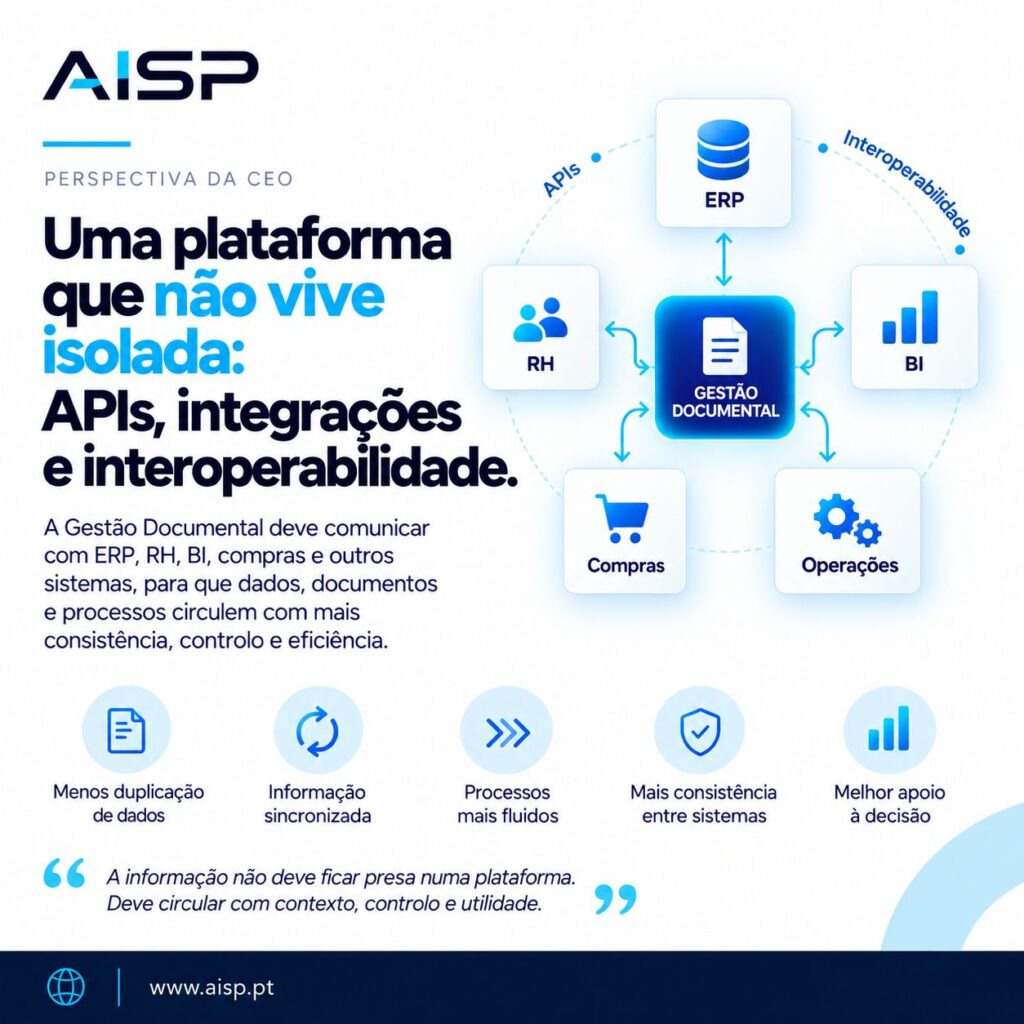
A document management platform should not work like an island, with no integration with other systems.
In fact, information in organisations flows between ERP, HR, BI, procurement, operations and many applications that are already part of daily work.
That is why, for me, integration and interoperability are not optional extras. On the contrary, they are essential for technology to truly keep pace with operations.
So, with that vision in mind, we designed this new generation of document management to communicate with other systems. As a result, data, documents and processes can flow in a structured way.
In other words, in practice, this means:
- APIs for integration with other systems
- Connection to ERP, HR, BI and operational applications
- Information synchronisation between platforms
- Less data duplication
- Less manual data entry
- Smoother processes
- Greater consistency between systems
In addition, for me, the most important point is simple:
information should not stay locked inside one platform. In fact, it should be available wherever people need it, with control, context and security.
When systems communicate with each other, document platform integration helps the organisation gain efficiency, reduce redundancy and improve information quality.
Thus, an integrated platform is a more useful platform.
Similarly, an interoperable platform is one that is ready to evolve.
Read also: The role of APIs in document management platforms and Your document management platform cannot be an island. On interoperability and digital transformation, see the European Commission.