
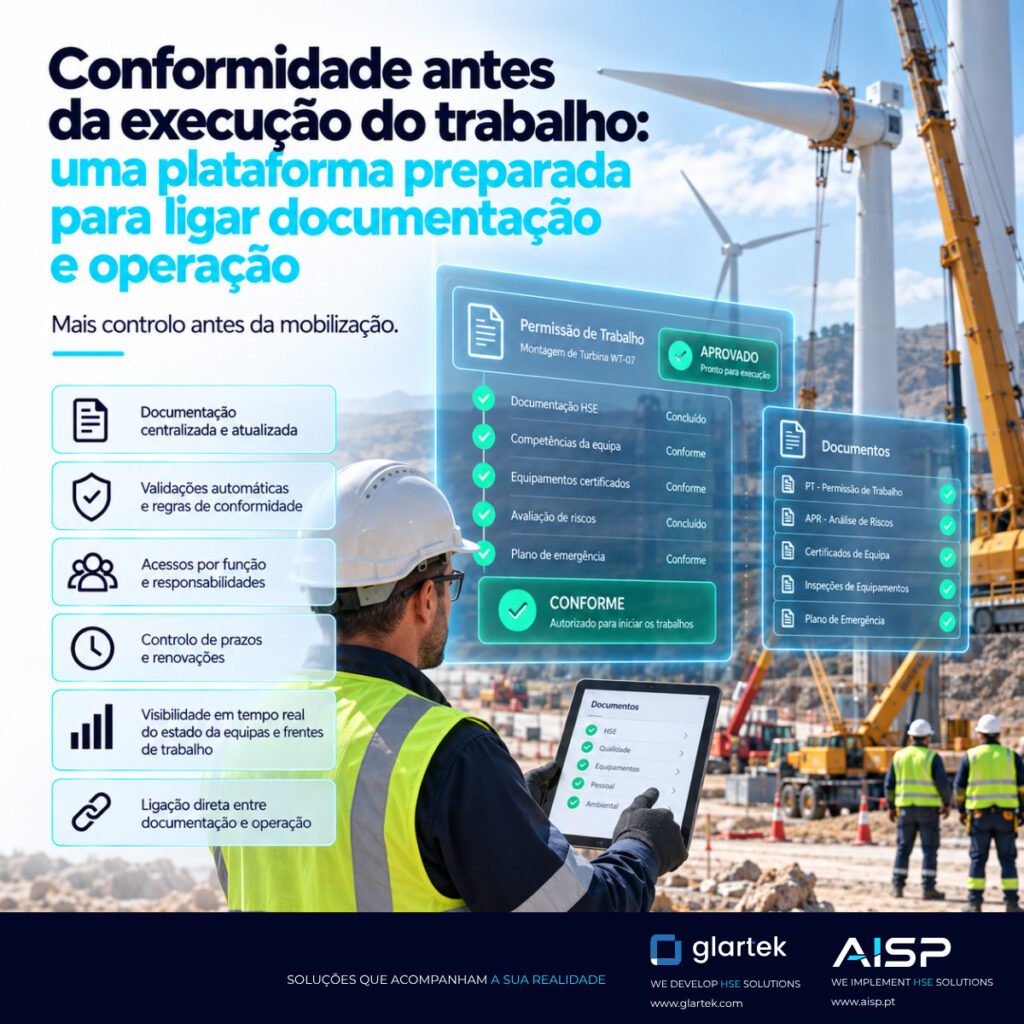
In industrial operations, construction, energy, maintenance or infrastructure, much of the document control happens before a team can start a given job. The goal is to ensure compliance before work starts.
Companies, workers and equipment all have requirements they must meet. For example, there are mandatory documents, specific skills, expiry dates, authorisations, evidence of training and requirements specific to each project.
The problem arises when teams analyse this information in isolation.
In fact, having documentation stored on a platform does not necessarily mean knowing whether a particular team is ready to carry out a particular activity.
That is why a more advanced platform can add value precisely in this link between document management and operations.
Check compliance before mobilisation and before work starts
Many document problems only become visible when operations should already have started.
For example, a worker arrives on site and a training course is missing.
A piece of equipment is on site, but an inspection has expired.
A company has approval, but it does not meet a specific requirement of that project.
Someone has submitted a document, but it is still awaiting validation.
In these cases, therefore, documentation is no longer just an administrative matter.
It has a direct impact on productivity.
Therefore, the goal should be to identify these situations before mobilisation.
When the organisation validates documentation in advance, it can act on exceptions before they turn into blockages.
Having a document does not mean meeting a requirement
This difference is fundamental.
For example, a worker may present a valid training certificate.
But the operational question is not just:
“Is there a certificate?”
You need to understand:
“Does this certificate show the competence that the planned activity requires?”
Similarly, this applies to fitness-for-work certificates, authorisations, equipment inspections, insurance, certifications and other requirements.
Thus, compliance depends on the relationship between:
requirement + evidence + context.
In other words, the document is only one part of that relationship.
The job role determines some of the requirements
In fact, two workers from the same company may need different documentation.
For example, an administrative technician will not necessarily have the same requirements as an electrician, an equipment operator or someone working at height.
Therefore, a platform should let you link requirements to the job role.
For example:
- training;
- fitness for work;
- certifications;
- authorisations;
- protective equipment;
- specific documents.
This way, validation no longer follows a generic checklist and instead reflects what each person will actually do.
Activity and risk also matter
The job role is not the only relevant factor.
In addition, the same worker may carry out different activities.
Some may introduce additional requirements.
Work at height, electrical risk, confined spaces, mobile equipment operation or hot work may require specific evidence.
Therefore, the document process must be able to relate:
worker + activity + risk + competence + evidence.
As a result, this level of detail avoids overly generic approvals.
Site-specific requirements
Each site may introduce its own requirements.
For example, one client may require specific training.
Another may set an additional authorisation.
Also, a project may use different criteria for equipment.
A facility may require specific access documentation.
So a worker may be fully compliant on one project and still pending on another.
However, this does not mean the documentation is wrong.
It means that the context has changed.
That is why a robust platform should let you configure different requirements per project without having to create separate systems.
Equipment also needs compliance before work starts
Furthermore, the analysis should not stop at workers.
The equipment used in operations may require:
- certificates;
- inspections;
- maintenance;
- insurance;
- periodic checks;
- specific authorisations.
Imagine a fully compliant team, but with a piece of equipment whose inspection has expired.
In other words, operations remain restricted.
That is why the view must cover people, companies and equipment at the same time.
From documentation to operational authorisation
When all these elements connect, it becomes possible to move from a simple document status to an operational decision.
Instead of showing only:
Document approved
the platform can help determine:
Team ready to start the activity
or:
Activity on hold due to a pending requirement
This difference matters.
Thus, documentation stops being the end point.
It becomes information that supports the decision.
Compliance alerts before and during the work
Moreover, expiry date control is another essential element.
A document may be valid today and expire during the project.
Therefore, analysing the current status is not enough.
It helps to anticipate:
- documents close to expiry;
- training due for renewal;
- equipment with upcoming inspections;
- authorisations that end before the activity finishes.
As a result, this capability makes it possible to plan renewals and reduce interruptions.
Real-time information for teams
In a complex process, information needs to be available quickly.
In other words, project managers, HSE teams, document managers and operations staff need quick answers. They should not have to open dozens of files to see a team’s status.
A platform can provide a consolidated view:
- worker;
- company;
- job role;
- documentation;
- skills;
- equipment;
- requirements;
- status;
- pending items.
Thus, this visibility reduces the time needed to make decisions.
The role of automation
Automation can also support several stages of the process.
For example, the platform can identify deadlines and generate alerts. It can also apply requirements according to job role or project and route documents to the right people.
Artificial intelligence can also help extract data and identify relevant information within the documents themselves.
However, automation does not mean removing human control.
Whenever there is ambiguity, contradictory information or insufficient evidence, the process should allow the case to go for review.
Compliance before and during the work, not a static snapshot
Also, another important point is that compliance changes.
For example, a worker may be compliant today and not tomorrow.
Training may expire.
A company may change its team.
Similarly, a piece of equipment may need a new inspection.
The client may introduce an additional requirement.
That is why compliance needs continuous monitoring.
As a result, you must be able to update the decision made before work begins as the context changes.
From document management to operational control
We can sum up the evolution of document management like this:
Traditional model:
Document → review → approval.
Integrated model:
Document → requirement → person/equipment → activity → risk → project → operational decision.
This link is what lets you use documentation to prevent problems before they reach the field.
Compliance before work starts: Fewer blockages, greater predictability
When it checks compliance before work starts, the organisation can reduce:
- restricted mobilisations;
- workers unable to start their activity;
- equipment without valid documentation;
- urgent renewals;
- last-minute decisions;
- avoidable interruptions.
At the same time, predictability increases.
In other words, the team knows in advance who is ready and where issues remain open.
The question that really matters
Ultimately, the question should not only be:
“Do we have the documents?”
Nor even:
“Have we approved the documents?”
The operational question is:
“Do we have enough evidence to confirm that this team can carry out this activity, on this project, right now?”
In fact, this change of perspective is what brings document management closer to operations.
Because compliance creates the most value when you check it before work starts.
Read also: Contractor approval with document management platforms and PPE management through document management platforms.
For more information on occupational safety and health, see the European Agency for Safety and Health at Work (EU-OSHA).