
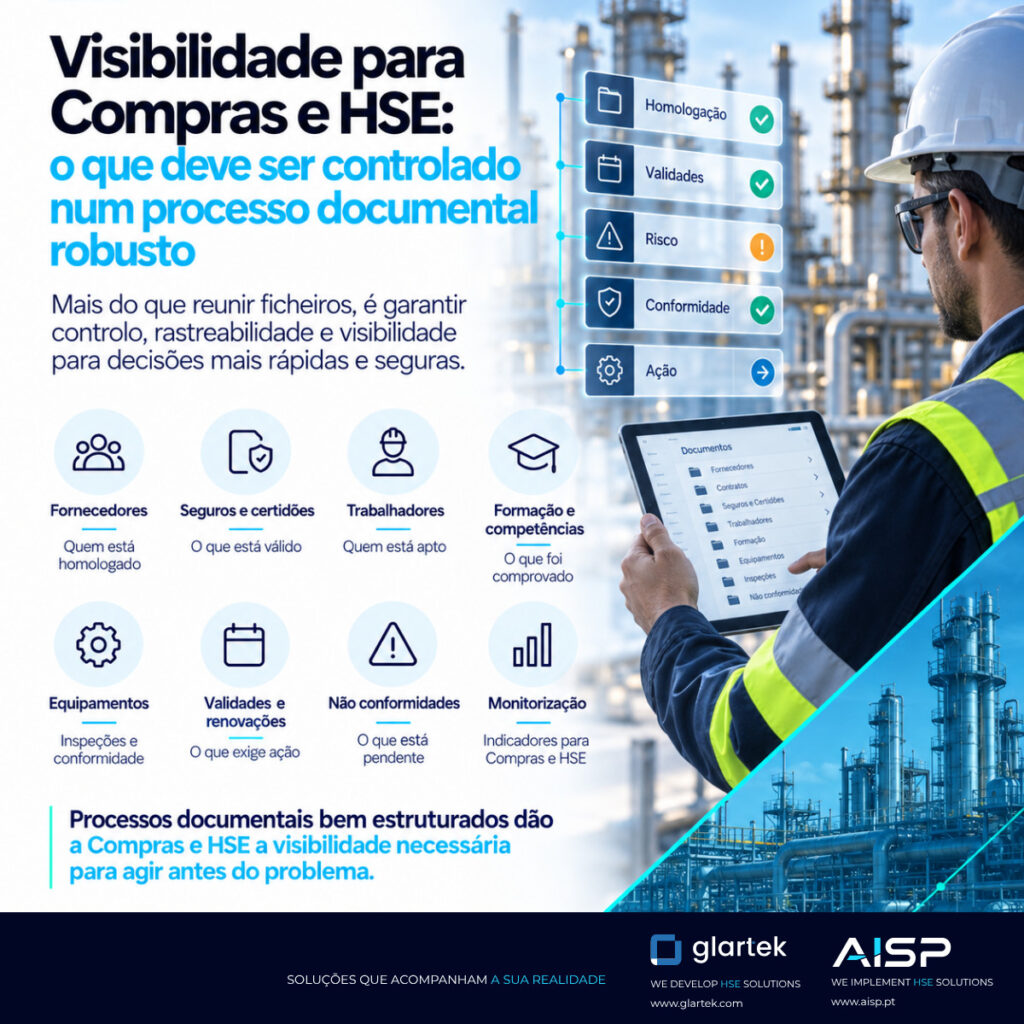
For Procurement and HSE, supplier management involves much more than hiring a company and filing its documents.
In fact, in industrial operations, construction, energy, maintenance or infrastructure, the relationship with a service provider involves commercial, contractual, document and HSE requirements all at once.
That is precisely why Procurement and HSE need to share a consistent view of each supplier’s status.
Procurement needs to know which suppliers hold approval, which corporate documentation remains valid and which situations could affect contractual continuity.
Similarly, HSE needs to track workers, competences, equipment, authorisations, inspections, expiry dates and non-conformities.
When these two perspectives live in separate systems or files, information silos appear.
As a result, a supplier may seem compliant to one team and present significant risks to another.
Contractor approval does not mean continuous compliance
A supplier may have gone through contractor approval correctly at the start of the relationship.
In addition, it may have submitted certificates, insurance, legal documentation and other necessary evidence.
But the situation changes over time.
For example, insurance policies expire.
Teams change.
Companies mobilise new workers.
Equipment enters and leaves operations.
Training has an expiry date.
Projects introduce additional requirements.
Therefore, nobody should read “approved” status as a permanent guarantee of compliance.
In other words, you need to follow how things evolve.
The Procurement view
For Procurement, document management can provide important information about supplier relationships.
Relevant elements include:
- approval status;
- legal documentation;
- insurance;
- certificates;
- contracts;
- expiry dates;
- contractual requirements;
- recurring non-conformities;
- document performance;
- outstanding issues.
This information shows not only whether the supplier passed approval, but also whether it still meets the conditions the business relationship requires.
The HSE view
HSE, however, needs a different level of granularity.
The company may hold approval, but that does not mean all its workers are ready to enter a site.
Nor does it mean that all its equipment is fit for use.
Therefore, it becomes necessary to track:
- workers;
- training;
- fitness for work;
- competences;
- authorisations;
- equipment;
- inspections;
- technical documentation;
- risk-related requirements;
- requirements specific to each project.
In fact, it is this link between supplier and operations that enables a more complete assessment.
The problem of separate views between Procurement and HSE
When Procurement and HSE work with different sources, inconsistencies can arise.
For example, imagine a supplier that appears as approved in the Procurement system.
Meanwhile:
- the insurance policy is close to expiry;
- two workers have expired training;
- one piece of equipment has a pending inspection;
- there is an open non-conformity on a site.
Even so, the company still holds approval.
But its capacity to carry out certain activities may face restrictions.
Without an integrated view, these differences only become visible when someone cross-checks the information manually.
A platform must connect different levels of compliance
Indeed, compliance can exist at several levels.
Company
Does the service provider meet the necessary requirements?
Workers
Do the mobilised people have the right documentation, training and competences?
Equipment
Do the resources in use have valid inspections, certificates and other requirements?
Project
Are there specific requirements from the client or the site?
Activity
Are there additional requirements linked to the task or the risk?
Therefore, a robust platform should make it possible to move between these different levels without losing the relationship between them.
Insurance, certificates and legal documentation
For Procurement, certain documents are particularly relevant because they can affect the very continuity of the relationship with the supplier.
For example:
- insurance;
- certificates;
- licences;
- declarations;
- company certifications;
- applicable tax or corporate documentation.
In addition, these documents may have their own expiry dates and rules.
Therefore, the platform should make it possible to monitor deadlines and anticipate renewal needs.
Training and competences
On the HSE side, one of the most important questions is whether workers have the competences they need for the activities they will carry out.
However, knowing that a certificate exists is not enough.
In other words, you need to relate:
worker + role + activity + competence + evidence
For example, a worker may have valid training, but that training may not match what a given activity requires.
Thus, visibility should make it possible to identify these gaps.
Equipment and inspections
Equipment compliance can also have a direct impact on operations.
A company may hold approval and the team may be ready from a document perspective, but the use of a piece of equipment may still depend on:
- an expired inspection;
- a missing certificate;
- pending maintenance;
- incorrect documentation;
- a project-specific requirement.
Therefore, equipment must be part of the same view.
Non-conformities that matter to Procurement and HSE
In addition, another important element is the follow-up of non-conformities.
However, it is not enough to know that something is pending.
In other words, you need to understand:
- the reason;
- the person responsible;
- the deadline;
- the impact;
- the evidence required for resolution.
This information matters to HSE, but it can also help Procurement in the overall assessment of the supplier.
Indicators shared by Procurement and HSE
An integrated platform can provide different dashboards for different profiles, all based on the same information.
For example, Procurement can track:
- approved suppliers;
- company documents about to expire;
- suppliers with the most outstanding issues;
- compliance trends;
- risks that could affect contracts.
Similarly, HSE can track:
- workers cleared for work;
- pending competences;
- restricted equipment;
- critical requirements;
- non-conformities;
- potentially affected activities.
In other words, the source data is the same.
However, the reading changes according to the role.
Less duplicated information between Procurement and HSE
When each department keeps its own records, duplicated data is common.
For example, the supplier appears in one spreadsheet.
The workers in another.
The expiry dates in a third file.
The non-conformities in a different system.
As a result, this fragmentation increases the likelihood of inconsistency.
Therefore, a centralised platform helps reduce duplication and keep a single source of information.
Procurement and HSE need different decisions, not different data
This principle is important.
In fact, Procurement and HSE do not need to work in completely separate systems.
What they need are perspectives suited to their responsibilities.
Procurement may focus more on approval, company validity and contractual continuity.
HSE may concentrate on risk, competence, workers and equipment.
But both areas should start from a coherent document database.
From documentation to risk management
When this integration exists, document management is no longer just a repository.
In this way, it makes more useful questions possible:
Which suppliers have critical pending issues?
What documentation expires in the next 30 days?
Which workers cannot start work?
What equipment is under restriction?
Which contracts could non-conformities affect?
Where is the operational risk greatest?
Thus, it is this visibility that turns document information into management capability.
Automation and alerts
The platform can also support the process through automation:
For example:
- alert on company documents about to expire;
- notify suppliers;
- flag restricted workers;
- identify critical requirements;
- update statuses automatically;
- route non-conformities;
- make information available in dashboards.
In fact, the goal is not to replace the teams.
It is to keep them from relying solely on manual checks.
A single operational reality for Procurement and HSE
Ultimately, Procurement and HSE manage different dimensions of the same reality.
A contracting decision has operational consequences.
In addition, a document failure can have a contractual impact.
Similarly, an HSE non-conformity can affect a supplier’s continuity.
Therefore, completely separating this information limits decision-making capability.
Consequently, a robust document platform must be able to connect:
supplier + contract + documentation + workers + equipment + requirements + risk
and give each team the information it needs.
Visibility for Procurement and HSE to act before problems arise
The real value lies in anticipation.
In other words, not waiting for an insurance policy to expire.
Nor discovering on mobilisation day that a training course is missing.
Not finding a pending inspection when the equipment is already on site.
And not noticing a non-conformity only once it affects operations.
Finally, well-structured document processes give Procurement and HSE the same thing:
visibility.
Visibility over who is compliant.
Over what is about to expire.
Over where risk exists.
And, above all, over where action is needed first.
Read also: Managing supplier and subcontractor documents and Document management + HSE. For the legal framework on occupational safety in Portugal, see the Portuguese Working Conditions Authority (ACT).