
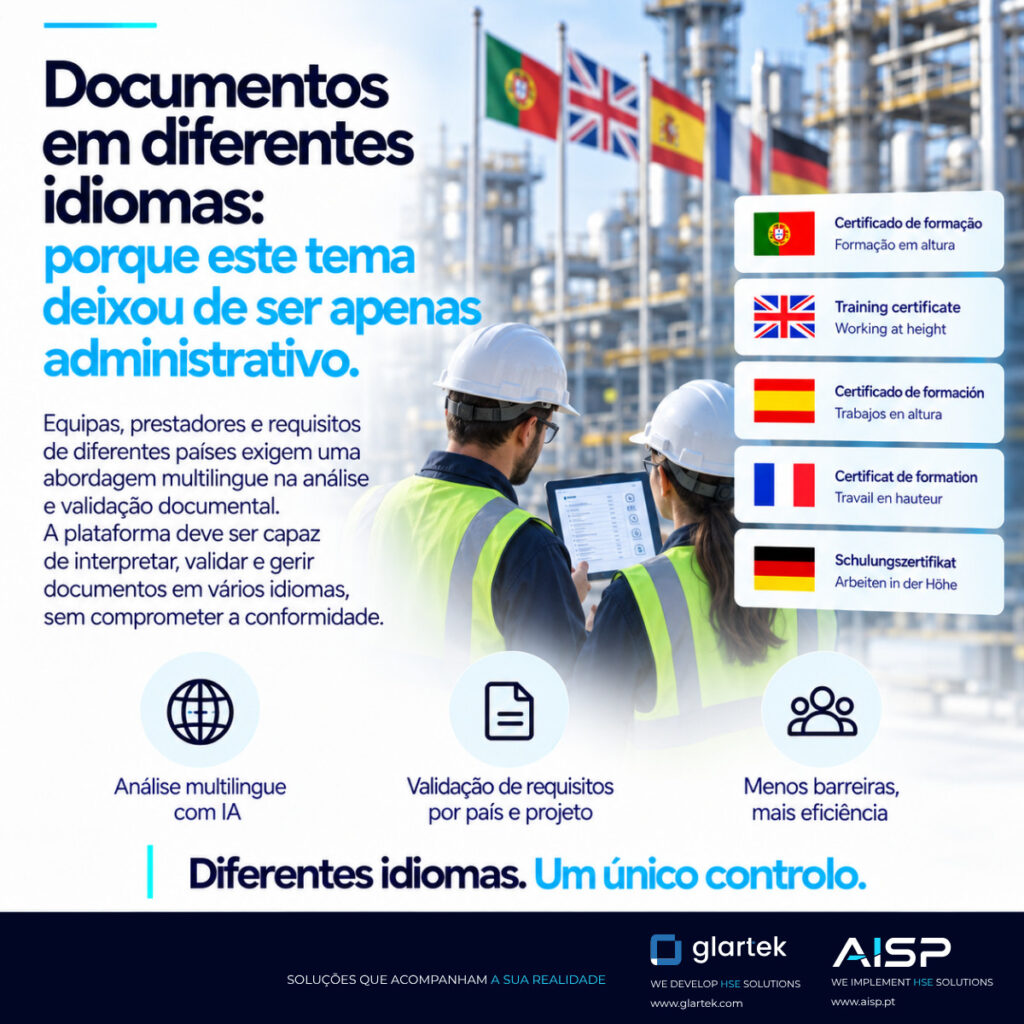
The internationalisation of companies, worker mobility and growing international subcontracting chains are also transforming document management. This is especially true when documents in different languages arrive.
In fact, it is increasingly common for a single organisation to receive documentation in Portuguese, Spanish, English, French or other languages.
For a long time, organisations treated this reality mainly as an administrative difficulty: someone had to understand the document, perhaps translate it and enter the necessary information into the system.
Today, however, the issue is far more relevant.
Language can influence operational control
In a document process linked to HSE, compliance or access control, understanding a document correctly can be decisive. It determines whether a company, worker or piece of equipment meets the conditions required for a given activity.
Therefore, identifying the type of document is not enough.
In other words, you need to understand:
• who the holder is;
• which entity issued it;
• its expiry date;
• which qualifications or authorisations it contains;
• which work or activities it covers;
• whether there are limitations, exclusions or conditions;
• whether it actually meets the requirement defined by the organisation.
When this analysis involves different languages, the risk of inconsistent interpretations increases.
Documents in different languages: The problem is not just translation
In fact, translating a document does not necessarily mean understanding its meaning in the context of the document process.
For example, a technical expression may have specific implications. Similarly, a given qualification may only be valid for certain activities. In addition, a declaration may include a restriction that matters for the compliance decision.
That is why modern document management must be able to connect content, requirement and operational context.
Multilingual capability must be part of the process architecture
Organisations that work in several countries should not have to create parallel processes just because they receive documents in different languages.
Technology makes it possible to move towards models in which teams can identify, structure and analyse document information more consistently, which supports those responsible for validation.
Thus, artificial intelligence plays a particularly relevant role here, as it can support tasks such as:
• document reading and interpretation;
• identification of relevant information;
• structured data extraction;
• recognition of dates, entities and references;
• support for comparison with defined requirements;
• processing of documents in different languages.
The goal is not just to speed up processes.
It is to make the analysis more consistent.
Different countries. Different languages. The same control criteria.
As organisations become more international, the ability to manage multilingual documentation is no longer an optional feature.
Instead, it becomes a condition for ensuring scalable, controlled and uniform processes.
A document management platform built for this reality should ensure that different languages are no longer a barrier between the document received and the decision the team must make.
At AISP, we work on structuring and developing document management processes designed for different organisations, projects and geographies.
Because operations can be international.
The level of control should remain the same.
Read also: Documents in different languages, a single platform and Artificial intelligence in document management. For the European strategy on AI, see the European Commission.