
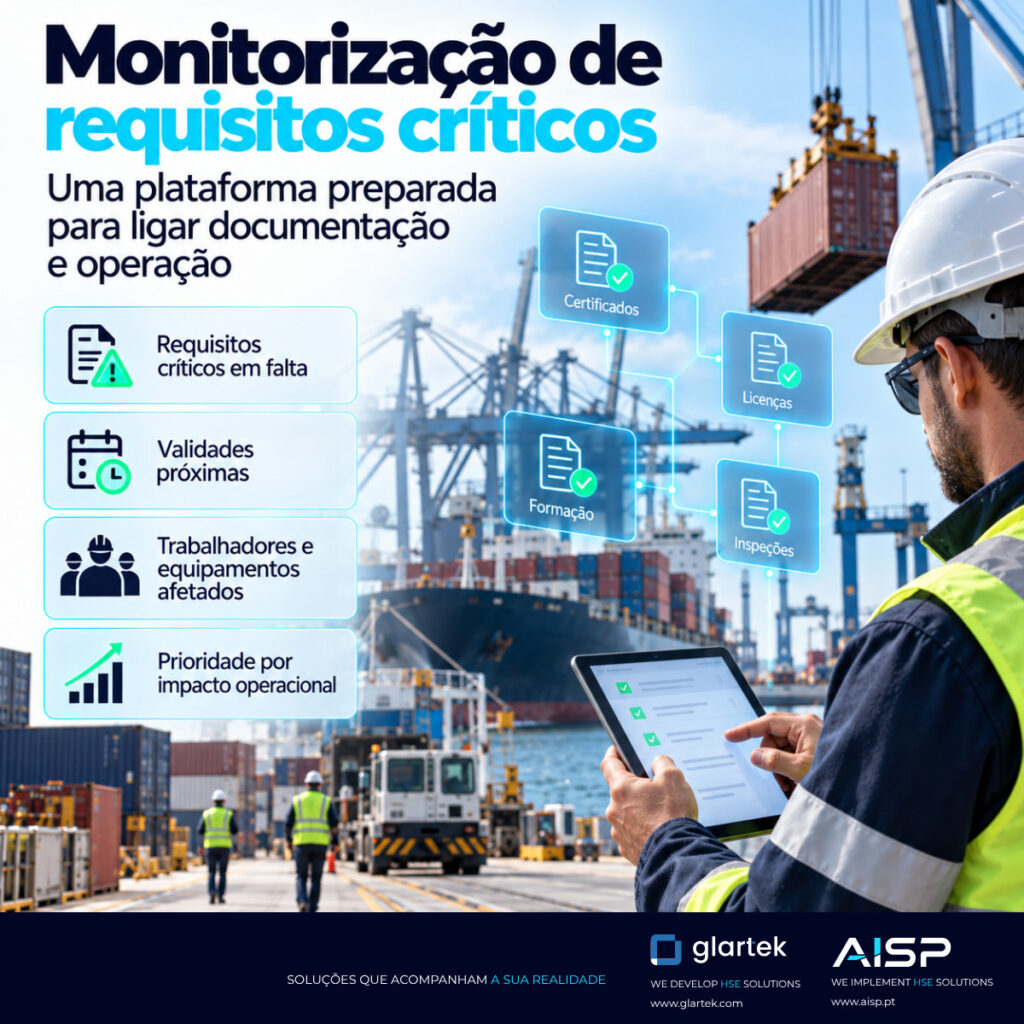
In complex document processes, not all requirements have the same operational importance, so monitoring critical requirements becomes essential.
For example, a missing document may represent nothing more than a pending administrative task. However, another may prevent a worker from carrying out an activity, block a piece of equipment or jeopardise a supplier’s continuity on a project.
Therefore, monitoring critical requirements does not just mean controlling documents.
In fact, it means understanding, at every moment, which requirements could affect operations and where you need to act first.
What makes requirements critical?
Criticality, in practice, can depend on several factors.
A requirement may be critical because it relates to:
- a high-risk activity;
- a mandatory authorisation;
- an essential competence;
- an equipment inspection;
- a legal requirement;
- a contractual condition;
- an imminent mobilisation;
- an operation that cannot start without that evidence.
The importance, therefore, does not lie only in the document.
In other words, it lies in the consequence of its absence or non-compliance.
A pending document can have very different impacts
For example, imagine two certificates that are close to expiry.
Moreover, both have the same expiry date.
But the first belongs to a worker with no activity planned in the coming weeks.
On the other hand, the second belongs to a technician needed for a critical intervention the next day.
In other words, from a document perspective, both have the same status.
Operationally, however, they do not have the same priority.
That is why a robust platform must be able to relate each requirement to the context in which it will apply.
From document status to operational impact
For example, in a traditional model, the team may see statuses such as:
- approved;
- pending;
- expired;
- rejected;
- under review.
This information is useful, but not sufficient.
Therefore, a more advanced platform should add questions such as:
Who depends on this requirement?
Which activity does it constrain?
Which project does it affect?
What is the deadline for action?
What level of risk does it carry?
Thus, this additional layer turns document management into operational information.
Workers and critical requirements
For workers, requirements may relate to the role, the activity or the risk.
For example:
- specific training;
- fitness for work;
- certification;
- authorisation;
- technical competence;
- a client’s own requirement.
In fact, a worker may have almost all their documentation in order. Even so, if they lack precisely one critical requirement, they cannot carry out a given activity.
Therefore, overall compliance percentages require careful interpretation.
Equipment: Critical requirements also need monitoring
Moreover, the same logic applies to equipment.
A machine may be physically available, but not ready for use from a document perspective.
For example, there may be requirements relating to:
- inspections;
- maintenance;
- certificates;
- insurance;
- periodic checks;
- authorisations.
Therefore, the platform must be able to identify in advance any situations that could hold up operations.
Service providers and aggregate impact
A critical requirement can also affect an entire supplier.
For example, an expired insurance policy, a missing mandatory certification or a specific company document can affect several people and activities.
In these cases, the system should make it possible to grasp the extent of the situation quickly.
However, flagging that a document is missing is not enough.
In other words, it is important to show who and what depends on it.
Critical requirements, expiry dates and anticipation
In addition, many critical requirements depend on dates.
Monitoring should therefore be preventive.
Thus, the platform can help identify:
- documents that expire in the coming days;
- requirements that stop being valid before the end of the project;
- training that needs renewal;
- upcoming inspections;
- time-limited authorisations.
The earlier you identify the risk, the greater your ability to act without interrupting operations.
Different alerts for different levels of criticality
Indeed, not all alerts deserve the same treatment.
For example, a low-criticality requirement may trigger a normal notification.
However, a requirement that is essential for an activity starting the next day may call for:
- high priority;
- escalation;
- notification of the people responsible;
- creation of a task;
- follow-up until resolution.
Therefore, monitoring should reflect this difference.
Prioritisation for document teams
When there are hundreds or thousands of documents, it is essential to avoid review queues without context.
Therefore, the platform can help prioritise documents related to:
- upcoming activities;
- high risks;
- mandatory requirements;
- people who are critical for mobilisation;
- essential equipment;
- documents with contradictory information;
- exceptions that require human review.
As a result, the team works first where the potential impact is greatest.
Risk-focused dashboards for critical requirements
A document dashboard should not just count approved and pending documents.
In fact, it can be far more useful to present:
- missing critical requirements;
- restricted workers;
- blocked equipment;
- suppliers with critical pending items;
- projects with the greatest exposure;
- requirements close to expiry;
- potentially affected activities.
This information, in turn, lets management move quickly from visibility to action.
The role of artificial intelligence
Artificial intelligence can support monitoring by helping to identify and structure the information that documents contain.
For example, it can recognise:
- document type;
- holder;
- expiry date;
- issuing body;
- competences;
- references;
- possible inconsistencies.
But determining criticality requires more than reading documents.
In other words, you need to relate this data to the rules the organisation has configured and to the operational context.
In short, AI can support the process.
However, the rules and the context determine the meaning.
Continuous monitoring of critical requirements, not one-off validation
A requirement you meet today may no longer hold tomorrow.
For example, documents expire.
Teams change.
New workers join.
Projects introduce new demands.
Companies replace equipment.
Therefore, do not treat compliance as a snapshot taken at the moment of approval.
In other words, it needs monitoring over time.
A platform built for operations
We can sum up the evolution as follows:
Traditional document model:
Document → status.
Operations-oriented model:
Requirement → evidence → context → criticality → impact → action.
This difference is, in fact, fundamental.
Because the goal is not simply to know whether documents are missing.
It is to understand which of them represent a real risk and where the organisation needs to act first.
Monitoring critical requirements thus brings document management closer to safety, operational continuity and risk management.
More than tracking documents, it means tracking what can hold up operations.
Read also: The importance of document requirements and Document requirements in contractor approval. For international management and safety standards, see ISO.