
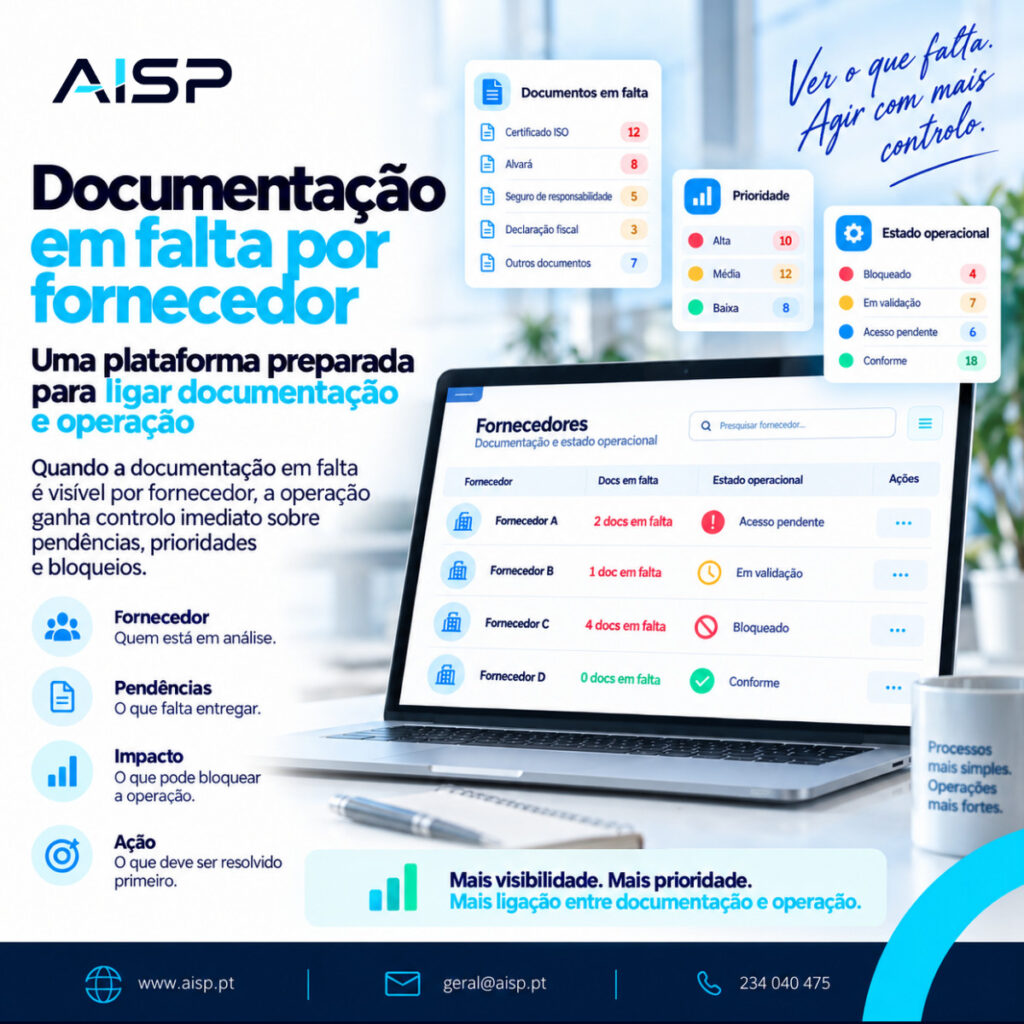
In an environment with multiple suppliers, subcontractors, workers and equipment, keeping track of missing documents by supplier can quickly become a complex task.
However, knowing how many documents are pending is not enough.
You need to understand who they belong to, which requirement remains unmet and what impact that missing document has on operations.
It is precisely in this link between document management and operational reality that a well-structured platform adds value.
Missing documents by supplier: Not just an administrative problem
In fact, in traditional document management, control often ends with a list of documents:
- submitted;
- approved;
- rejected;
- expired;
- missing.
This information is necessary, but it does not tell the whole story.
A missing document may have no immediate impact or, on the contrary, block a worker’s mobilisation, the use of a piece of equipment or the start of a critical activity.
That is why the analysis must go beyond the status of the file.
Analysing missing documents by supplier in the context of operations
Consider, for example, a supplier with dozens of workers involved in a project.
The platform may show that 95% of the documents are compliant.
At first glance, the result looks positive.
But if the missing documents belong to the workers needed for an activity planned for that day, the other 95% does little to solve the operational problem.
That is why the right question is no longer just:
“Which documents are missing?”
Instead, it becomes:
“Which documents are missing and what is on hold because of their absence?”
Missing documents: What to see for each supplier
A platform built for complex operations should let you quickly check:
Company documents
Insurance, certificates, authorisations, declarations, certifications or other corporate requirements.
Worker documents
Training, medical fitness, identification, certifications and role-specific requirements.
Equipment and its documents
Inspections, insurance, certificates, maintenance records or authorisations.
Missing documents
Clear identification of requirements not yet met.
Expired documents or documents due for renewal
So that you can act preventively, not just when the validity ends.
Non-conformities
Documents that are rejected, incomplete or do not meet the applicable requirement.
Operational impact
Identification of the people, equipment or activities affected.
Different requirements for different suppliers
In fact, not all suppliers need the same documents.
Requirements can vary depending on:
- contract;
- activity;
- risk;
- location;
- project;
- client;
- worker type;
- equipment used.
That is why a robust platform must let you configure requirements in detail.
For example, a cleaning contractor may have one set of documents.
An electrical maintenance company, however, will have another.
A supplier working at height, in confined spaces or at energy facilities may face additional requirements.
The platform should therefore adapt to these differences without forcing you to create parallel processes or new solutions for each situation.
From pending documents to operational decisions
When documentation truly connects to operations, a pending item is no longer just an administrative alert.
Instead, it directly answers questions such as:
- Which supplier is ready to start work?
- Are there workers who are not yet cleared for mobilisation?
- Which equipment has incomplete documents?
- What requirements are blocking a given task?
- Which documents expire in the next few days?
- Where should the team focus its attention first?
This capability therefore reduces analysis time and improves prioritisation.
More visibility, less risk of disruption
Structured document management also makes it possible to identify patterns.
If a supplier repeatedly has missing documents, late renewals or high rejection rates, that information can become relevant for contract management and performance assessment.
As a result, documentation is no longer just a set of files needed to “comply”.
On the contrary, it provides data for better-informed supply chain management.
Document management connected to project reality
The goal should not simply be to reach a certain percentage of approved documents.
Instead, it should be to ensure that:
the right companies, with the right workers and the right equipment, meet the requirements needed to carry out the planned activity.
It is this link between documentation and operations that turns document management into a true operational control tool.
Because knowing what is missing matters. Knowing what that gap prevents matters much more.
See also: From the central platform to client platforms: Document management across multiple systems and From document compliance to authorisation to work.
Finally, for information on occupational health and safety obligations, visit the ACT, the Portuguese Authority for Working Conditions.