
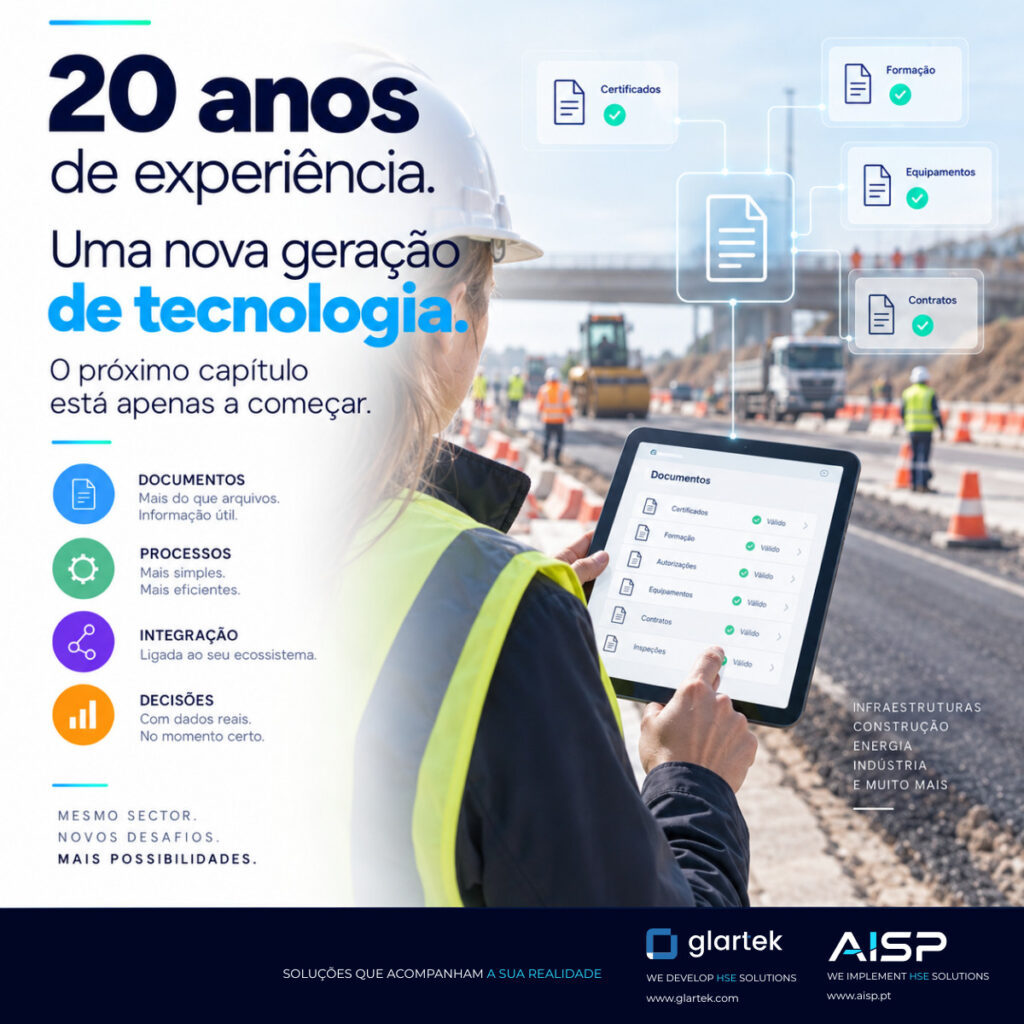
For more than 20 years, AISP has supported organisations in implementing, configuring and operating document management processes. Today, that experience is the foundation of next-generation document management.
In fact, more than two decades of work in real settings have shown us, very concretely, the challenges that companies face every day.
Overly manual processes.
Rigid platforms.
Difficulty adapting workflows.
Information scattered across systems.
Dependence on development for small changes.
Large volumes of documents to analyse, validate and monitor.
It was precisely this experience, therefore, that led us to look for a new approach.
Experience shows what really needs to change
Technology can evolve quickly.
But innovation only creates value when it solves real problems.
Over the years, we have supported contractor approval processes and the management of contractor companies, workers, equipment and documents in different operational contexts.
As a result, this constant contact with reality has allowed us to identify limitations that recur in many organisations.
Among them:
- excessive manual work;
- difficult configuration;
- inflexible processes;
- isolated systems;
- underused information;
- low team autonomy;
- a growing need to work across different languages and geographies.
That is why next-generation document management must respond precisely to these challenges.
Artificial intelligence in next-generation document management
A document no longer has to sit in storage, waiting for someone to consult it.
With artificial intelligence, therefore, you can extract, structure and reuse part of the information it contains.
In this way, dates, entities, requirements, references, statuses or other data can feed databases, reports, indicators and processes.
In other words, the information is no longer trapped in the file.
Instead, it starts working for the organisation.
More automation, less repetitive work
For example, you can build tasks such as routing, notifications, status changes, validations or approvals into automatic workflows.
As a result, waiting times drop and processes become more consistent and traceable.
No-code configuration and greater autonomy
Processes change.
Therefore, the platform must change too.
A no-code approach thus lets you adapt fields, forms, statuses, rules, permissions and workflows with less dependence on development.
In this way, technology moves closer to operational reality.
Systems that talk to each other
In addition, a modern document management platform cannot work as an island.
APIs, integrations and interoperability make it possible to connect document management to ERP, human resources, maintenance, business intelligence, HSE platforms and other systems the organisation uses.
The aim is to reduce duplication, keep information flowing and create more integrated processes.
Next-generation document management ready for international operations
Companies, teams and documents increasingly operate across different geographies.
That is why a multilingual platform can keep pace with this reality without creating parallel processes for each language or market.
Experience and technology in next-generation document management
What changes in this new phase is not what we have learnt over more than 20 years.
It is what we can now do with that knowledge.
Experience allows us to understand the problem.
Technology, on the other hand, allows us to create new ways of solving it.
In short: less manual work, more autonomy, more connected information, more control and more capacity to evolve.
More than 20 years of experience.
A new generation of technology.
The next chapter is only just beginning.
See also: The next generation of document management and The future of document management: From document repository to intelligent platform.
Finally, to learn about European digital transformation policies, visit the European Commission.