
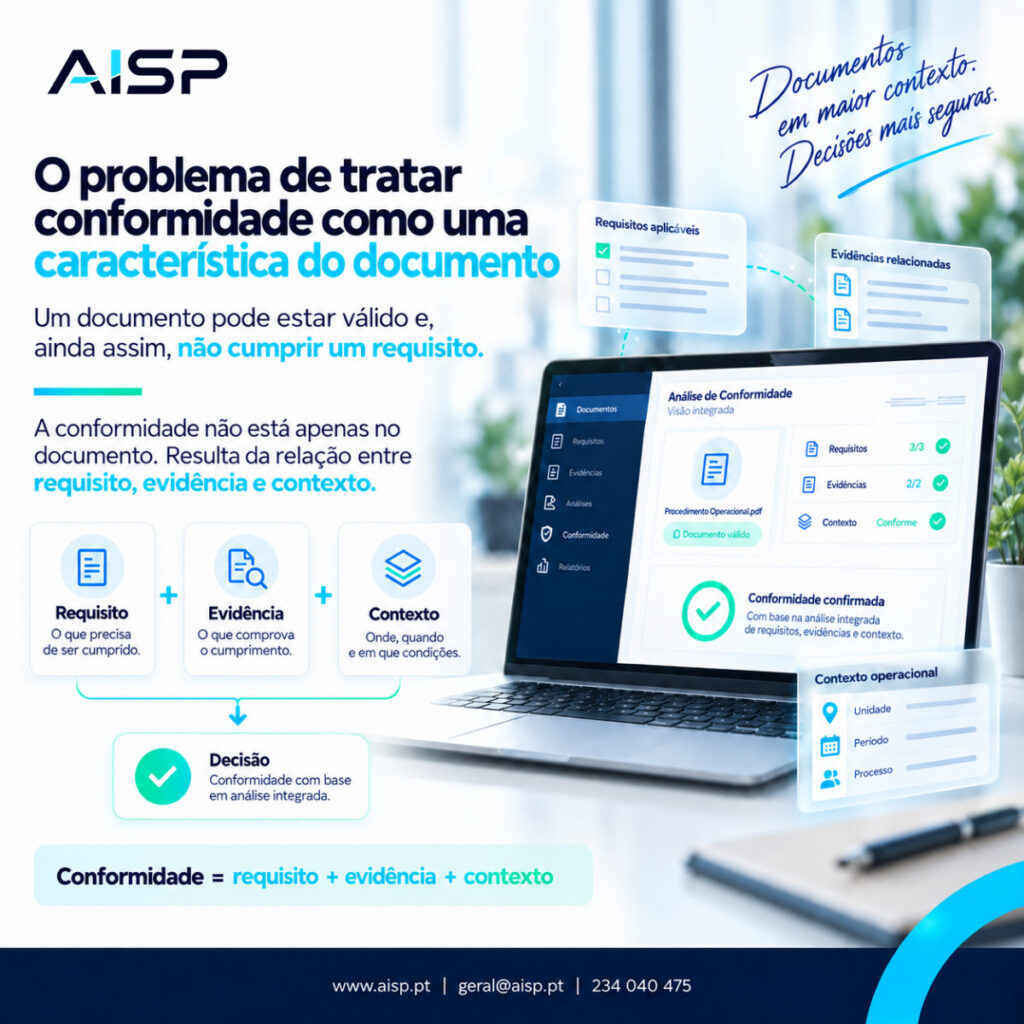
The problem with treating compliance as a feature of the document
For many years, digital document management focused most of its processes on validating the document itself: whether it exists, its validity, holder, dates, signature or other formal elements.
These checks are still essential. However, on their own they are no longer enough to determine whether there is genuine document compliance.
A document can be valid and still fail to meet the requirement it is meant to demonstrate.
Document validity does not mean compliance
For example, imagine a worker who presents a valid training certificate.
From a document point of view, the file may be correct: it identifies the worker, comes from a recognised body and is within its validity period.
But one essential question remains:
Does that training actually match the role, activity or risk the worker is going to face?
If it does not, the document may be valid without being enough to authorise that activity.
This difference is therefore what makes compliance analysis more complex than a simple document check.
Compliance comes from the relationship between requirement, evidence and context
Thus, in a robust document process, the decision should consider three dimensions at the same time.
Requirement: what the organisation, the client, the project or the law requires.
Evidence: the document or information that shows the requirement is met.
Context: the person, company, role, equipment, activity, risk, project, location or period in which that evidence applies.
In other words, a genuine compliance decision comes from the relationship between these elements.
The same document can have different compliance outcomes
In fact, a document does not necessarily have a universal compliance status.
It may serve one activity and fall short for another. Likewise, it may meet the requirements of one project and not those of another. A document may also allow a certain operation today and stop allowing it when the role, the risk or the contractual framework changes.
This is particularly relevant in environments with multiple contractors, workers, equipment, projects and HSE requirements.
In these contexts, treating compliance only as a feature of the document can create a false sense of security.
From document management to operational decisions
That is why the evolution of document management platforms depends precisely on this ability: linking documents to operational reality.
This means being able to link requirements to roles, activities, risks, companies, workers or equipment, and to analyse whether the evidence presented actually fits the context of use.
With structured processes and artificial intelligence applied to document analysis, it also becomes possible to automate part of this check and identify exceptions. In addition, the platform can route to human validation the cases where there is not enough evidence for a safe decision.
As a result, the goal is no longer just to know whether a valid document exists.
Instead, it is to answer a far more important question:
Does this evidence confirm that this requirement is met in this specific context?
It is this evolution that truly brings document management closer to operations, safety and risk management.
Compliance = requirement + evidence + context.
See also: Identifying the issuing body: Why it is no longer just an administrative matter and From document compliance to authorisation to work.
Finally, for information on occupational health and safety obligations, visit the ACT, the Portuguese Authority for Working Conditions.