
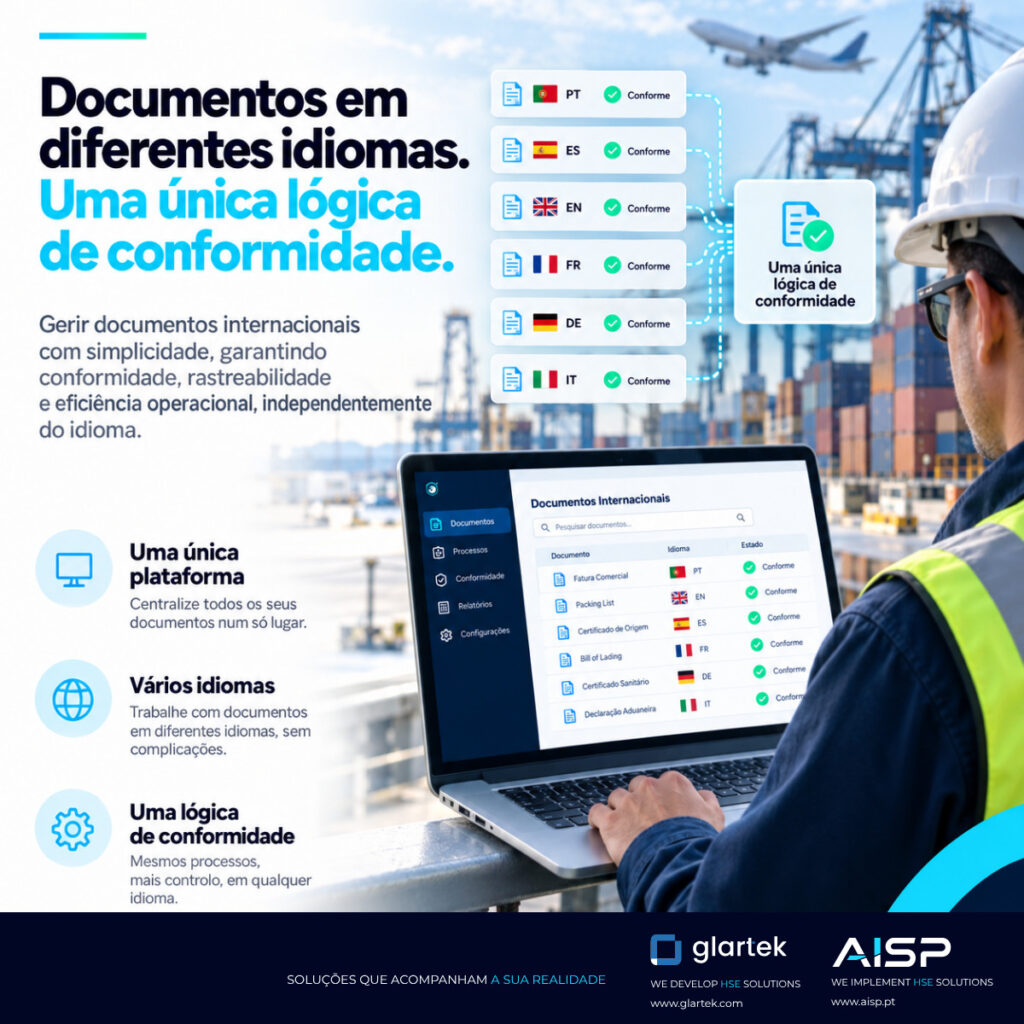
The internationalisation of companies is profoundly changing how organisations receive, analyse and control documentation, especially when documents in different languages arrive.
A single organisation may manage documentation issued in Portugal, Spain, France, Germany, the United Kingdom or other regions at the same time.
Languages change.
Formats also change.
Issuing bodies change too.
However, what the organisation needs to check remains essentially the same.
Language should not change the compliance criterion
In a document management process, the question is not just understanding what the document says.
It is also about determining whether the document actually meets the defined requirement.
Regardless of the language, you need to understand:
• who the document belongs to;
• who issued it;
• its expiry date;
• which qualification, authorisation or condition it proves;
• which activities it covers;
• whether there are restrictions or limitations;
• whether the evidence provided is sufficient for the requirement under review.
This means that multilingual document management cannot stop at translation.
Instead, teams need to interpret the content within the context of the process.
Translating documents in different languages is not the same as validating them
A document may have an accurate translation and still not be enough to authorise a given activity.
A training course may exist but not match the required content.
Similarly, a qualification may be valid, but only for certain roles.
Likewise, a declaration may contain a relevant exclusion.
An authorisation may also only cover a specific category, piece of equipment or type of work.
Therefore, the real challenge lies in connecting:
document + content + requirement + operational context.
Only then can the organisation support a consistent compliance decision.
A common logic for different regions
When an organisation works internationally, each country or team risks developing its own way of interpreting documents.
As a result, over time this can create significant differences in validation criteria.
Similar documents may receive different decisions depending on the person, team or region that carries out the review.
A document management platform built for international operations should let you structure requirements centrally and apply a common control logic.
This does not mean ignoring local requirements.
On the contrary.
The platform should let you configure differences by country, project, client, activity or risk level, while keeping a consistent decision architecture.
The role of Artificial Intelligence with documents in different languages
Artificial Intelligence can play an important role in this process.
By supporting the reading and structuring of documents in different languages, it can reduce part of the manual work needed to find relevant information.
For example, technology can support tasks such as:
• identifying the document type;
• extracting names, dates and entities;
• identifying expiry dates;
• recognising qualifications and references;
• detecting potentially relevant information;
• comparing document data with the defined requirements.
The goal is not simply to translate documents automatically.
Rather, it is to turn document information into structured data that can support decision-making.
Documents in different languages do not have to mean different processes
An international organisation should not have to create a separate document process for each language.
Similarly, teams should not depend permanently on spreadsheets, informal translations or individual knowledge to interpret documentation from different regions.
However, technology makes another way of working possible.
A single platform can manage different languages, requirements and regions within the same document structure.
As a result, it increases consistency, improves traceability and reduces process fragmentation.
From document to compliance
Modern document management should help you move from a file-centred model to a decision-centred model.
The journey is no longer simply:
Document → archive.
Instead, it becomes:
Document → reading → interpretation → requirement → validation → decision.
This shift is especially relevant in HSE environments, where a document decision can affect a worker’s access, the use of equipment or the start of an activity.
The language changes. Control must stay consistent.
As organisations become more international, the ability to work with multilingual documentation is no longer an optional extra.
Instead, it becomes part of the very architecture of document management.
At AISP, we structure and develop document management processes designed for different organisations, projects, regions and languages.
Together with technology solutions such as Glartek, we can develop more configurable, integrated models that handle international documentation within a common compliance logic.
Because documents may come in different languages.
But the organisation must still know exactly what it needs to check.
See also: Multilingual document management: How to manage international documentation on a single platform and Working internationally should not mean multiplying platforms and processes.
Finally, for international reference standards, visit ISO.