
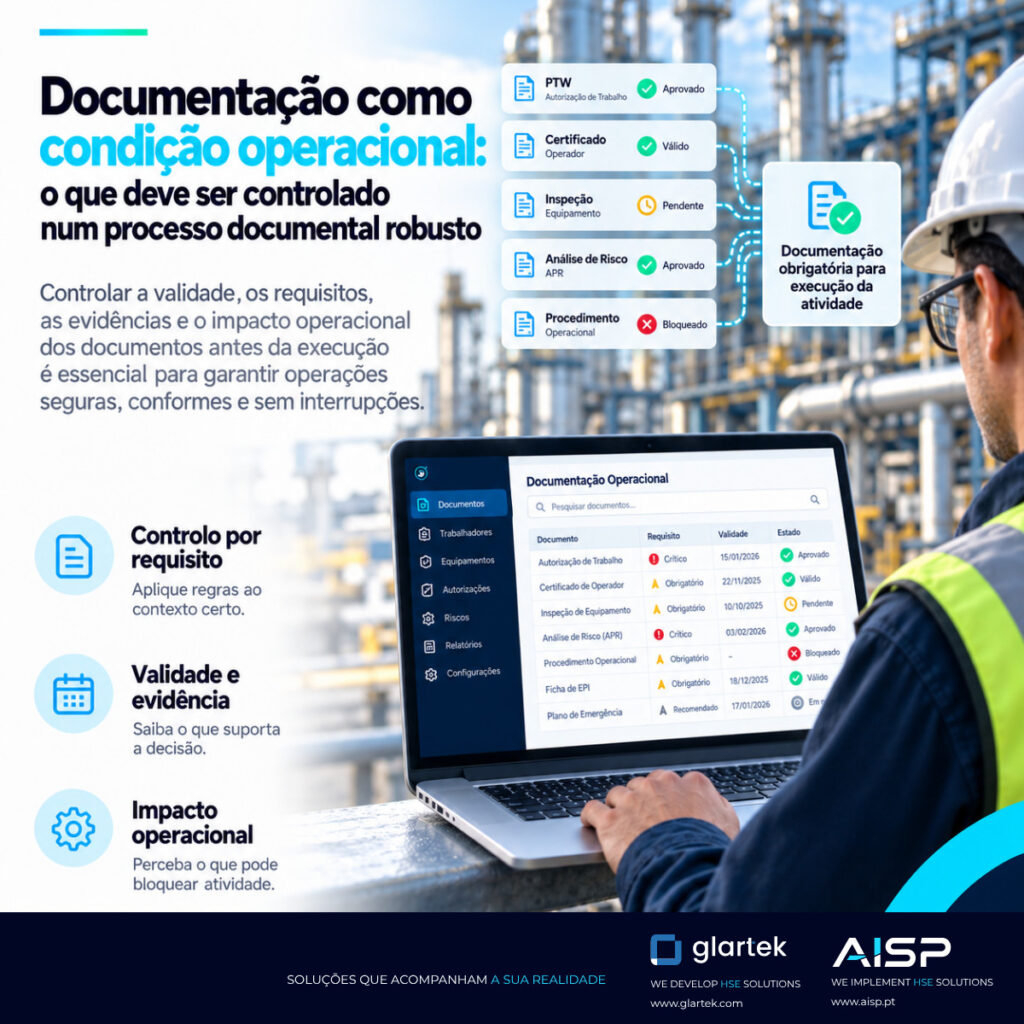
Many organisations still see document management as an essentially administrative process, and they do not treat documentation as an operational condition.
- Receiving documents.
- Uploading files.
- Checking expiry dates.
- Archiving evidence.
However, in operations with HSE, qualification, safety, access, subcontracting or equipment control requirements, documentation plays a far more important role.
- It can determine whether a company enters the site.
- Whether a worker can carry out a given activity.
- Or whether a piece of equipment can go into use.
- Whether a service can start.
Therefore, organisations should not see documentation as a mere record.
They should treat documentation as an operational condition.
Control does not start with the file
In fact, a robust document process does not just ask whether a document exists.
It asks whether the document proves what it should prove.
This difference is therefore fundamental.
For example, someone may upload a certificate that does not match the right requirement.
A training certificate may be valid but not cover the activity the worker will carry out.
Likewise, an authorisation may exist but contain restrictions.
A declaration may be formally correct but not apply to that worker, company or piece of equipment.
That is why the existence of the document is not enough on its own.
Control should therefore focus on the content, the context and the link to the requirement.
What a robust document process should control
A consistent process should be able to answer at least the following questions.
1. Does the document match the requested requirement?
First, the control must confirm that the submitted document is actually the document you need.
A file uploaded to the wrong category should not count as valid evidence just because it exists in the system.
2. Does it belong to the correct entity?
You need to confirm that the document belongs to the company, worker, equipment or other entity under review.
In addition, linking errors can create a false sense of compliance.
3. Is it still valid?
Expiry dates remain one of the most important criteria in document management.
However, control should go beyond the simple expiry date.
In other words, you need to know whether minimum periods, specific conditions or additional requirements apply to validity.
4. Did the appropriate body issue it?
In fact, not all documents have the same evidential value.
Depending on the requirement, you may need to confirm the issuing entity, competent body, training provider or responsible authority.
Controlling documentation as an operational condition
5. Does it contain all the necessary information?
A document may be formally valid and still be incomplete for review purposes.
It may be missing:
• the holder’s identification;
• a description of the activity;
• the qualification category or level;
• the expiry date;
• a signature;
• a technical reference;
• evidence of a specific condition.
The process must therefore distinguish between existence and sufficiency.
6. Does it actually prove the required condition?
Indeed, this is one of the most critical points.
Teams should analyse each document against what it needs to prove.
If the requirement is fitness for a given activity, a medical record alone is not enough.
Similarly, if the requirement is a specific qualification, generic training is not enough.
If the requirement is an authorisation for specific equipment, a different authorisation will not do.
Therefore, validation should link the document content directly to the operational requirement.
7. Are there limitations or conditions?
In addition, many documents contain information that can change the decision.
“Valid only for…”
“Except…”
“With restrictions…”
“Not authorised for…”
“Applicable only to…”
In other words, these expressions can matter as much as the document’s validity itself.
A robust document process must be able to identify and handle these conditions.
Context and pending items in document review
8. Does the document apply to the right context?
The same person, company or piece of equipment may have authorisation for one project and not for another.
It may meet the requirements for one activity and not for another.
It may also have valid documentation that is not sufficient for a specific risk level.
Therefore, context must be part of the review.
Project, activity, client, location, risk and type of work can all change the validation outcome.
9. Are there pending items that prevent work from starting?
The system should therefore distinguish between administrative pending items and critical requirements.
However, not all missing documents have the same impact.
For example, some may be complementary.
By contrast, others may block the start of the activity completely.
This classification is essential if document management is to truly support operations.
From documentation to operational decision
When you structure these controls, the logic of the process changes.
It is no longer:
Document → archive.
Instead, it becomes:
Document → requirement → review → condition → operational decision.
This change is therefore particularly important in HSE.
In this way, documentation starts to work as a prevention mechanism.
Before the risk reaches the field, document review has already carried out part of the control.
Document control and operational control must go hand in hand
In addition, a document system cut off from operations loses much of its value.
If a worker does not meet a given requirement, that information must have consequences.
Likewise, if a piece of equipment has a document block, operations must know about it.
If a company has expired critical documentation, that status must be visible before work begins.
Document management should therefore connect to processes such as:
• contractor approval;
• access control;
• work authorisation;
• company onboarding;
• worker management;
• equipment control;
• inspections;
• HSE management.
The stronger this connection, the better the organisation can turn documentation into effective control.
The role of technology in documentation as an operational condition
Technology therefore makes it possible to structure this process far more consistently.
A modern platform can support:
• defining requirements by entity or activity;
• automatic expiry date control;
• validation workflows;
• status management;
• identification of pending items;
• alerts;
• decision traceability;
• compliance dashboards;
• structured information extraction;
• Artificial Intelligence support for reading and analysing documents.
The goal should not only be to process documents faster.
It should also be to improve the quality of the decision.
From “is there a document?” to “can they do the work?”
This is probably the most important change in the evolution of document management.
The question is no longer:
“Do we have the document?”
Instead, it becomes:
“Do we have enough evidence to authorise this company, worker or piece of equipment in this context?”
In fact, that difference completely transforms the value of the process.
Documentation is no longer just an administrative obligation.
Instead, it becomes part of the organisation’s control system.
At AISP, we structure and develop document management processes focused on control, traceability and connection to operations.
Together with technology solutions such as Glartek, we can develop more configurable, integrated document models that connect requirements, evidence and decisions.
Because a robust document process should not stop at storing documents.
It should help ensure that only what meets the defined conditions moves into operations.
See also: The difference between having documents and having document control and Document management is not just archiving. It is an operational decision.
Finally, for background on occupational health and safety, visit the ACT, the Portuguese Authority for Working Conditions.