
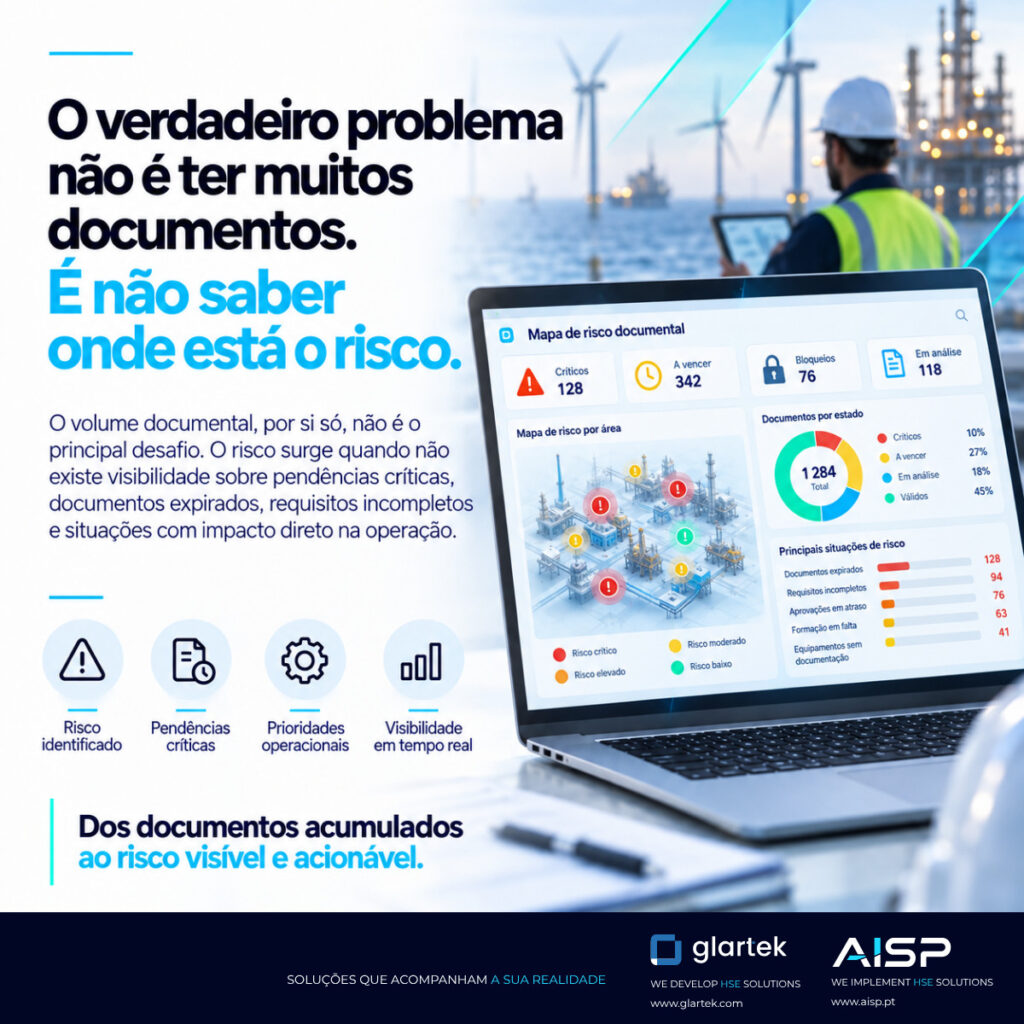
In organisations with multiple suppliers, workers, equipment, projects and requirements, the volume of documents grows quickly and, with it, document risk.
Hundreds or thousands of certificates, insurance policies, fitness-for-work records, reports, inspections, declarations, authorisations and logs can be part of day-to-day operations.
In fact, it is common to see this volume as the main problem.
But, in practice, the difficulty rarely lies in quantity alone.
In other words, the real challenge is being able to answer a far more important question:
Where is the risk?
After all, an organisation can store thousands of documents correctly. Yet it may still fail to spot, in good time, the pending items that could affect operations.
Not all documents have the same operational importance
From an administrative point of view, all documents may look alike.
But the impact of a document failure varies greatly.
For example, training that is about to expire may have little impact if the worker has no activity planned.
However, the same situation can be critical if that worker has a high-risk task scheduled for the next day.
An expired inspection can prevent the use of essential equipment.
Similarly, a missing insurance policy can affect an entire service provider.
In addition, a pending authorisation can block a work front.
That is why document management must go beyond the status of the file.
In other words, it must consider the context.
Compliance percentages can hide the real document risk
Overall indicators are useful.
But they can be misleading when analysed in isolation.
For example, imagine a project with 1,000 documents, 980 of which have approval.
Thus, the compliance rate is 98%.
At first glance, the result looks very positive.
But if the 20 missing documents relate to the workers who will carry out a critical activity the next day, the operational situation is very different.
Therefore, the question is not just:
“What percentage of documents have we approved?”
It is also:
“Which documentation is not compliant, and what impact does that non-compliance have?”
Document risk comes from the relationship between document and context
In fact, an isolated document tells us little about risk.
Therefore, to understand the real exposure, you need to relate different elements:
Document
What evidence exists?
Requirement
What must you comply with?
Person, company or equipment
Who depends on that evidence?
Activity
What work will take place?
Risk
What criticality applies?
Project
Which specific rules apply?
Timing
When will you need that evidence?
Thus, it is from this relationship that a truly operational view of compliance emerges.
Missing documentation does not always mean the same thing
Therefore, a robust platform must be able to distinguish between different types of pending items.
For example:
- document not yet submitted;
- expired document;
- rejected document;
- requirement partially met;
- insufficient information;
- document under review;
- missing competence;
- pending renewal.
In other words, each situation may have a different priority.
In fact, the aim is to avoid generic lists of “pending items” that force the team to investigate case by case.
Prioritising document risk by impact
When risk has context, prioritisation becomes possible.
For example, a platform can consider factors such as:
- proximity of the activity;
- criticality of the requirement;
- risk associated with the role;
- expiry date;
- number of people affected;
- impact on the supplier;
- importance of the equipment;
- history of non-conformities.
In this way, the team no longer works only in order of arrival.
Instead, it works according to potential impact.
Restricted workers
One of the clearest examples lies in worker management.
Thus, a missing certificate can mean:
- no immediate consequence;
- a need for renewal;
- inability to carry out a specific task;
- inability to enter a site;
- a blocked mobilisation.
The same pending document can therefore have completely different consequences.
The platform must be able to show not only the document status, but also the worker’s operational status.
Equipment and document risk
In addition, the same principle applies to equipment.
An inspection, maintenance record or certificate may relate directly to whether anyone can use the equipment.
Thus, if the documentation is incomplete or expired, the issue is not just a document issue.
It is operational and, potentially, a safety issue.
Therefore, a platform should make it possible to quickly identify:
- which equipment has restrictions;
- which requirement is pending;
- when it expires;
- which activity depends on that equipment.
Suppliers with different document risk
Likewise, do not judge suppliers by overall percentages alone.
A supplier may have high document compliance and, even so, present a critical non-conformity.
Another may have more pending documents, but none of them with an immediate impact on operations.
Therefore, management should consider criticality and context, not just volume.
The role of artificial intelligence
In addition, AI can help make this analysis more efficient.
For example, it can support the identification of:
- document type;
- holder;
- issuing body;
- expiry date;
- competence;
- inconsistencies;
- missing fields;
- possible exceptions.
But AI, on its own, does not define the risk.
Risk arises when someone relates the extracted information to the organisation’s rules and the operational context.
In other words, it is this combination that creates value.
Dashboards that show exposure, not just volume
Thus, a good document dashboard should not show only:
- the total number of documents;
- the number of approved documents;
- the number of rejected documents.
It should also make it possible to view:
- pending critical requirements;
- restricted workers;
- non-compliant equipment;
- documents close to expiry;
- suppliers with the greatest exposure;
- projects with the highest document risk;
- potentially affected activities.
As a result, the team can quickly answer:
Where should we act first?
From volume-based management to document risk management
We can sum up the evolution as follows:
Traditional model:
Documents → statuses → percentages.
Risk-oriented model:
Documents → requirements → context → impact → priority.
Thus, it is this shift that brings document management closer to operational management.
More documents do not necessarily mean more risk
An organisation may have a high document volume and a very well-controlled process.
However, another may have few documents and high exposure.
In other words, the difference lies in the quality of the information and the ability to use it.
In fact, the risk does not lie in the number of files.
It lies in what is not compliant, in its criticality and in the impact that situation can have.
The goal is to know where to act
Document management should help teams make decisions.
That means being able to answer quickly:
- Which pending item is critical?
- Who does it affect?
- What activity could come to a halt?
- Which document needs renewal?
- What supplier requires attention?
- Where is the greatest exposure?
When these answers are available, documentation stops being just an administrative obligation.
In other words, it becomes a source of information for managing risk.
The real problem is not having many documents.
It is not knowing where the risk lies and where to act first.
Read also: The document manager’s role in reducing operational risks and Identifying service providers is also risk management. For more information on preventing risks at work, see the European Agency for Safety and Health at Work (EU-OSHA).