
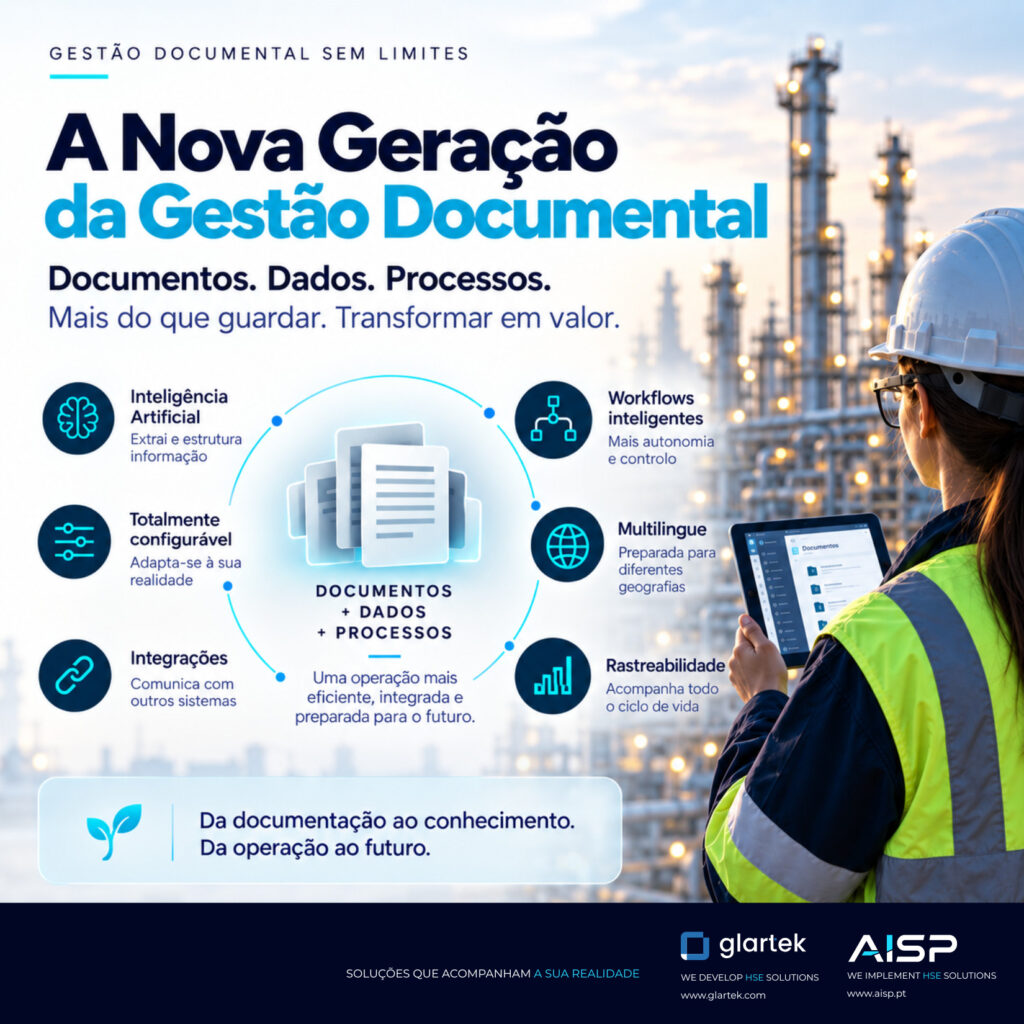
For many years, document management in practice had a relatively simple goal: to receive documents, organise and validate them, and make sure they were available when needed.
Today, that is no longer enough.
In fact, organisations work with more information, more requirements, different systems, new geographies and increasingly interconnected processes.
That is why we talk about a new generation of document management.
Not because documents have become less important, but because they are now part of a much wider ecosystem, where information, data, workflows and operational processes need to work together.
Documents are no longer just files
A document contains information.
For instance, it may hold dates, entities, statuses, references, values, evidence, requirements, workers, equipment or suppliers.
In addition, artificial intelligence can extract, structure and reuse part of this information automatically.
As a result, the document is no longer just a stored file.
It also becomes a source of data.
In this way, this shift helps reduce manual tasks, avoid duplicate information and make data available for reports, indicators, control mechanisms and decision-making processes.
The platform adapts to the organisation
No two companies work in exactly the same way.
In other words, approval circuits, responsibilities, requirements, access levels and the processes themselves all change.
Therefore, a modern platform should not impose a rigid model.
A no-code approach lets you configure:
- Fields and forms
- Statuses and stages
- Workflows
- Rules and permissions
- Requirements and validations
- Reports and indicators
Thus, the goal is to let technology follow the organisation’s reality, instead of forcing the organisation to adapt to the limits of technology.
Smarter workflows
Document management also no longer needs to depend on manual sequences and constant follow-up by teams.
Workflows can help automate:
- Information routing
- Approvals
- Notifications
- Tasks
- Status changes
- Validations
- Responsibilities at each stage
Consequently, processes become smoother, more predictable and more traceable.
A platform that does not work in isolation
For example, ERP, human resources, maintenance, Business Intelligence, operational systems and HSE platforms are all part of an organisation’s technology ecosystem.
Document management must therefore be able to communicate with that ecosystem.
In this way, APIs, integrations and interoperability let information flow between systems, reducing the need to enter the same data manually in different applications.
Real digital transformation does not happen when we digitise each process in isolation.
It happens when we manage to connect them.
Ready for different languages and geographies
Projects, suppliers and teams increasingly work across different countries.
Documentation reflects that reality too.
Multilingual capability therefore plays an important role for organisations that run international operations and need to handle documentation in different languages within the same platform.
Document management in practice: The link to HSE and OSH
In HSE and OSH, documentation ties directly into operations.
For example, service providers, workers, equipment, chemical substances, inspections, audits, non-conformities, contractor approvals and action plans are all part of the same reality.
When these processes sit in different systems, information becomes fragmented.
When they connect, it becomes possible to build a much more integrated view of operations.
From document to action in the field.
Document management in practice: More autonomy for organisations
The new generation of document management should not increase technological dependency.
On the contrary, it should reduce it.
In other words, organisations need to be able to adapt processes, create new requirements, change workflows and respond to new needs without turning every change into a new development project.
More autonomy also means a faster response.
What changes in document management, in practice?
In fact, the very role of document management changes.
Thus, it is no longer just a system for storing and validating documentation.
It becomes a platform that can:
- Interpret information
- Structure data
- Automate processes
- Integrate systems
- Adapt workflows
- Support HSE and OSH
- Work with different languages
- Evolve with the organisation
Less manual work.
More autonomy and more traceability.
More information available and more capacity to evolve.
At AISP-GEDOC, in partnership with Glartek, this is the vision we are bringing to a new generation of document management.
Because the future of document management is not just about managing documents better.
It is about making the information inside them work better for the organisation.
See also: Don’t just buy today’s features. Choose a platform ready for tomorrow and Documents that automatically feed databases and reports.
To follow the development of artificial intelligence and digital transformation in Europe, see the digital strategy of the European Commission.