
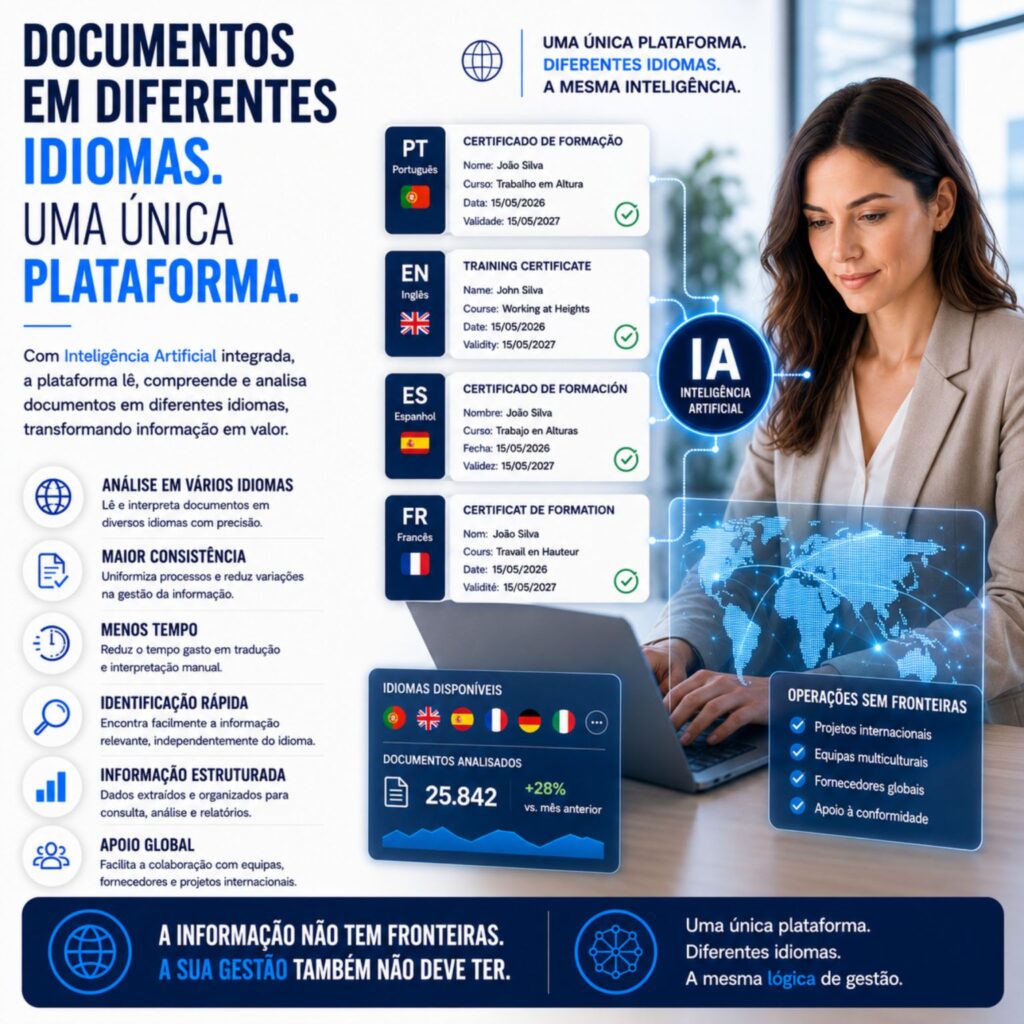
In an increasingly international business context, documentation no longer arrives only in Portuguese. That is why managing documents in different languages has become a necessity.
For example, certificates, contracts, reports, technical data sheets, licences and other documents may arrive in different languages, often within the same project.
Thus, the new generation of document management responds to this reality.
Managing documents in different languages with artificial intelligence
In addition, with built-in artificial intelligence, the platform can support document reading and analysis in different languages. This reduces dependence on manual processes and makes it easier to manage information in international operations.
In practice, this means:
🌐 document analysis in several languages
📄 greater consistency in information management
⚡ less time spent on manual interpretation
🔎 easier identification of relevant data
📊 structured information for lookup and analysis
🤝 more support for international teams, suppliers and projects
One platform for international operations
Because digital transformation should not stop at a language border.
One platform. Different languages. The same management logic.
🚀 Document management built for companies that work across borders.
In short, managing documents in different languages with the same management logic reduces manual tasks and supports international teams, suppliers and projects.
See also: Multilingual by nature: Managing international companies, workers and documentation and The future of AI in document management platforms.
When these documents include personal data of workers or suppliers, their processing must follow the GDPR and the guidance of the Portuguese National Data Protection Commission (CNPD).