
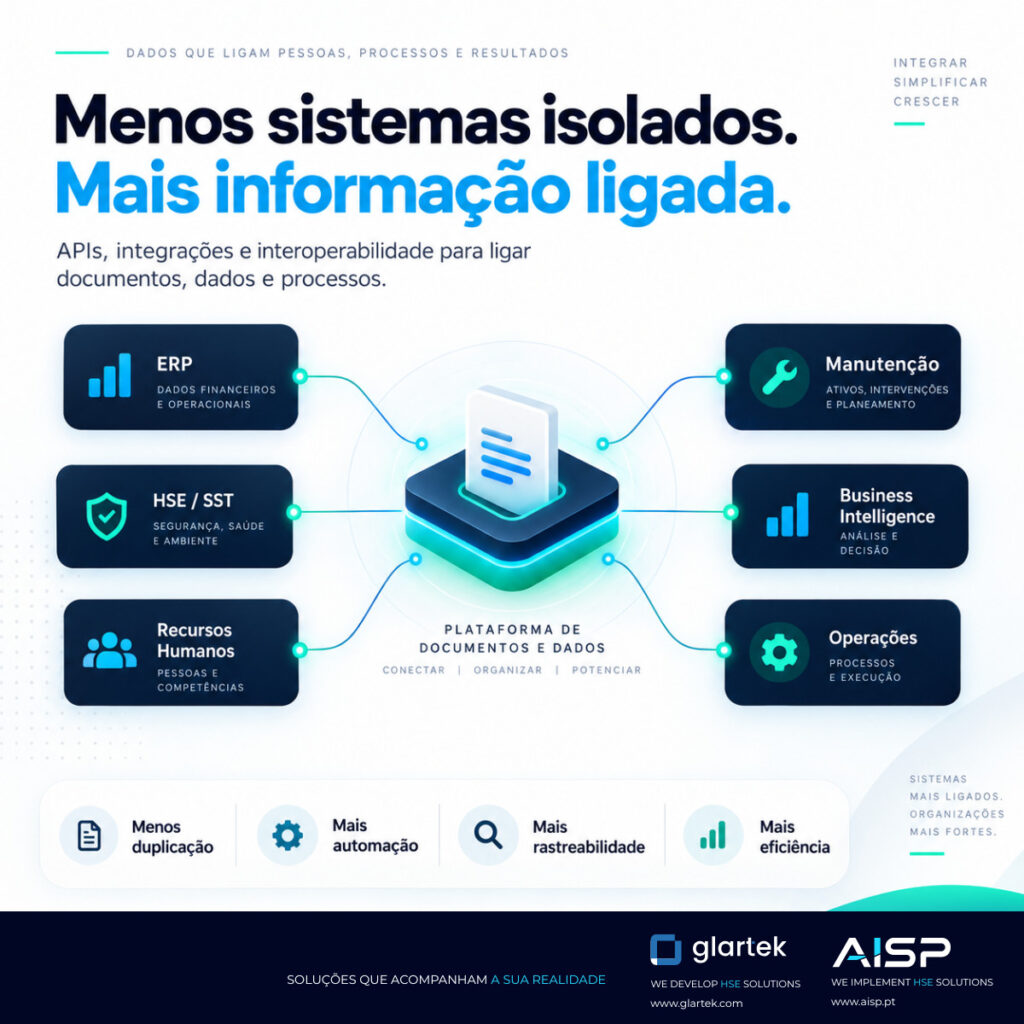
For many years, many organisations grew technologically in stages, accumulating isolated systems along the way.
For example, they implemented one platform for document management, another for ERP, another for HSE, another for Human Resources, another for maintenance and, later on, further solutions for reporting, analysis or operations.
At first glance, this path seems natural.
After all, each system meets a specific need.
The problem arises when these platforms do not communicate with each other.
As a result, information becomes fragmented, processes lose fluidity and teams start wasting time repeating tasks, entering data in several places and reconciling information between different systems.
This is precisely why one of the key demands of the new generation of document management emerges: it must stop working as a technological island.
The problem with isolated systems
When information is spread across several unconnected platforms, very concrete day-to-day difficulties arise:
- data entered more than once;
- a higher risk of error and inconsistency;
- manual processes between systems;
- reduced traceability;
- difficulty obtaining an integrated view;
- slower decision-making.
In practice, the organisation may even have several digital solutions, yet it still depends on manual work to make sure information reaches the people who need it.
In other words, it digitised processes, but it did not connect the information.
The importance of APIs, integrations and interoperability
To solve this fragmentation, three concepts become essential: APIs, integrations and interoperability.
APIs
APIs make it possible to create communication mechanisms between different systems.
In short, they act as connection points that make it possible to exchange data and trigger actions between separate platforms.
Integrations
In addition, integrations let you connect document management to the systems the organisation already uses.
For example, this can include ERP, HSE platforms, HR software, maintenance, Business Intelligence or other operational applications.
Interoperability
Finally, interoperability goes beyond a simple technical connection.
It ensures that the information systems exchange stays structured and that the different processes and platforms can use it consistently.
What changes in practice without isolated systems?
When document management stops working in isolation and becomes part of the organisation’s technology ecosystem, the benefits become very clear:
- less data duplication;
- reduced manual work;
- greater automation between processes;
- better traceability;
- more consistent information;
- higher operational efficiency.
In this way, a document is no longer just something stored on a platform.
On the contrary, the information it contains can start to flow, feed other systems and support decision-making.
Particularly relevant in HSE and OHS
In HSE and OHS, this connection between systems is especially important.
Documentation, service providers, workers, equipment, audits, inspections, non-conformities and operational processes are often related.
If each of these realities lives in an isolated system, management becomes heavier and less effective.
When systems share information, however, it becomes possible to build a much more integrated view of operations and strengthen control throughout the whole process.
Real digital transformation goes beyond isolated systems
Real digital transformation does not happen just because each process has gone digital separately.
It happens when systems stop living in isolation and start working together.
Ultimately, this is what turns documents into useful information, information into smoother processes and processes into better decisions.
Fewer isolated systems. More connected information.
That is why this is the logic of document management ready to meet the demands of today’s organisations.
See also: From the central platform to client platforms: Document management across multiple systems and The next generation of document management.
To follow European policies for interoperability and the digital transformation, visit the European Commission.