
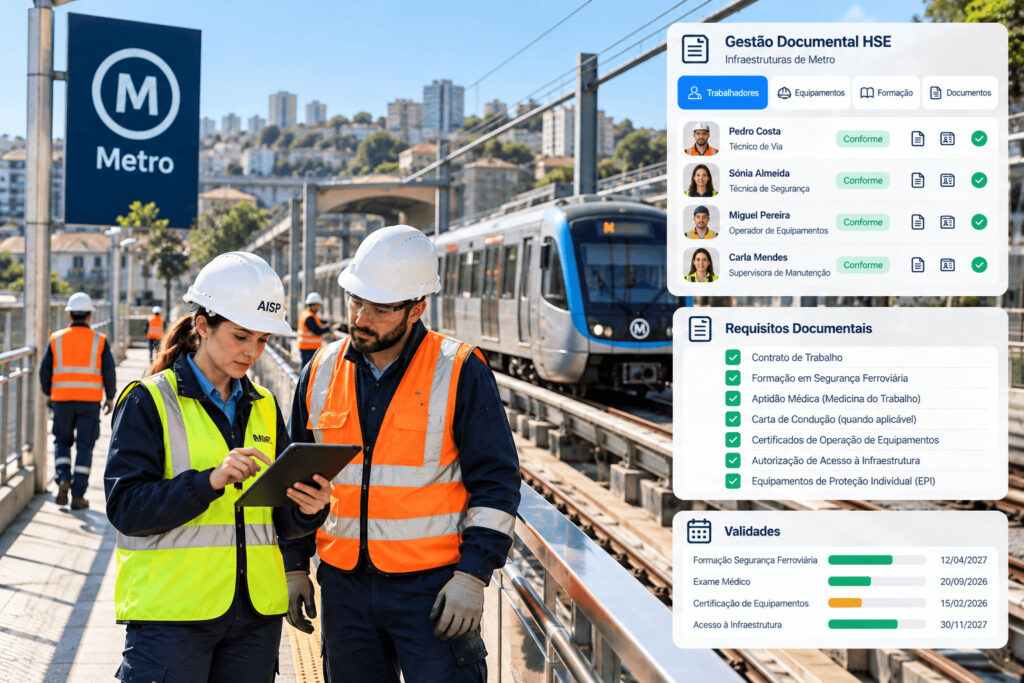
Document management platform selection is a decision whose impact lasts for many years. A poor choice means another migration and more training and, in many cases, loss of information. Therefore, rather than simply comparing features, it is essential to run a structured selection process, with clear stages, criteria defined from the outset and documented decisions.
In this article, we present a six-stage process for selecting a document management platform, from preparation to contract award. We also cover the essential evaluation criteria, the warning signs and the specific features of organisations subject to public procurement rules. In addition, we include practical examples, a checklist and answers to frequently asked questions.
Stage 1: Prepare the process
Before contacting suppliers, the organisation should decide who takes part in the selection, what budget is available and what the timetable is. In general, it is a good idea to set up a small working group with representatives from the user departments, IT, procurement and legal. In addition, it must be clear who takes the final decision. This way, endless discussions and changes to the criteria halfway through the process are avoided.
The starting point should be the organisation’s context, because there is no ideal platform for everyone. For example, a small company that only wants to organise contracts has very different needs from an industrial group that controls the documentation of hundreds of contractors. So, before looking at the market, it is worth answering a few simple questions:
- Which document processes cause the most problems today?
- How many internal and external users will use the platform?
- What volume of documents is expected over the next few years?
- Which existing systems need to be connected?
- Which legal and data protection obligations apply?
Within the working group, each department brings its own perspective: health and safety knows the document requirements, procurement knows the suppliers, legal assesses the contract and data protection, and IT analyses security and integrations. Bringing these perspectives together avoids choosing a platform that solves one department’s problem but creates new problems in another.
Stage 2: Define requirements and criteria
Requirements should distinguish between what is mandatory and what is desirable. For example, multi-factor authentication, export of documents and metadata or hosting data in the European Union may be mandatory, whereas automatic data extraction with AI may only be desirable. Next, an evaluation grid is defined with weightings for each criterion. As a result, the comparison between proposals becomes objective and transparent.
Example evaluation grid
| Criterion | Weighting | How to assess |
|---|---|---|
| Coverage of functional requirements | 30% | Demonstration with real cases |
| Security and data protection | 20% | Certifications, data location, contract |
| Ease of use | 15% | Tests with key users |
| Integrations | 15% | API documentation and references |
| Total cost | 10% | Subscription, implementation and training |
| Support and development | 10% | Service levels and development roadmap |
Naturally, the weightings should be adjusted to each organisation’s priorities. Even so, having criteria defined before the demonstrations avoids decisions based solely on first impressions.
Stage 3: Consult the market
With the requirements defined, the organisation sends a request for information or for proposals to a group of suppliers. The document should describe the context, the processes to be supported, the expected volumes, the mandatory requirements and the required response format. Above all, it is worth asking for concrete answers rather than just sales brochures. For example, suppliers can state for each requirement whether it is met out of the box, through configuration or only with additional development.
In this consultation, it is worth including questions that reveal each platform’s limits: where the data is hosted and which sub-processors are used, how documents and metadata are exported at the end of the contract, what service levels apply to availability and support, and how far in advance version changes are announced. It is also advisable to request written answers and attach them to the proposal, so that they form part of the contractual commitment.
Stage 4: Demonstrations and proof of concept
Next, the shortlisted suppliers should demonstrate the platform using real scenarios from the organisation. Whenever possible, it is worth moving on to a proof of concept, in which a small group of users tests the solution for a few weeks. Indeed, this stage reveals aspects that no written proposal shows, such as ease of use, quality of support and actual performance.
Stage 5: Negotiation and contract
Before signing, it is advisable to review the contract carefully, in particular the service levels, the data protection rules and the data processing agreement required by Article 28 of the GDPR, the exit conditions, the price review rules and data ownership. In addition, the implementation plan should be defined, with milestones and responsibilities for each party.
The exit conditions should guarantee the return of documents and metadata in a usable format, at no additional cost. In turn, the implementation plan should provide for the migration of existing data and a gradual roll-out, starting with a pilot department or site before extending the solution.
Stage 6: Decision and communication
After the proof of concept and negotiation, the working group prepares a recommendation for the decision maker. This recommendation should summarise the evaluation results, the strengths and weaknesses of each alternative, the risks identified and the expected total cost. The decision should then be communicated to the whole organisation, explaining why that solution was chosen. Likewise, it is good practice to inform the unsuccessful suppliers professionally, keeping the door open for future opportunities.
Documenting the entire process is important. On the one hand, it allows the decision to be justified to management, auditors or, in the case of public bodies, the oversight authorities. On the other hand, it serves as a reference for future selections, avoiding repeated mistakes and speeding up similar processes.
Essential criteria for document management platform selection
The evaluation grid should cover at least the following criteria. In each case, it is important to confirm how the platform works with the organisation’s real cases, and not just on the basis of advertised features.
Functional requirements
The platform should store and organise different types of documents and offer search by metadata and full text, as well as filters and views by entity, for example by contractor, by site or by document type. Likewise, it should allow workflows, forms and permissions to be configured without custom development.
Ease of use
A platform that is hard to use ends up being bypassed, with documents circulating by email again. For this reason, it is worth testing it with real users, including people with little digital experience, and confirming access from mobile devices.
Security and data protection
Multi-factor authentication, role-based access control, encryption of data at rest and in transit, and activity logs are essential. It is also important to know where the data is hosted, which sub-processors the supplier uses and whether there is a contract that complies with Article 28 of the GDPR.
Integrations
Connecting to HR, procurement or access control systems multiplies the platform’s value. Therefore, it is worth checking whether documented APIs and ready-made connectors are available.
Performance and scalability
The platform should handle large volumes of documents and concurrent users and keep pace with the organisation’s growth without requiring a new selection within a few years. It is therefore worth confirming the limits on users, storage and performance, as well as the availability, backup and recovery policies.
Support and development
Technical support, training and the frequency of updates are as important as the features, because a platform that does not evolve becomes outdated in the face of new legal and technological requirements.
Specific aspects of contractor management
When the platform is intended to control contractor documentation, additional requirements arise. First, the portal for external parties should be simple, available in several languages when needed and accessible from a mobile phone. Second, the platform should allow different requirements to be defined by contractor type, by service type and by site. Expiry alerts, standardised rejection reasons and the link to access control are also decisive features.
It is also worth assessing the ability to cope with peaks in workload, such as maintenance shutdowns, when hundreds of workers need to be validated in a few days. At such times, the speed of validation and the quality of support for contractors make all the difference. In general, a specialised platform offers workflows, validations and alerts already designed for this context, whereas a general-purpose platform requires more configuration to achieve the same result.
Warning signs when choosing
Some situations should raise doubts during selection. One example is a supplier that cannot explain where the data is held, does not allow documents and metadata to be exported at the end of the contract or refuses to demonstrate processes with real cases. Similarly, very low prices with unclear additional costs for integrations, training or support can lead to a total cost far higher than expected. Finally, an attractive interface does not make up for a lack of exit guarantees or suitable data hosting.
How to assess the total cost
The price of the subscription or licences is only part of the cost. In practice, the assessment should also consider initial configuration, document migration, integrations with other systems, training, support and the internal time devoted to the project. In addition, it is worth looking at a three to five year horizon, including price review rules and exit costs. This way, the comparison between proposals reflects the real effort of each alternative and not just the initial price quoted.
The role of users in the selection
End users are often missing from selection processes. However, they are the ones who will determine whether the platform is actually used. It is therefore worth involving them at three points: when defining requirements, to ensure they reflect real work; during demonstrations, to assess ease of use; and in the proof of concept, to test the solution in real conditions. Furthermore, when the platform will be used by external contractors, it is worth inviting some of them to test the submission portal. As a result, the final decision is based on the concrete experience of those who will work with the platform every day, and not just on sales presentations.
Specific features of public procurement
Public bodies, and certain private entities covered by the rules, must follow the Portuguese Public Contracts Code. In that case, selection takes place through the procedure appropriate to the value and subject matter of the contract, with tender specifications and award criteria defined in advance. For this reason, defining requirements becomes even more important: anything not included in the tender specifications can hardly be required later. Likewise, it is advisable to avoid specifications that unjustifiably favour a particular supplier.
Practical example: Selection in an industrial company
Imagine an industrial company with three factories that wants to control the documentation of 400 contractors. The working group defines 25 requirements, eight of which are mandatory, and sends a request for proposals to five suppliers. Three move on to the demonstration stage and two carry out a one-month proof of concept at one of the factories. In the end, the company chooses the solution with the best results in user testing, even though it is not the cheapest. As a result, the roll-out to the other factories runs with few problems.
Practical example: Choosing in a services company
Consider a services company with 50 employees and 80 subcontractors. After analysing its context, it concludes that the biggest problem is controlling subcontractor documentation, not managing internal documents. Next, it compares three platforms with a real case: inviting a subcontractor, submission, validation and expiry alert. Finally, it chooses the solution that is simplest for subcontractors and offers the best exit conditions. As a result, uptake is quick and the investment is aligned with the real problem.
Selection process checklist
- Problems and objectives defined before contacting suppliers.
- Working group and decision maker defined.
- Budget and timetable approved.
- Mandatory and desirable requirements separated.
- Weighted evaluation grid defined before proposals.
- Demonstrations with real scenarios.
- Proof of concept with users.
- Data location and data processing agreement reviewed.
- Exit and export conditions confirmed.
- Total cost estimated over three to five years.
- References from similar clients contacted.
- Contract reviewed by the legal department.
- Decision justified and documented.
Common mistakes to avoid
A frequent mistake is changing the criteria after seeing the proposals, which undermines the objectivity of the decision. Another is skipping the proof of concept to save time, only to discover problems after signing. In addition, many organisations do not involve end users, who are the ones who will determine the platform’s success. It is also common to choose the platform with the most features or the lowest price, instead of the one that best solves the actual problems. Finally, many organisations ignore exit costs and end up tied to unsatisfactory suppliers.
Frequently asked questions
How many suppliers should be consulted?
In general, between three and five, to ensure real alternatives without making the process too long.
How long does a selection process take?
Between two and four months is typical, including the proof of concept. In public procurement, timescales depend on the procedure chosen.
Is a proof of concept always necessary?
It is not mandatory, but it is strongly recommended for projects with many users or critical processes. The cost of a few weeks of testing is far lower than the cost of the wrong choice.
Who should be part of the working group?
Representatives of the departments that will use the platform, IT, procurement and legal, with a clear person responsible for coordinating the process.
Should we ask for references from other clients?
Yes. Talking to clients of a similar size and sector is one of the most reliable ways to learn about the quality of support, the stability of the platform and how the supplier resolves day-to-day problems. It is therefore worth asking for at least two references and preparing specific questions.
Should price be the main criterion?
No. Price is important, but it should be assessed together with functional fit, security, ease of use and the total cost over the years.
Is a cloud solution or an on-premises installation better?
For most organisations, a cloud solution is simpler, more secure and more cost-effective, provided that the contract and data location are appropriate.
Can a free platform be enough?
For very simple needs, perhaps. However, free solutions rarely offer adequate guarantees of security, support, service levels or contractual terms for documents containing personal data or subject to legal obligations. For professional use, it is worth carefully assessing the risks before choosing one.
Conclusion on document management platform selection
Document management platform selection benefits greatly from a structured process: preparation, requirements, market consultation, demonstrations, proof of concept and contract. Each stage thus helps to reduce the risk of a wrong choice.
With criteria defined from the outset, such as functional fit, security, integrations and total cost, and with user involvement, the organisation makes a transparent, well-founded decision aligned with its real needs. Moreover, it creates the conditions for faster implementation, with less resistance and visible results from the first few months.
Read also: Cost control when selecting a document management platform, Advantages and disadvantages of document management platforms and Difficulties in implementing a document management platform.
To learn about the GDPR obligations that apply to document management, visit the website of the Portuguese Data Protection Authority (CNPD).