
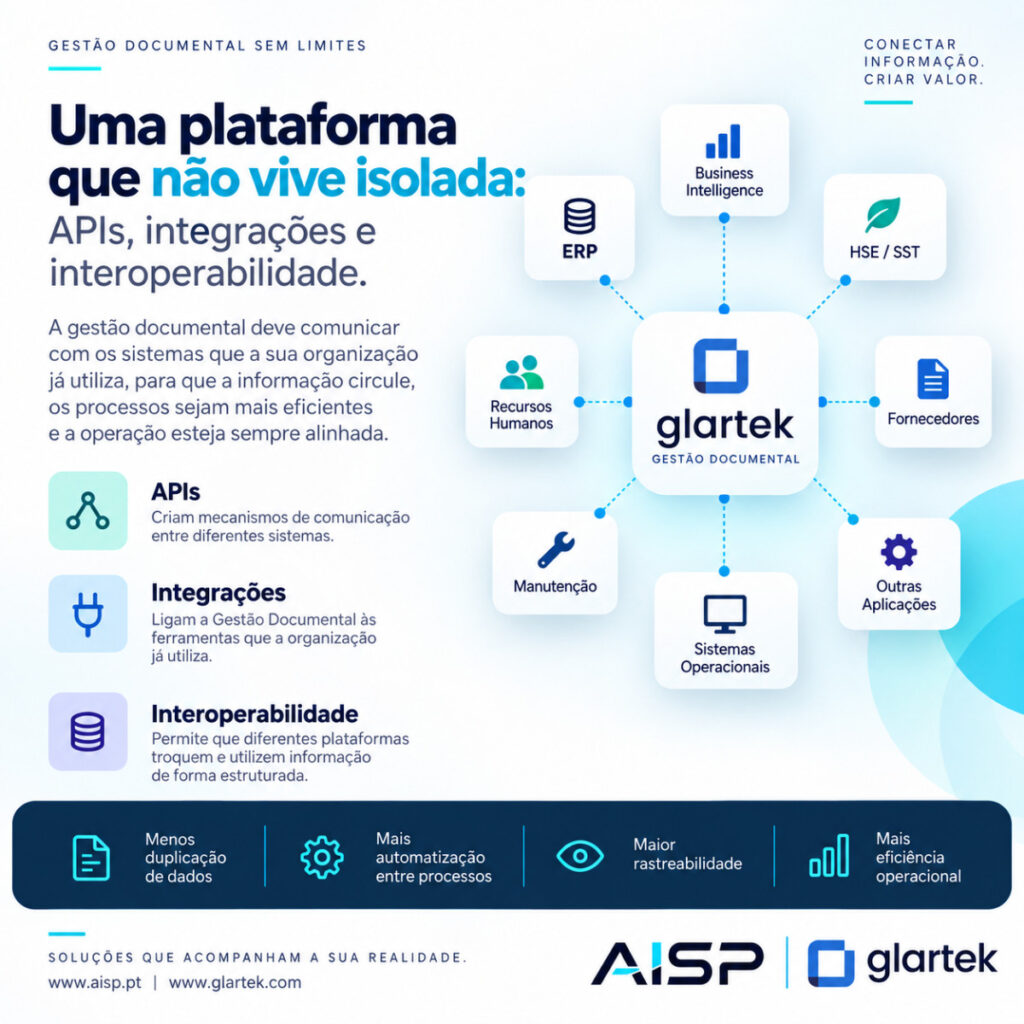
For many years, organisations digitised their processes by implementing one system after another. Today, APIs and interoperability allow these systems to communicate with each other.
For example, an ERP for business management. A platform for human resources. Another for HSE. Specific solutions for maintenance, Business Intelligence, operations management or document management.
Individually, each system may perform its intended role well.
The problem arises when these platforms do not communicate with each other.
As a result, information ends up spread across different applications and people enter the same data several times. Users also have to switch between systems, and many processes still depend on manual transfers of information.
That is why a new generation of document management must follow a different logic.
In other words, it must be ready to become part of the organisation’s technology ecosystem.
Document management should not be an island
In fact, a document rarely exists in isolation.
It may relate to a supplier, worker, piece of equipment, project, contract, HSE requirement, inspection, contractor approval process or any other operational reality.
Therefore, document information becomes far more valuable when it can communicate with the organisation’s other processes.
Imagine, for example, that certain data extracted from a document could flow automatically into another system, feed an indicator or trigger a step in a process.
This is precisely where APIs, integrations and interoperability play an essential role.
What are APIs?
An API, or Application Programming Interface, works as an interface that enables structured communication between different systems.
In practice, it creates mechanisms through which one application can provide information to another or receive information from it.
Thus, in a document management platform, APIs can make it easier to connect to other applications the organisation uses, reducing the need for manual information transfers.
What does it mean to integrate systems?
An integration allows two or more applications to exchange information within a process.
In this way, instead of entering the same data into different platforms, information can flow between systems in a structured way.
For example, this can make it possible to:
- Link document information to business systems
- Update data used in other processes
- Feed reports and indicators
- Reduce duplicated information
- Automate steps across different platforms
- Improve process traceability
The aim is not necessarily to replace the systems the company already uses.
On the contrary, it is to help them work better together.
Integration and interoperability are not quite the same thing
Integrating systems is important.
However, interoperability goes one step further.
In other words, it is not enough for two applications to exchange information. The different systems and processes must also be able to understand and use that information consistently.
This capability makes it possible to build more integrated digital ecosystems and reduce technological fragmentation within organisations.
From document to process with APIs and interoperability
The evolution of document management lies precisely in this change of logic.
As a result, the document no longer ends its journey inside the document platform.
Instead, the information can feed:
- Databases
- Workflows
- Reports
- Dashboards
- Validation processes
- HSE systems
- Control and decision mechanisms
In this way, document management stops being just a repository and takes an active part in the organisation’s information system.
APIs and interoperability: Particularly relevant in HSE and OSH
In HSE and OSH (occupational safety and health), this integration capability is particularly important.
For example, documentation on workers, companies, equipment, substances, requirements, approvals, inspections, audits or non-conformities may relate to different systems and operational processes.
When this information remains isolated, duplication, parallel processes and the difficulty of obtaining an integrated view all increase.
On the other hand, when systems communicate, document information can move closer to what really happens in the field.
Real digital transformation happens when we connect processes
Digitising each process individually was the first phase of digital transformation.
However, the next stage is about connecting them.
A modern document management platform should therefore be ready to join the existing technology ecosystem and evolve with it.
At AISP-GEDOC, in partnership with Glartek, we consider this one of the fundamental dimensions of a new generation of document management: a configurable, integrated and interoperable platform, ready to move information between documents, systems and processes.
Because a truly digital platform should not work in isolation.
It should be part of the organisation.
See also: Your document management platform cannot be an island and The role of APIs in document management platforms.
To learn about European interoperability and digital transformation initiatives, see the digital strategy of the European Commission.