
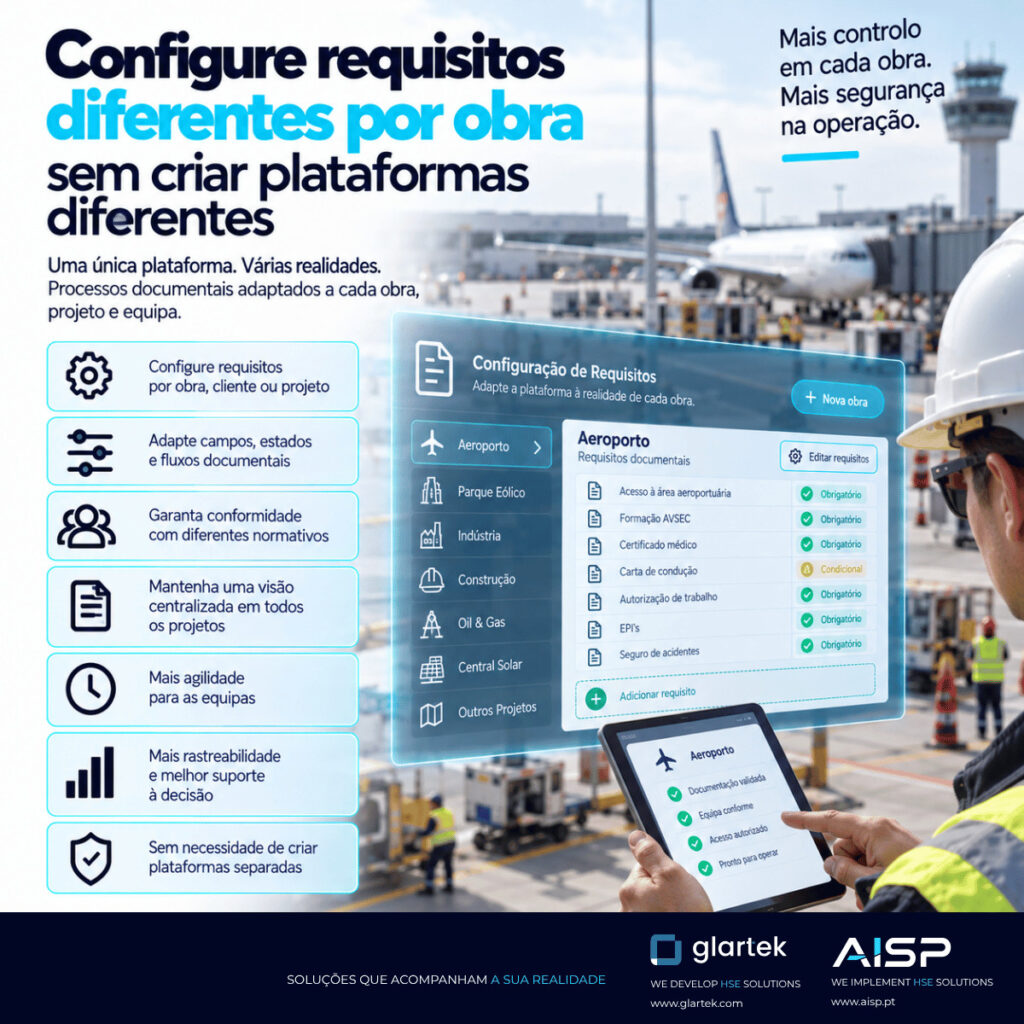
An airport, a wind farm, an industrial plant and a construction site. Four realities, four sets of site-specific requirements and, often, four different tools to manage them.
Moreover, each isolated platform duplicates company and worker records, forces teams to validate the same document several times and prevents a consolidated view. Whenever a contractor works on several projects, nobody knows for sure where they are compliant.
What to control with site-specific requirements
However, a single platform can cover several realities, as long as the requirements are configurable by context:
- Requirements by site, client or project: each location therefore requires what it needs, no more and no less.
- Tailored fields, statuses and workflows: the document process adapts to each type of operation.
- Compliance with different regulations: each client’s and sector’s rules applied consistently.
- A centralised view of all projects: one place to know who is cleared to work and, above all, where.
- Greater agility for teams: documents validated once and then reused wherever they apply.
- Greater traceability: each decision is also recorded together with the requirement that justified it.
On the Glartek platform, the base structure is shared and the requirements vary by layer: organisation, client, site and role. That is why opening a new project becomes a matter of configuration, not a new implementation.
One platform. Many realities. More control on every site.
Request a demo with two of your most different projects and see their requirements configured side by side on the same platform.
Further reading: Contractor and subcontractor management: The complete guide.
Read also: Each site can have different requirements and A worker can be compliant on one project and non-compliant on another. Finally, find out more about document requirements management.