
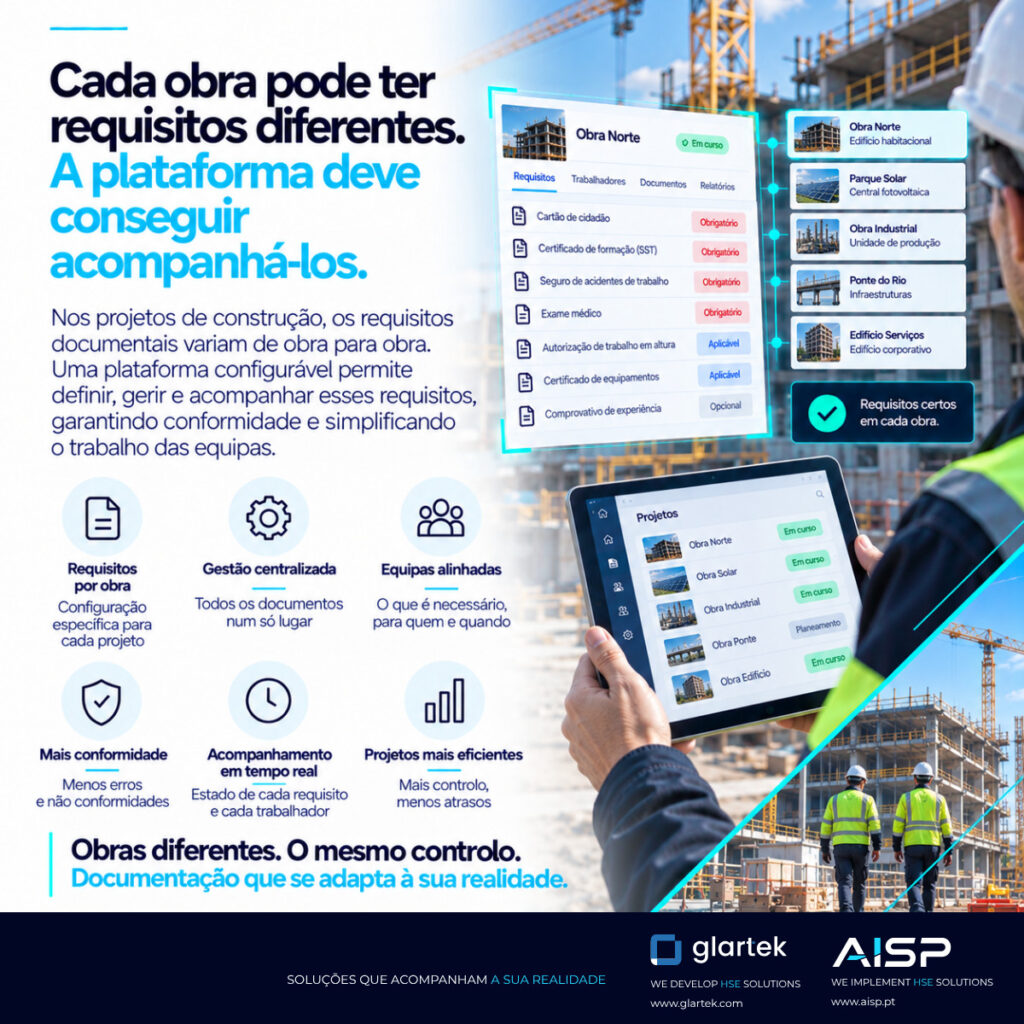
A common mistake in document management is to overlook site-specific document requirements and assume that the same requirements apply uniformly to every project and every site.
In reality, each site can have its own characteristics.
For example, the client may define additional documents. In addition, the type of activity may require specific competences. Certain risks can introduce new demands. Likewise, some equipment may be subject to different rules. And the same company may work on several projects at once, each with a different level of control.
That is why a robust document platform must adapt to the reality of each site without forcing the organisation to create separate systems.
Site-specific document requirements within the same organisation
For example, consider a company that manages several projects at the same time.
On one site, the client may require:
- company documents;
- medical fitness;
- general safety training;
- worker identification.
On another, there may be additional requirements, such as:
- specific training for work at height;
- electrical authorisations;
- equipment certification;
- the client’s own document requirements.
Both projects belong to the same organisation, but they do not have to follow the same document matrix.
A platform must reflect site-specific document requirements
Therefore, the platform must let you configure requirements across different dimensions, such as:
Project or site
Which documents does that context require?
Role
Which competences and evidence does a given profile require?
Activity
Are there additional requirements for certain tasks?
Risk
Are there specific demands linked to electrical risk, confined spaces or work at height?
Client
Does the contract set its own criteria?
Equipment
Which certificates, inspections or authorisations apply?
This level of detail is therefore essential to avoid two unwanted situations: asking for unnecessary documents or leaving important requirements unchecked.
The same worker can have different statuses
A worker can be fully compliant on one project and still have pending requirements on another.
However, this is not an inconsistency.
In fact, it is a natural consequence of different contexts.
For example, the worker may have all the documents needed for a standard activity, but not yet the training required for a specific task on another project.
That is why document status should not exist only at the level of the person.
It should relate to the context in which that person will work.
The same document can be sufficient on one project and insufficient on another
In addition, the same logic applies to document evidence.
A certificate may meet the requirements of one project, but not those of another.
For example, an insurance policy may be sufficient for one contract and insufficient for another.
A training course may be acceptable for one activity but not prove sufficient competence for a more critical task.
That is why document management must analyse the relationship between:
requirement + evidence + context
and not just the document in isolation.
Configuring site-specific document requirements without creating new platforms
When each project has different requirements, an inflexible approach tends to create multiple parallel structures.
New spreadsheets.
Additional forms.
Separate workflows.
Sometimes, even new platforms.
As a result, this adds complexity, duplicates information and blurs the overall view.
That is why a configurable platform must let you keep a common base and apply specific rules to each site.
The role of no-code
The ability to change requirements without complex development is especially relevant in these scenarios.
Projects change.
For example, clients introduce new demands.
Legislation evolves.
Activities change.
The platform must therefore keep up with this reality.
With no-code configuration tools, you may be able to adjust:
- fields;
- mandatory documents;
- rules;
- workflows;
- statuses;
- notifications;
- profiles;
- approvals.
This reduces reliance on development whenever operations change.
Centralisation without losing flexibility
The advantage of a single platform does not lie in forcing every project to work the same way.
In fact, it lies in centralising information while keeping local flexibility.
The organisation can keep:
- workers;
- suppliers;
- equipment;
- documents;
- history;
- indicators.
And, at the same time, apply different requirements to each project.
In this way, it makes overall management easier without removing operational specifics.
Better reuse of information
A centralised platform also helps avoid unnecessary duplication.
If a worker already holds a valid certificate, that evidence can be available to other projects.
Then each site decides whether that document meets its specific requirements.
So the worker does not necessarily need to upload the file again and again.
In other words, what changes is the validation context.
More control over changes
Site-level configuration must also keep traceability.
When a requirement changes, it must be possible to know:
- what changed;
- when it changed;
- who made the change;
- which workers or suppliers it affected;
- whether the change requires a new validation.
However, flexibility without traceability can create new risks.
That is why configuration and governance must evolve together.
The platform must keep up with each site’s document requirements
In fact, the reality of a project is not static.
A site can move from an initial construction phase to commissioning and later to operation.
Document requirements can change at each phase.
Therefore, the platform must follow this evolution without losing history or forcing you to rebuild the whole process.
This capability is what sets a rigid structure apart from a truly configurable document management platform.
One platform. Many realities.
Modern document management should not try to standardise every project artificially.
On the contrary, it should make it possible to control different realities within a common structure.
The goal is simple:
apply the right requirements, to the right people, on the right project, at the right time.
Because every site can be different.
The platform must be able to keep up with that difference without losing control.
See also: Managing physical documents in construction projects and The revolution of document management platforms in site safety coordination.
For more information on safety at work on construction sites, visit the Portuguese Working Conditions Authority (ACT).