
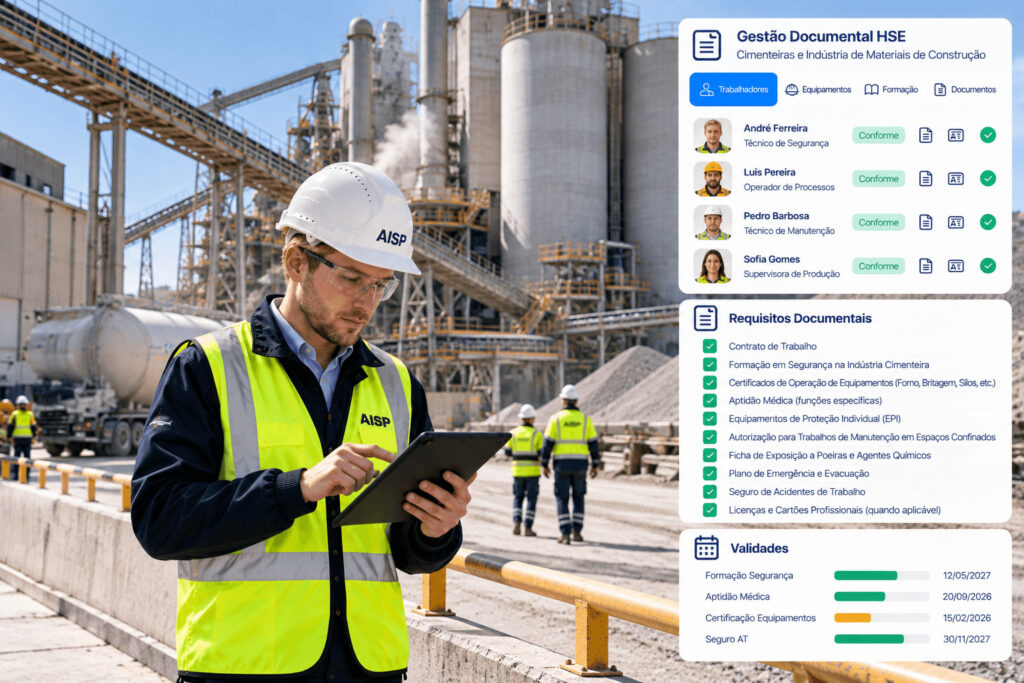
For many years, digitising HSE document management mainly meant replacing physical archives with digital files, rather than using the HSE document data they contained. Organisations began uploading documents to platforms, linking them to companies, workers or equipment, classifying them by type and controlling them through statuses and expiry dates. This shift brought significant gains in traceability, access and organisation. However, it kept one fundamental feature of the previous model: much of the information remained locked inside the document itself.
A certificate may contain the worker’s name, the issuing body, a competence, an issue date and an expiry date. Similarly, a fitness-for-work certificate may hold information that determines whether a person is fit for a given role or exposure. An equipment document may also identify the model, serial number, inspections and limitations. If these elements exist only inside a PDF or an image, the organisation can store the document. Even so, it still depends on people to interpret it whenever it needs that information.
The most relevant evolution in document management, therefore, is not about storing more files. Instead, it is about being able to turn document content into structured data that can take part in the organisation’s processes. This is where artificial intelligence, automatic information extraction and system integration begin to profoundly change the role of document platforms.
HSE document data: The document is no longer just evidence
In a traditional document model, the document works mainly as evidence. It exists, someone uploads it, someone consults it and someone confirms whether it meets a given requirement. Its content may be essential to the decision. Nevertheless, it stays hard to reach for other processes because it is embedded in an unstructured file.
When the platform extracts the relevant information and turns it into data, the potential changes. For example, the expiry date identified on a certificate can automatically feed an expiry control. The platform can also link a worker’s competence to the task they will perform. Likewise, it can compare an item of equipment’s identification with the registered asset. In addition, an issuing body can serve as an extra validation element. As a result, nobody needs to re-enter or reinterpret the information whenever another process needs it.
This difference may seem purely technological, but it changes the very architecture of document management. Gradually, the focus moves away from the file and towards the information the file can provide. The document remains essential as evidence and original source. However, its data can start to take part in workflows, dashboards, alerts, integrations and decisions.
For an HSE organisation, this capability is particularly relevant because much of compliance depends on combining different elements. Knowing that a certificate exists is not enough. You also need to understand who it belongs to, which competence it refers to, how long it is valid and whether that competence matches the work the person will carry out. Turning documents into HSE document data therefore brings documentation closer to operational reality.
Extracting information is not the same as deciding compliance
Technological progress also calls for an important distinction. Being able to read a document automatically does not mean that every decision can or should be automated.
Extraction can identify a name, a date, a document number, an entity or a reference. The platform can then run certain objective checks on that data. For instance, it can compare an expiry date with the current date, match an identifier against the existing record and look for a competence within a predefined set of requirements.
However, there are situations where context remains decisive. A document may contain contradictory information. The evidence may be partly illegible. A certificate may mention several competences, and it may not be clear which one applies to the activity. Finally, a form may indicate fitness that is conditional or limited to certain situations.
In these cases, turning uncertainty into an automatic decision can create more risk than efficiency.
The most robust architecture therefore tends to distinguish between different levels of processing. The platform can automatically extract and use information that is objective and sufficiently clear. In contrast, ambiguous, contradictory or high-impact situations should go to human review. In this way, technology reduces repetitive work and lets professionals focus precisely on the cases that require expertise.
This separation is essential to avoid a common mistake when talking about AI: assuming that the goal is to remove all human involvement. In HSE document management, the goal should be to automate what is repetitive and predictable, without automating uncertainty.
HSE document data connects documentation to operations
The real leap happens when extracted information no longer serves only to simplify document validation and other processes start using it.
Consider a worker who is about to carry out an activity with specific requirements. The organisation may hold information on their company, role, training, fitness, project and applicable documentation. If these elements are structured and linked, the platform can assess that person’s readiness in a far more contextual way than a simple list of approved files allows.
The same reasoning applies to equipment. The platform can link certificates, inspections, identifiers, equipment type and project to determine whether a given asset is ready for use. Furthermore, when the platform shares this data with other systems through integrations, document information can even start to influence external operational processes.
At this point, document management stops being just an administrative system and starts working as a layer of operational control.
The difference is significant. In the traditional model, someone consults the documentation to decide whether a person or item of equipment can proceed. In a more integrated model, however, the structured information itself can feed workflows, authorisations, alerts or other systems, while the original document remains as evidence.
The value, then, no longer lies only in finding a PDF quickly.
It lies in being able to use what that PDF contains.
The quality of HSE document data matters as much as the documents themselves
This evolution also raises the bar for information quality. In an essentially manual process, a professional can interpret small inconsistencies and realise that two different names refer to the same entity. However, once data starts feeding automations, integrations and analytics, these inconsistencies have a greater impact.
Duplicate names, incorrect identifiers, inconsistent classifications or wrong links between worker, company and project can undermine results that look technically correct. For this reason, the organisation needs to combine extraction technology with governance of HSE document data.
First, it is necessary to define which fields are relevant, which values should be standardised, which information is the official reference and who is responsible for its quality. There should also be traceability between the structured data and the evidence it came from, especially when the information contributes to a compliance decision.
This concern becomes even more important when different sources contribute to the same process. Information may arrive through documents, integrations, forms and corporate systems. Consequently, the platform needs to know which reference is appropriate and how to handle discrepancies.
Artificial intelligence can greatly speed up information processing, but it does not remove the need for a coherent data architecture. On the contrary, the higher the level of automation, the more important it is to ensure that data has a clear meaning, origin and context.
Where to start: Four practical steps
Moving from documents to data does not require a large-scale project. Instead, it can start in phases, with visible gains at each stage:
- Choose the highest-volume document types. Training certificates, fitness-for-work certificates and insurance documents are often the most time-consuming and benefit most from data extraction.
- Define the fields that matter. For each document type, identify the data the processes actually use, such as holder, issuing body, competence and expiry date, with format and standardisation rules.
- Measure extraction quality. On a sample, compare the extracted data with human review before using it in automatic decisions.
- Connect the data to a specific process. For example, expiry alerts or a readiness dashboard per project, to show value quickly and earn the teams’ trust.
Each step produces useful information for the next and reduces the risk of automating on data that is not yet reliable.
The next generation of document management will focus less on the file
Documents are not going to disappear. They will still be needed as evidence, records, contractual proof or information support. What is changing is the role they play within the system.
For a long time, the main question was:
“Where is the document?”
Then it became:
“Is the document valid and approved?”
The next evolution adds new questions:
“What information does it contain?”
“Which process does it relate to?”
“What decision can it support?”
“What action can it trigger?”
This shift brings document management closer to other HSE areas and to operations themselves. Documentation, competences, workers, equipment, requirements, projects and activities gradually stop working as separate worlds. Instead, they form a connected information structure.
This is where AI can deliver real value. Not only because it can read documents faster, but because it turns information once trapped in files into raw material for processes, indicators and decisions.
The future of document management does not lie in storing more and more documents.
It lies in making better use of the information that already exists within them.
And when that information can flow in a structured way between requirements, processes and systems, document management is no longer just a mechanism for archiving and compliance.
It becomes part of the organisation’s operational intelligence.
Further reading: HSE platform and HSE digitalisation: A complete guide.
Read also: Documents that automatically feed databases and reports and From document to requirement: How AI and OCR are changing HSE document analysis.
For more information on digital transformation and artificial intelligence in Europe, visit the European Commission.