
Digitising document processes has brought organisations huge gains. However, manual data entry is still common.
Documents no longer circulate only on paper. Teams now upload them to platforms and can consult them from practically anywhere.
But in many organisations, one part of the process remains virtually unchanged.
Teams still type information that already sits inside documents into other systems by hand.
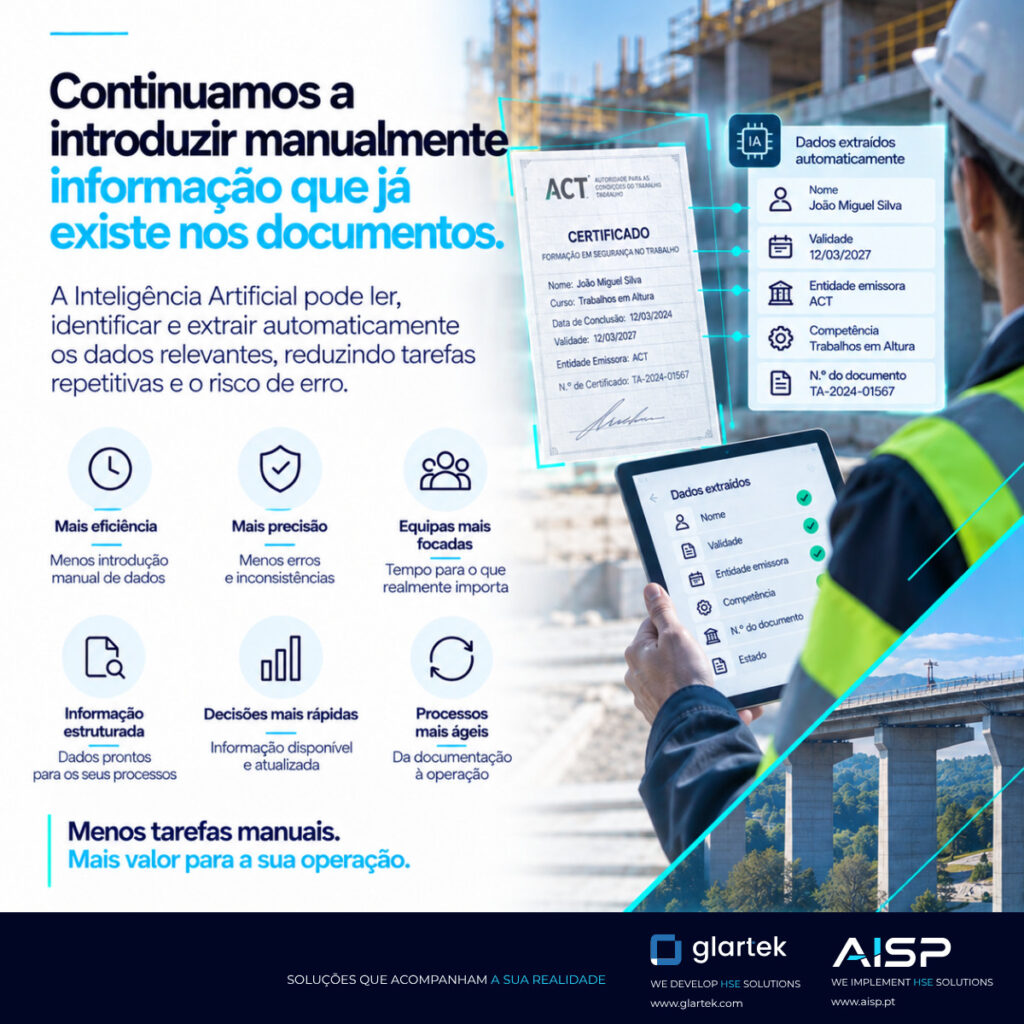
For example, an employee opens a certificate, looks for the name, identifies the issuing body, checks the expiry date, reads the competence and copies each item into fields on the platform.
The file is digital.
The process, however, remains partly manual.
The hidden cost of manual data entry
When we look at a single document, copying a few fields may seem a trivial task.
The problem arises when you repeat this operation hundreds or thousands of times.
For example, an organisation that manages documentation for workers, suppliers and equipment may receive a significant daily volume of:
- training certificates;
- medical fitness certificates;
- declarations;
- insurance policies;
- reports;
- inspections;
- technical certificates;
- licences;
- authorisations;
- maintenance records.
In fact, each document may require someone to open, interpret, locate and transcribe different pieces of information.
As a result, a considerable amount of time goes into tasks that add no direct knowledge to the process.
Manual data entry of information that already exists
For example, consider a training certificate.
The document may contain:
- worker’s name;
- issuing body;
- course title;
- certificate number;
- issue date;
- expiry date;
- duration;
- competence acquired.
If this data is already in the document, why should anyone enter it manually again?
Therefore, this is where OCR and artificial intelligence technologies can support a new approach.
From automatic reading to structured extraction
The first step is being able to read the document.
But reading is not enough.
A smart solution must also identify what the information means.
For example, finding a date is not enough.
You need to understand whether it is the issue date, the expiry date or another reference.
Likewise, finding a company name does not automatically tell you whether it is the issuing body, the employer or the client.
Therefore, a robust process needs to combine different capabilities:
Reading → identification → extraction → structuring → validation
The aim, therefore, is to turn items already in the document into structured data that other processes can use.
What can you extract?
Depending on the document type, you can extract data such as:
- holder’s name;
- company;
- issuing body;
- document number;
- dates;
- validity;
- competence;
- training;
- role;
- equipment;
- serial number;
- result;
- specific references.
In fact, the relevant information varies from one document to another.
That is why process configuration remains essential.
Less manual data entry, fewer chances of error
In addition, manual transcription is repetitive and prone to mistakes.
Typical errors include:
- wrong dates;
- misspelt names;
- incomplete certificate numbers;
- links to the wrong worker;
- incorrect classification;
- missing information.
As a result, automatic extraction can remove much of this transcription.
In this way, teams focus more on validating exceptions and less on copying data.
Without manual data entry, information feeds other processes
However, the real gain does not end with extraction.
Once information has a clear structure, different parts of the organisation can use it.
For example, an expiry date can trigger an alert.
Similarly, a competence can feed a competence matrix.
The system can also compare the holder with the worker linked to the document.
In addition, the issuing body can form part of the validation rules.
The data can feed dashboards and indicators.
Documentation thus moves from a static logic to an operational one.
Extracting does not mean approving
There is, however, a fundamental distinction.
Being able to extract information from a document does not mean the platform should approve it automatically.
A certificate may say “Work at height”, but you may still need to check:
- that it belongs to the right person;
- whether it is still valid;
- if it matches the project requirement;
- that the issuing body is suitable;
- whether the training is sufficient for the role;
- if any other mandatory requirements apply.
Therefore:
data extraction ≠ compliance decision
In other words, extraction reduces administrative tasks.
Compliance, however, requires rules, context and decision criteria.
When human review is still necessary
In fact, not all documents are clear.
Some scanned documents have poor quality, contradictory information, incomplete fields or terminology that is hard to interpret.
In these cases, therefore, the technology must know when to stop.
When there is not enough information for a safe decision, the document should go to human review.
Efficient automation, therefore, is not the kind that tries to decide everything.
It is the kind that automates what is clear and routes exceptions correctly.
Document data that serves operations
With structured data, processes that previously required manual searches become possible.
For example:
- identifying documents close to expiry;
- knowing which workers hold a given competence;
- viewing suppliers with pending requirements;
- tracking documentation by project;
- feeding compliance dashboards;
- identifying review priorities.
As a result, information no longer stays locked inside files.
Instead, it becomes available to support decision-making.
From documentation to operations
We can sum up the shift as follows:
Traditional model:
Document → human reading → manual data entry → validation
AI-supported model:
Document → data extraction → structuring → rules → validation → decision
However, the document remains the original evidence.
But the team no longer has to re-enter information that already exists.
Less manual data entry. More human value.
The goal of artificial intelligence in document management should not be to replace the team’s knowledge.
Instead, it should help teams make better use of it.
A specialist adds more value by analysing an ambiguous situation, a non-conformity or a complex requirement than by copying an expiry date from a PDF into a field.
In fact, this is precisely where one of the biggest opportunities of document automation lies.
The idea is to take repetitive tasks away from people and give them back time for work that requires judgement, knowledge and decision-making.
The information already exists inside the documents.
Technology can help extract it. Teams can then focus on what truly requires human intelligence.
Read also: Automation in document management and Cost reduction and productivity improvement.
To learn about the European framework for artificial intelligence and digital transformation, see the European Commission’s digital strategy.