
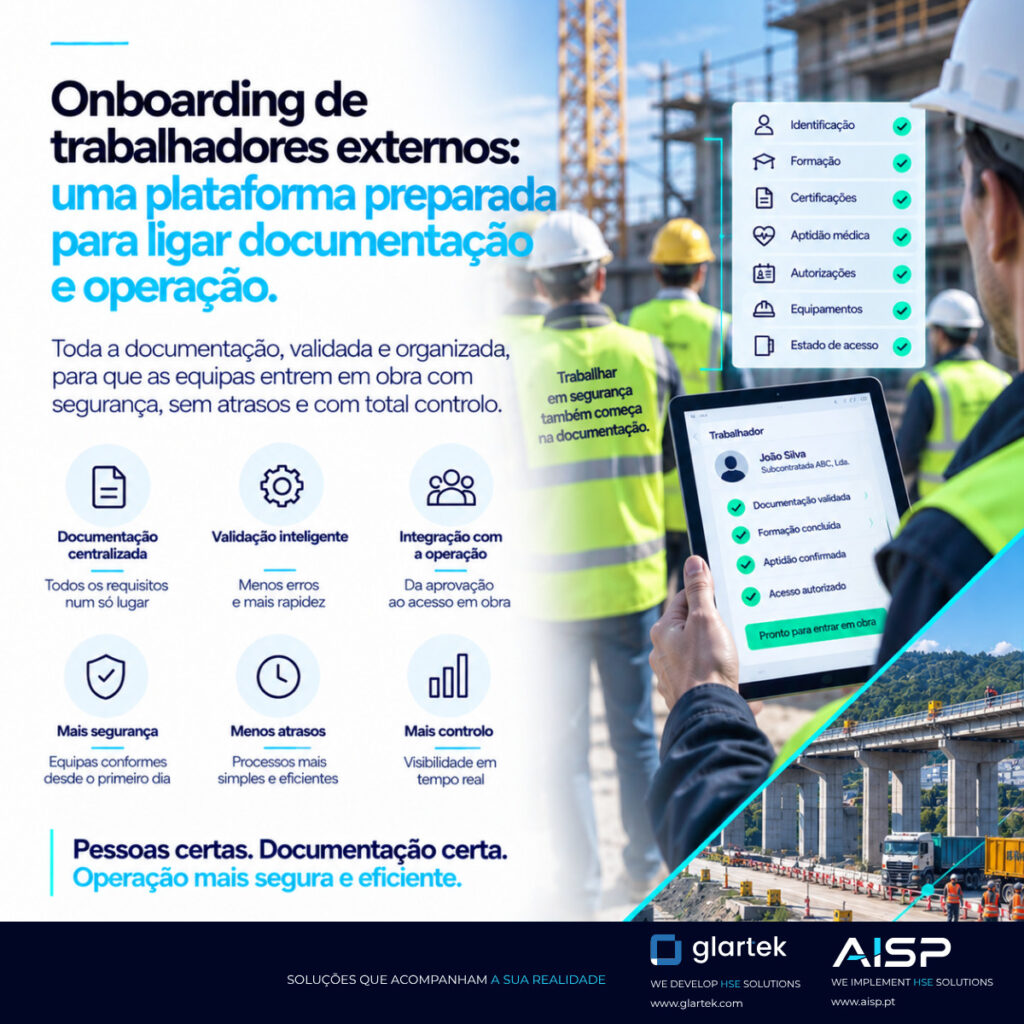
Many organisations treat external worker onboarding as an administrative process: collect documents, check a few requirements and authorise entry.
However, in operations with multiple suppliers, roles, risks, projects and locations, the process is far more complex.
After all, the question is not just whether the worker has handed in the requested documents.
In fact, it is about making sure that the documents and competences presented suit the role and the activity that person will actually carry out.
This link between document management and operations is therefore what turns onboarding into a real operational control process.
External worker onboarding starts before arrival on site
That is why efficient onboarding must start before mobilisation.
Ideally, when the worker arrives at the site, factory, industrial facility or project, most checks should already be complete.
To achieve this, you need to know in advance:
- the employer or contractor;
- project or site;
- role;
- planned activity;
- associated risks;
- required competences;
- mandatory training;
- applicable documents;
- client-specific requirements.
Without this structure, however, it becomes easy to request too many documents or, on the contrary, leave essential requirements unvalidated.
In onboarding, not all external workers need the same documents
In addition, one of the main onboarding challenges is avoiding generic document processes.
An administrative worker, an electrician, an equipment operator, a maintenance technician and someone working at height do not face the same risks or need the same competences.
Therefore, a robust platform must let you configure requirements based on different variables.
For example:
Role
Which documents and competences does that role require?
Activity
Are there additional requirements for a given task?
Risk
Is there specific training or evidence linked to work at height, electrical risk or confined spaces?
Project
Has the client set additional requirements?
Location
Are there specific rules for a given facility or site?
This level of detail is what lets you move from a generic checklist to a process truly tailored to operations.
Submitted documents do not automatically make a worker fit for work
Another common mistake is to consider onboarding complete as soon as the worker has submitted all the documents.
But having a document does not necessarily mean meeting the requirement.
For example, a certificate may be valid and still not match the required training.
A fitness certificate may exist but not provide enough evidence for a given activity.
A document may belong to the right worker but have expired.
Or there may be a project-specific requirement that nobody has met yet.
That is why the process needs to connect:
Worker + requirement + evidence + role + activity + risk + context
Only then does it make sense to decide whether the person is actually ready to start work.
The importance of seeing the status before mobilisation
An integrated platform should therefore show the status of each worker at a glance.
For example:
- complete documents;
- missing documents;
- documents under review;
- rejected documents;
- expired documents;
- requirements due for renewal;
- specific requirements still pending;
- worker fit for a given role;
- worker with restrictions for a given activity.
As a result, this visibility lets you act before mobilisation, not just when the problem arises.
Fewer emails and spreadsheets
In fact, in many traditional processes, onboarding depends on repeated email exchanges.
Someone requests a document.
The supplier sends it.
Then someone reviews it.
The team asks for another one.
A question comes up.
The supplier sends it again.
Meanwhile, someone updates a spreadsheet.
However, another person checks a different version.
This model becomes particularly hard to manage when there are dozens of suppliers and hundreds or thousands of workers.
That is why a centralised platform lets you consolidate the process and keep a single view of document status.
Automating what is repetitive
Artificial intelligence can also support some stages.
It can help identify:
- document type;
- holder;
- issuing body;
- dates;
- expiry date;
- training;
- competences;
- relevant references.
The platform can then compare this data with requirements configured in advance.
However, the goal is not to automate every decision indiscriminately.
It is to reduce repetitive tasks and send anything that requires interpretation, an exception or a decision to human review.
External worker onboarding linked to competence management
When documents and data have a clear structure, onboarding can also feed competence management.
As a result, the organisation can see:
- who holds a given training qualification;
- which workers are ready for a given activity;
- which competences are close to expiry;
- where the gaps are;
- which teams the organisation can mobilise for a given project.
Onboarding is therefore no longer just an initial step.
In other words, it feeds the ongoing management of external people throughout the project.
From external worker onboarding to authorisation to operate
In fact, the end goal should be simple.
Before a worker starts an activity, the organisation must be able to answer:
Who is this person?
Who do they work for?
What activity will they carry out?
What risks does it involve?
Which requirements apply?
What evidence has the worker provided?
Are they actually fit to carry out this task?
In this way, this capability reduces blockages, improves predictability and makes mobilisation safer to manage.
One platform, several projects and different requirements
Another important point, moreover, is the ability to adapt the process without creating a new solution for each site.
For example, the same worker may take part in different projects and be subject to different requirements.
The platform should keep a central identity and document history, and then apply the specific requirements of each context.
This way, you avoid unnecessary duplication and maintain traceability.
Document management linked to operations
External worker onboarding is a good example of how document management is evolving.
The goal is therefore no longer just to receive and approve documents.
It is to turn those documents into useful information for deciding who is ready to enter, work and carry out a given activity.
When documents, competences, role, risk and operations connect, the process stops being purely administrative.
It becomes part of operational management and safety.
Because well-structured onboarding does not end when the worker uploads the last document.
It ends when there is enough evidence to ensure the worker is ready for the activity they will carry out.
See also: The importance of worker approval and Issuing personalised credentials to approved workers.
For more information on occupational health and safety, visit the Portuguese Working Conditions Authority (ACT).