
International service
International hub for HSE platform implementation and management
Your operation in any country. A specialist team supporting it from Portugal.
We implement the platform, structure the document requirements, prepare the users and support the operation. A model tailored to the different companies, countries and work sites of your organisation.
Situations you may recognise
When operations cross borders, document management and HSE become more complicated
It is not usually the technology that fails first. It is the lack of a common structure, of someone to administer it and of someone to connect each country's process to the platform.
Every country has its own rules
Document and HSE requirements change with the country, the sector and the type of work, and nobody has the full picture.
Several companies, several ways of working
Each group company manages contractors and workers in its own way, with its own formats and criteria.
The platform exists, but nobody administers it
After go-live, requests have no owner and the configuration stops following the process.
Local teams with no time for the platform
Site managers have an operation to run, not a platform to administer.
Physical access does not follow the documentation
The gatehouse relies on lists and credentials that do not show whether the requirements are still valid.
Between the supplier and the operation, a bridge is missing
The technology belongs to the supplier, the process belongs to the operation, and nobody connects the two in each country.
Who this service is for
We work with management, operations, HSE/OSH, document management, human resources, procurement, compliance and IT, because an international project involves all of these functions.
You need to implement a platform
You are about to launch an HSE or document management platform and want to do it methodically, in one or several countries.
You already have technology and want support
The platform is chosen or in use. What is missing is a team to structure the requirements, train the users and support the operation.
You want to coordinate several countries
A group with several companies and work sites that needs common rules without ignoring local specifics.
You want to delegate administration or document tasks
You prefer that platform administration and, depending on the contracted scope, document analysis and operation are handled by specialists.
You want to link documentation and access
You want document requirements to determine the authorisation of companies, workers and equipment.
The hub
We implement in any country. We administer and support from Portugal.
AISP brings together, in a specialist hub in Portugal, skills in implementation, configuration, training, document analysis and technical support. We help international companies and groups implement and manage their HSE platforms, combining common requirements with the specifics of each country, company and work site. From preparing the platform to day-to-day operation, we provide the support defined for each organisation.
People
Specialist teams in Ílhavo, at PCI, Creative Science Park, combining implementation, training, document analysis and platform administration.
Methodology
The AISP Methodology, in eight phases, applied in the same way in every country and adapted to the reality of each operation.
Support
Ongoing administration and technical support from Portugal, at the level defined in the proposal.
What happens on site and what stays centralised
In the country, the company and the work site
- Survey of the existing process and systems, when the project requires it
- Sessions with users and local managers
- Confirmation of local requirements with the competent people
- Remote, on-site or hybrid implementation, depending on the project
In Portugal, from the hub
- Project coordination and requirements design
- Configuration, data preparation and testing
- Functional administration and technical support
- Document analysis and operation, when contracted
On-site presence, travel and working languages are confirmed in the proposal, before any commitment.
Who does what
An international project involves three parties. Making them clear from the start avoids doubts along the way.
AISP
- Project coordination and diagnosis
- Structuring of requirements and authorisation criteria
- Configuration, data preparation and testing
- User training and go-live support
- Functional administration and technical support within the contracted scope
- Document analysis and operation, if contracted
Technology supplier
- The software and its features
- The infrastructure and data centres
- The evolution of the product
- Development beyond configuration, which AISP escalates and follows up
Your organisation
- Decides the criteria and the business rules
- Appoints a global owner and local owners
- Provides access to the systems and data needed
- Validates the requirements and the tests
- Ensures user participation
The framework is adjusted to each contract and set out in the proposal. AISP does not store clients' documentation: the data stays in the platforms' data centres, and AISP accesses only what each task requires, under the terms agreed with each client and the GDPR.
The service
Six components, from analysing the operation to extending to new countries
Each component corresponds to phases of the AISP Methodology, so that the project follows the same path in any country.
Diagnosis
We understand the organisation, the processes, the countries, the sites and the systems in use: who is involved, what information flows and where the bottlenecks appear. The result is a map of the operation and agreed priorities.
Phase: Understand the operation
Requirements and authorisation criteria
We structure the document requirements by country, activity and type of entity and define which criteria determine the authorisation of companies, workers and equipment. Local requirements are confirmed with the competent people before they are configured.
Phases: Structure the requirements, Design the solution
Configuration, data and testing
We configure the platform according to the approved design, prepare the data, assess the integrations needed and test by user profile, with a pilot in a real context before extending.
Phases: Design the solution, Configure and integrate, Validate before production
Training and go-live
We train users by profile and by process, remotely, on site or in a hybrid format depending on the project, and we support the move into real operation, adjusting what only appears in production.
Phases: Prepare the teams, Support the go-live
Administration, support and document operation
After go-live, we take on the functional administration and technical support defined in the contract and, if contracted, document analysis and operation, from Portugal.
Phase: Administer and evolve
Evolution
We extend the platform to new processes, companies, sites and countries, repeating the cycle with what we learned in each phase.
Phase: Administer and evolve, new cycle
AISP Methodology: understand the operation, structure the requirements, design the solution, configure and integrate, validate before production, prepare the teams, support the go-live, administer and evolve. Learn about the AISP Methodology.
How it works
From diagnosis to ongoing support, with the client in every decision
Implementation is remote, on site or hybrid, depending on the project. At each stage it is clear what we do and what we need from your side.
Kick-off and diagnosis
AISP
Meets with management and the people in charge, and maps countries, companies, work sites and systems.
The client
Appoints a global owner and local owners and shares the existing processes and documentation.
Requirements and design
AISP
Proposes the common structure and the local variants, and designs statuses, permissions and notifications.
The client
Validates the requirements and confirms the local requirements with the competent people in each country.
Configuration and data
AISP
Configures the platform, prepares the data and assesses the integrations needed.
The client
Provides access to the systems and data and decides what to load or migrate.
Testing and pilot
AISP
Tests by user profile and runs a pilot in a real context before extending.
The client
Provides the pilot users and approves the results.
Training and go-live
AISP
Trains users by profile and supports the move into real operation.
The client
Ensures the teams take part and communicates internally.
Administration and evolution
AISP
Administers and supports according to the model contracted and proposes the evolution.
The client
Submits requests, approves changes and decides on extending to new countries and sites.
We do not give generic timelines. The schedule is defined in the proposal, after the diagnosis, because it depends on the number of countries, companies, sites and integrations.
Several countries, one structure
Common rules where they make sense, local specifics where they are needed
A group does not need one platform per country or the same configuration everywhere. We structure what is common once and add the local variants in a controlled way.
- Group common coreStatuses, document categories, validation flows, profiles, permissions and indicators.
- Country variantsDocuments and deadlines required by local law and practice, and languages of use.
- Company specificsStructures, owners and contractual criteria of each group company.
- Work site requirementsAccess and safety rules specific to each facility or project.
How we handle each country's requirements
Identify
We gather the document and HSE requirements of each country, company and site.
Confirm
The requirements are confirmed with the competent people in your organisation before they are configured.
Configure
We configure what was confirmed, as a variant of the common core.
Review
When a requirement changes, the change follows the same path: request, confirmation, configuration and validation.
AISP structures and configures what your organisation confirms. It does not replace local legal advice. Administration stays centralised and each country keeps its local owners, with adjusted permissions. The languages of use and of training are stated in the request and confirmed in the proposal.
For the background to the topic, see International document management. This page covers the service for implementing and managing the platforms.
Technology and specialists
Technology automates what it can; the specialist team decides where judgement is needed
Each platform has its own capabilities
We do not assume that all platforms do the same. Before defining the scope, we assess what the platform in question supports in document requirements, validations, notifications, integrations and artificial intelligence. We do not promise what the platform does not do: we propose the alternative, such as a controlled manual process or an assessed integration.
Documentation and access: three different concepts
Identification
Who the person, company or equipment is: a card, a tag or a record.
Document status
Whether the applicable requirements are met and within their validity, calculated by the platform from the validated documents.
Authorisation
The decision to allow access, which combines the document status with the rules of the site.
A credential identifies, but does not in itself prove, that all requirements remain valid. The document status may change after the credential is issued, so authorisation should depend on the current status. Connection to barriers, turnstiles or other physical systems depends on an assessment of the integrations available. We assess the connection to the access control system you already have, without requiring its replacement from the outset.
Artificial intelligence in specific functions
Where the platform supports artificial intelligence, we use it for defined tasks, not as a generic promise.
Classification
Identify the type of each document received, to match it to the right requirement.
Information extraction
Read the relevant information from documents, so as not to depend on manual typing.
Verification support
Support the checking of the content of documents against the defined requirements.
When the result is ambiguous, a specialist steps in
A document that is illegible, in an unusual format or contains contradictory information goes to specialist review. The acceptance criteria are always those defined by your organisation.
What we confirm before including it in the scope
- Which AI functions the platform in question actually supports
- In which languages and document formats they work
- Which steps always remain with specialist review
Models
Three ways of supporting you, with the scope defined in the proposal
Implementation and internal team enablement
AISP implements the platform and prepares the client's team to administer it.
Suitable when
The organisation has, or wants to have, internal administrators.
Who administers afterwards
The client's team.
Implementation with ongoing administration and support
In addition to implementation, AISP administers the platform and provides technical support from Portugal.
Suitable when
There is no internal administrator, or the organisation prefers a single point of contact.
Who administers afterwards
AISP, within the contracted scope.
Implementation with administration and document operation
In addition to everything in model B, an AISP team analyses and operates the documentation, according to the contracted scope.
Suitable when
The volume of companies, workers and equipment justifies delegating the document activity.
Who administers afterwards
AISP, including document analysis and operation.
Included, depending on the model
- Diagnosis of the organisation, processes, countries, sites and systems
- Structuring of document requirements and authorisation criteria
- Configuration, data preparation, assessed integrations and testing
- User training and go-live support
- Functional administration and technical support (models B and C)
- Document analysis and operation (model C)
- Evolution to new processes, companies, sites and countries
Out of scope
- Decisions that belong to the organisation: acceptance criteria, HSE policy and legal obligations
- Local legal advice
- Software, licences, infrastructure and product evolution, which belong to the technology supplier
- Bespoke development that requires the supplier: AISP escalates and follows up
- On-site presence and travel, unless defined in the proposal
Hub, or a more specific service?
Many needs touch more than one service. See where the hub ends and where each neighbouring service begins.
HSE platform implementation
In the hub: the same implementation applied to several countries, companies and sites, with coordination and administration centralised in Portugal.
Standalone service: choose it when the implementation is for a single company or operation.
Learn more →Platform administration and technical support
In the hub: administration and support are included in models B and C, together with the implementation.
Standalone service: choose it when the platform is already implemented and only needs administration and support.
Learn more →Integration and automation
In the hub: integrations are assessed by country and by work site, without being designed in detail.
Standalone service: choose it when the main goal is to connect platforms and systems, such as human resources, ERP or access control.
Learn more →HSE platform replacement
In the hub: the starting point is a platform already chosen, or still to be assessed, for the international operation.
Standalone service: choose it when the priority is to switch platform and migrate the documentation.
Learn more →Synchronisation between platforms
In the hub: the hub implements and manages the platform for the international operation.
Standalone service: choose it when you already have several platforms and need to keep them synchronised.
Learn more →International document management
In the hub: it is the service that puts the framework into practice, when you already know you want to implement and manage the solution.
Standalone service: read it first to frame the topic: how to combine global and local rules.
Learn more →How the proposal is sized
The proposal depends on the number of countries, companies and work sites, the model chosen, the volume of users, workers, contractors and equipment, the platforms and integrations involved, the languages and the level of response required. We do not publish prices or timelines.
How to get started
Proposal request or meeting
Describe your operation in the form, or book a no-obligation meeting.
Diagnosis and scope
We analyse what you have told us and confirm with you the countries, sites, platform and model.
Proposal
You receive the proposal with the model, each party's responsibilities and the project phases.
Track record
What you can verify about our capability
We only state what is published on the site and can be verified. We do not disclose results, project figures or client quotes.
in document management and HSE. About AISP
AISP Methodology in 8 phases, from understanding the operation to administration and evolution. See the methodology
A team in Portugal, at PCI, Creative Science Park, with support defined for each organisation.
AISP does not store clients' documentation: the data stays in the platforms' data centres.
Renewable energy, construction, industry, logistics and ports, oil & gas and chemicals.
“One platform, different geographies”: a platform that supports document management in several countries, with central governance and local configuration. See the case studies
Clients with operations in several countries, already published
Client pages published for 14 countries, in Europe, Africa, South America and Central Asia.
See the countries →Client pages published for Portugal and Brazil.
See the client →Client pages published for Portugal and France.
See the client →We only list clients already published in Clients. We do not disclose results, project figures or quotes on this page.
Illustrative scenario
Fictitious example: it does not describe a real client or results achieved
How the hub would work with a renewable energy group operating in four countries
“Example Group” is invented. It shows how the components of the service fit together in an international operation.
- Starting pointThree companies, four countries (Country A, B, C and D) and a platform already chosen by the group. Each company receives documents in different formats and access to work sites is managed through lists.
- DiagnosisThe hub maps companies, countries, sites and systems, and identifies where the requirements differ and where they are the same.
- RequirementsA common structure is defined for companies, workers and equipment. In countries where the required documentation differs, variants are created, and the group confirms each one with the competent local owner before it is configured.
- Configuration and pilotThe platform is configured and tested by profile. The pilot runs at a work site in Country A, and the extension to the remaining sites and countries is done in phases.
- TrainingRemote sessions by profile for the group's administrators, the local HSE managers and the contractors.
- Model chosenThe group opts for ongoing administration and support. AISP administers the platform from Portugal, and the local managers submit their requests through the defined process.
- Documentation and accessThe group considers linking the document status to the gatehouse at one of the sites. The connection depends on the existing access control system and is assessed before being included in the scope.
The example gives no timelines, costs or results, because none of these can be anticipated without knowing the real operation.
Frequently asked questions
What organisations ask before moving forward
Which countries do you work in?
Methodologies tested in 14 countries, as shown by the organisations published in Clients. We implement in any country where your operation requires it, and we administer and support from Portugal. Specific coverage, including languages and on-site presence, is confirmed in each proposal.
Do you have a team or office in our country?
Administration and support are carried out from Ílhavo, in Portugal. Implementation is remote, on site or hybrid, depending on the project. If on-site presence is needed, the conditions are defined in the proposal.
Which languages do you work in?
The site and the leaflets are available in Portuguese, English, Spanish and French. State in your request the languages your operation needs, for users, training and documents, and we will confirm in the proposal what we can provide in each.
We already have a platform. Can you work with it?
Yes, the service can support a platform that is already chosen or in use. We first assess what the platform supports in requirements, integrations and artificial intelligence, to define the scope rigorously. If you have not yet chosen a platform, say so in your request and we can help assess it.
What stays with AISP and what stays with the platform supplier?
AISP is responsible for implementation, training, functional administration and technical support within the contracted scope. The technology supplier is responsible for the software, the infrastructure and the evolution of the product. When an issue requires the supplier, AISP acts as the bridge and follows up until there is an answer.
How are the requirements of each country confirmed?
The requirements of each country and operation are identified and confirmed with the competent people in your organisation before they are configured. AISP structures and configures what is confirmed, but does not replace local legal advice.
Where is our data stored?
AISP does not store clients' documentation: the data stays in the platforms' data centres, and AISP accesses only what each task requires, under the terms agreed with each client and the GDPR. The actual location of the data depends on the platform and is confirmed in the proposal.
How much does it cost?
We do not publish prices. The proposal depends on the number of countries, companies and sites, the model, the platforms and integrations, the languages, the document volume and the level of response required.
How long does implementation take?
The schedule is only defined after the diagnosis, because it depends on the size and complexity of the operation. We do not give generic timelines.
Can we start with one country or one work site?
Yes. Implementation adapts to the reality of each operation and can be phased by process, company, site or country. The phasing is defined in the proposal.
What happens after go-live?
It depends on the model. Your team takes over administration, or AISP continues to administer and support from Portugal and, if contracted, to analyse and operate the documentation. Channels, hours and response levels are defined in the proposal.
Does artificial intelligence decide on its own?
It does not replace your criteria. Where the platform supports artificial intelligence, we use it for specific functions, such as classification, information extraction and verification support, and ambiguous cases go to specialist review. The functions available vary from platform to platform and are confirmed before they enter the scope.
Can you link document requirements to access control?
Yes, we assess the connection to the access control system you already have, without requiring its replacement from the outset. Connection to barriers, turnstiles or other physical systems depends on the integrations available. A credential identifies, but only the current document status shows whether the requirements remain valid.
We already have an in-house HSE team. Does the hub make sense?
Yes. The first model was designed for this: we implement the platform and prepare your team to administer it.
What is the difference between HSE platform implementation, administration, integrations, replacement and synchronisation?
Each service addresses a specific need: HSE platform implementation, administration and technical support, integrations, platform replacement and synchronisation between platforms. This hub applies them to organisations with several companies, countries or work sites, with coordination and administration centralised in Portugal. The section “Hub, or a more specific service?” on this page shows when to choose each one. The international document management page covers the topic: how to combine global and local rules.
What happens after I request a proposal?
The AISP team analyses the information you provided and contacts you in the way you chose, to confirm the scope and prepare the proposal. Clarifications may be needed beforehand. We do not state response times on this page.
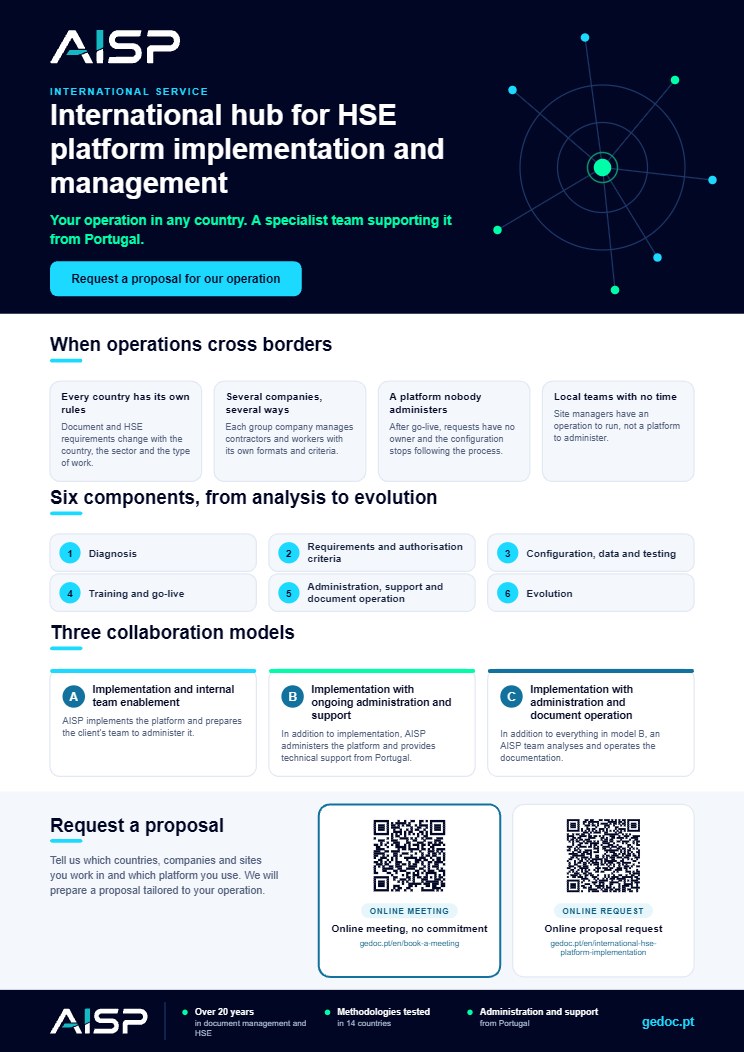
Service leaflet
Download our leaflet
The international HSE platform hub on one A4 page: when it makes sense, the three collaboration models and how to request a proposal. To read, print or share with your team.
Download leaflet (PDF)PDF, A4. Direct download, no registration.
Request a proposal
Request a proposal for our operation
Describe your operation. With this information, the AISP team prepares the conversation and the proposal. Fields marked with an asterisk are required. The others help us prepare better, but can wait.
Request received
Your proposal request for the International hub for HSE platform implementation and management has been sent to the AISP team.
Next step: the team analyses the information you provided and contacts you in the way you chose, to confirm the scope and prepare the proposal.
If you would like to add anything in the meantime, write to geral@aisp.pt or call +351 234 040 475.
The request could not be sent
The data you entered has not been lost. Please try again in a moment or write to geral@aisp.pt.
Form not yet connected to a destination
Nothing was sent. This message only appears while the form is not connected to the internal destination (geral@aisp.pt).
Complementary services
Services that combine with the hub
HSE platform implementation
The implementation service itself, from diagnosis to support after go-live. The hub applies it to operations with several companies, countries or sites.
Learn more →International document management
How to combine a central model with each country's local rules.
Learn more →Platform administration and technical support
Ongoing functional administration of the platforms after go-live.
Learn more →Integration and automation
Platforms that synchronise with each other and with other systems in the organisation.
Learn more →Access control
Access conditioned on the document status of companies, workers and equipment.
Learn more →HSE platform replacement
For when you need to switch platform and migrate the documentation.
Learn more →Show us your operation and we will prepare the proposal
Tell us which countries and sites you operate in and which platform you use. The AISP team analyses the request and contacts you to prepare the proposal.