
Drills planned, carried out and documented, so that an emergency is not the first time
AISP plans, coordinates and documents emergency drills, with the assessment and corrective actions that turn each exercise into real improvement.
Hundreds of drills carried out in Portugal, in all business sectors
Why drills fail
An emergency plan is only worth as much as its practice. And practice needs preparation and records.
Exercises done out of obligation
Drills organised in a hurry, with no scenario, no objectives and no assessment, that meet the calendar but teach little.
No record and no evidence
Attendance, response times and observations are lost, and the organisation cannot show what was done.
Corrective actions that go nowhere
Failings found in the exercise are not assigned to anyone, and they repeat in the next one.
Framework
ISO 45001 (clause 8.2, emergency preparedness and response) asks organisations to periodically test and exercise their planned response capability. In Portugal, the fire safety regime for buildings provides, in many cases, for an emergency plan and drills, with requirements that depend on the risk category.
AISP organises and documents the exercises. Emergency plans and legal responsibilities remain with the organisation.
Who it is for
For organisations that want to test their emergency response, not just tick off the calendar.
Organisations with an emergency plan
They want to put it to the test with a scenario, assessment and record, and know what to correct.
Sites with several companies
Own and contractor teams in the same place, in a single exercise and a single record.
Organisations that answer to audits
They need evidence of the drills carried out, for example under ISO 45001.
What AISP does for you
From scenario to report, with every exercise documented.
Drill planning
We define with you the scenario, objectives, participants, schedule and assessment criteria.
Preparing the teams
We link the exercise to HSE training and awareness, so that people know what is expected of them before the day.
Coordination and recording
We follow the exercise and record attendance, times, incidents and observations.
Assessment and corrective actions
We produce the report, assign the actions and prepare the next exercise, with evidence for audits.
How it works
A repeatable cycle: plan, prepare, execute and improve.
1. Plan
- The company contacts AISPProvides the scenario to simulate
- AISP invites external teamsINEM and fire brigades, if you decide
- Participation confirmedWe organise the drill
2. Prepare
- StagingSimulated smoke and casualties
- Resources and materialsAISP’s, yours, or both
3. Execute
- Drill and recordWe record every action
4. Improve
- Final reportIncidents and improvements
The improvements in the report feed into the next drill
Scenarios we organise
Your organisation defines the scenario. We plan, prepare and coordinate the exercise.
Fire and evacuation
Fire-fighting and building evacuation, with a smoke machine when the scenario requires it.
Accidents and medical emergencies
Simulated casualties, with casualty make-up, and medical emergencies.
Spills and chemical emergencies
Spills of chemicals, fuels and oils, with the chemical emergency kit when you ask for it.
Other scenarios
Other emergencies relevant to the risk of your operation, defined with you.
Materials and teams: your decision
When you contact us, you tell us what you need and how you want the drill organised. We adapt.
Materials
You can use your own materials, with your own workers, or AISP brings whatever is needed.
AISP always brings the casualty make-up material for accident drills and the smoke machine for fire-fighting drills. We bring extinguishers and the chemical emergency kit when you ask for them.
Teams
Drills with your internal teams, or with invited external teams, such as INEM and the fire brigades.
The decision is yours. AISP handles the invitation and the coordination.
Plan and legal responsibility
The emergency plan and legal responsibilities remain with your organisation. AISP organises and documents the exercises that put it to the test.
What is included and what is not
So there is no doubt about what AISP does and what remains with the organisation.
Included
- Planning of the scenario, objectives and assessment criteria
- Preparation of the teams
- Invitation and coordination of external teams, when you want to include them
- Casualty make-up material and smoke machine, when the scenario requires them
- Extinguishers and chemical emergency kit, when you ask for them
- Coordination and recording on the day: attendance, times, incidents and observations
- Report with assigned corrective actions
Not included
- Drawing up or replacing the emergency plan
- The organisation’s legal responsibilities
- Carrying out the corrective actions, which remain with the organisation
What changes in your organisation
Exercises with a scenario, a record and assigned actions, instead of calendar compliance.
Exercise agreed with operations, with scenario, schedule and participants defined before the day
Attendance, response times and incidents recorded in every exercise
Own and contractor teams in the same exercise, with a single record
Report with assigned corrective actions, as evidence for audits
How the proposal is sized
The proposal depends on the scenario and the decisions you make with us.
What influences the proposal
- Type of scenario and objectives
- Materials: yours, AISP’s or both
- Internal and external teams (INEM, fire brigades)
- Number of sites, companies and participants
- Country and language
- Frequency of the exercises
How to start
Meeting
We listen to your operation and the scenario you want to test.
Proposal
We prepare the proposal with the materials and teams you define.
Scheduling
We agree the calendar and plan the first drill.
Integrated with the rest of what AISP does
This service does not work in isolation. It connects with the other services and platforms, so that the HSE operation is controlled end to end.
Regulatory framework for information only. The applicable requirements depend on the country, the sector and the risk category of each installation.
Frequently asked questions
What organisations ask before moving forward.
Does AISP replace the emergency plan?
No. The emergency plan and legal responsibilities remain with the organisation. AISP plans, coordinates and documents the exercises that put it to the test.
What types of drill can be carried out?
Fire and evacuation, accidents with simulated casualties and medical emergencies, spills and chemical emergencies, or any other emergency relevant to the risk of your operation. The scenarios are defined with you.
Who provides the materials?
It depends on what you decide. You can use your own materials, with your own workers, or AISP brings whatever is needed. AISP always brings the casualty make-up material for accident drills and the smoke machine for fire-fighting drills. We bring extinguishers and the chemical emergency kit when you ask for them.
Who takes part in the drill?
Your internal teams and, if you decide, external teams such as INEM and the fire brigades. AISP handles the invitation and the coordination.
Does it work with several companies on the same site?
Yes. We can coordinate the participation of own and contractor teams, and consolidate the evidence in a single record.
What evidence do I receive at the end?
A report with attendance, response times, incidents and observations, and with the corrective actions assigned. It serves as evidence for audits.
Has AISP organised drills before?
Yes. We have organised hundreds of drills in Portugal, in all business sectors.
Is it available for our sector and outside Portugal?
Yes. AISP services are available for all business sectors and anywhere in the world. The legal requirements of each country are taken into account in the planning.
How do we start?
With a meeting. We listen to your operation and propose the next step.
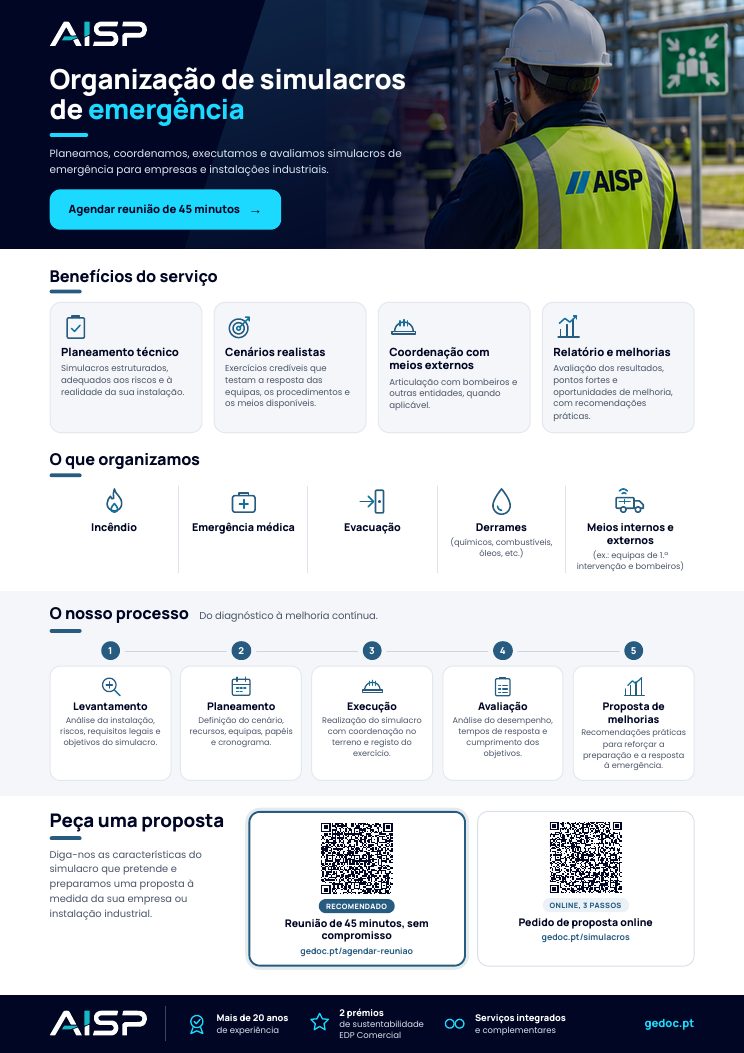
Service leaflet
Download our leaflet
Organising emergency drills on one A4 page: benefits, what we organise and the 5-step process. To read, print or share with your team.
Download leaflet (PDF)PDF, A4, 269 KB. Direct download, no registration.
Tell us the scenario and we will prepare the proposal
Fill in the details below. The more specific the scenario, the better tailored the proposal. If you would rather talk first, book a meeting.
Want drills that really improve your response? Start with a conversation.
Choose the day and time directly in the calendar. The conversation is yours: we listen first.
A frank assessment
We listen to your organisation’s context and tell you candidly where the risk lies and what can be improved.
The possible paths, compared
Assess a new project, the evolution of what you already have or alternatives, before requesting a proposal.
A clear next step
You leave the meeting knowing what to do next.