
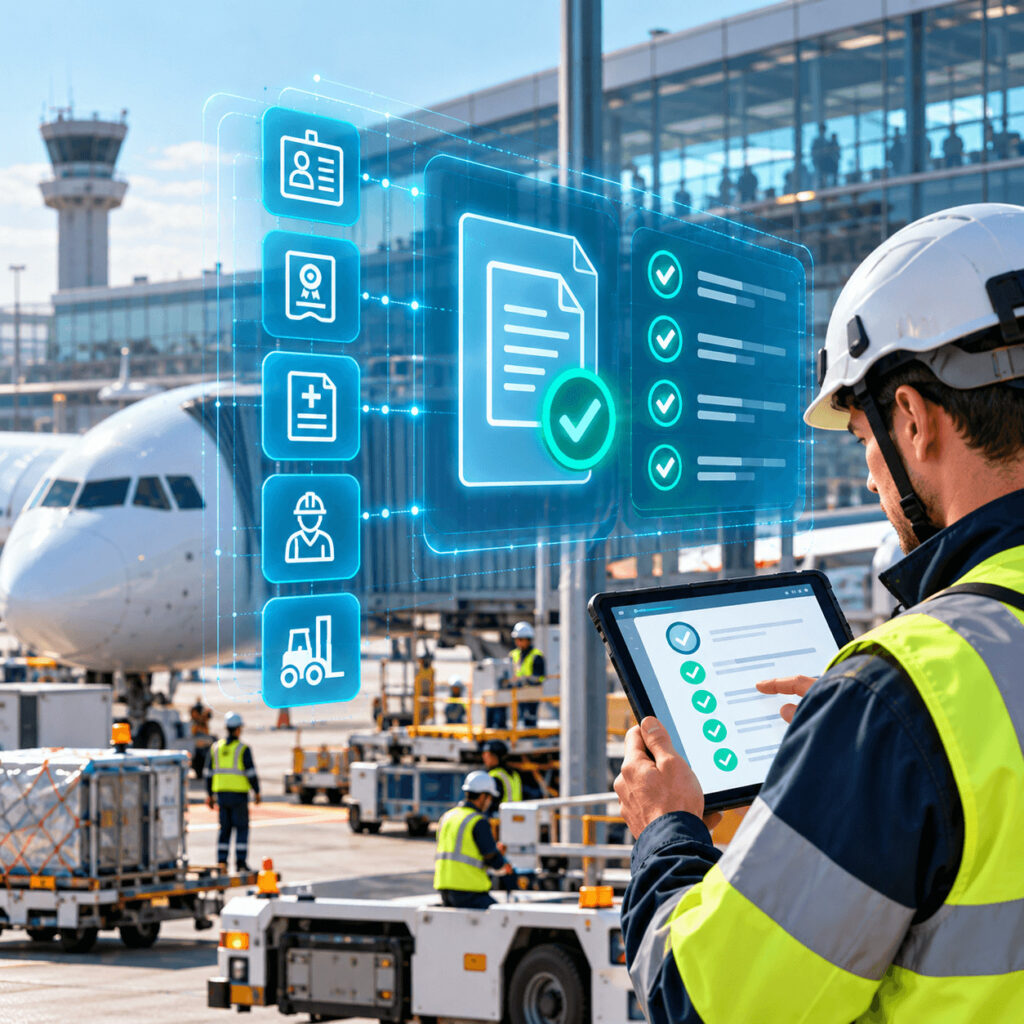
In September 2026, AISP takes a new step in its digital offering and starts implementing Glartek, an integrated HSE and document management platform (HSE/EHSQ). The solution suits organisations that want to centralise processes, reduce manual tasks and bring document information closer to operations.
The partnership brings together two complementary components. On the one hand, AISP contributes its experience in implementing and supporting document management and HSE processes. On the other hand, Glartek, a Portuguese company specialising in an AI-native EHSQ platform, contributes the technology. Under the model agreed for this partnership, AISP works with organisations on process analysis, solution configuration, integration, training and implementation support. Glartek technology, in turn, provides the digital infrastructure on which these processes run.
This development allows AISP to respond to a need that we see more and more in the projects we support. Organisations are not just looking for a platform to store and validate documents. Instead, they want to connect documentation, contractors, workers, equipment, safety, compliance and operational processes in a common digital structure.
From document management to an integrated HSE ecosystem
Document management remains an essential component of the solution.
Teams can manage companies, workers, equipment and their requirements within the platform, while tracking documentation, statuses, expiry dates and compliance processes.
However, the real difference lies in what can happen from there.
The same platform can cover processes such as inspections, audits, non-conformities, corrective actions, chemical substance management, competence management, training, knowledge and document control. It also covers other health, safety, environment and quality processes. Glartek presents the solution as a native, unified EHSQ platform that connects field and back-office teams through the same data model.
As a result, organisations can stop treating document management as an isolated application and make it part of a broader HSE architecture.
For example, a document requirement may relate to a worker.
In turn, that worker may take part in a specific activity.
The activity may then require an inspection, an authorisation, training or a specific action.
When these processes belong to the same ecosystem, information flows more easily. The organisation also reduces the need to maintain different systems to control different stages of the operation.
A configurable HSE and document management platform without constant development
Configurability was one of the factors that weighed most in AISP’s decision to invest in this solution.
Over more than 20 years of work in document management, we have supported very different organisations. Their requirements, approval flows, structures, responsibilities and ways of working are rarely the same.
Therefore, a rigid platform tends to force the company to adapt its processes to the limitations of the technology.
Glartek’s approach, by contrast, follows the opposite logic.
The platform uses a no-code architecture, so teams can configure processes, forms, workflows, rules and other components. They do this without turning every change into a traditional software development project. Glartek itself highlights configuration autonomy as one of the features that set the solution apart.
For AISP, this capability is particularly important because it allows us to configure the solution around each client’s reality.
For instance, the organisation can start with a given set of processes and expand later.
- It can change requirements
- Create new workflows
- Add projects
- Introduce new geographies
- Extend use to other HSE areas
The platform can keep up with that growth without the need to rebuild the whole system.
Artificial intelligence built into the platform itself
Another relevant difference lies in how the platform integrates artificial intelligence.
Glartek currently presents itself as an AI-native EHSQ platform. In other words, AI does not just work as an extra search or reporting tool. Instead, it sits inside the operational processes themselves. Among other capabilities, the platform offers AI for contractor management, documentation, inspections and risk analysis. It also offers natural language interaction through GIL, the intelligent layer of Glartek.
In document management, this development is especially relevant.
Documents contain information that traditionally requires manual reading and data entry: dates, entities, references, identifiers, statuses, qualifications and other elements that the process needs.
The approach we are implementing uses artificial intelligence to support the reading, extraction, classification and analysis of document information. It turns part of that information into structured data that can feed the processes of the platform.
The aim is not to take control away from teams.
Rather, it is to reduce repetitive tasks so that professionals can focus on the cases that truly require interpretation and decision-making.
A platform ready for work in the field
Another differentiating feature is the focus of Glartek on the users who carry out the work.
Glartek built the solution with a mobile-first approach, and teams can use it in the field, even where connectivity is limited. In this way, they can carry out tasks, consult information and record data close to where the activity takes place.
For HSE, this is particularly important.
Digital transformation cannot stay confined to the back office.
After all, inspections, observations, checks, actions and safety information often happen in the field.
The simpler it is to record that information when it occurs, the better the quality and timeliness of the data available to the organisation.
Integration with the systems the organisation already uses
Implementing a new platform should not force a company to create yet another information silo.
That is why integration capability is another relevant factor in this partnership.
Glartek offers integrations with different business systems and an open API to connect to other solutions. Among other categories, the ecosystem the company presents includes ERP, human resources, business intelligence, document management, identity and access, hardware and artificial intelligence assistants.
In practice, this means that document management and HSE can become part of the existing digital ecosystem.
For example, an organisation may already hold worker information in an HR system, use an ERP for certain processes or work with business intelligence tools.
The logic should not be to enter the same data by hand all over again.
Instead, it should be to let the systems communicate with each other.
Ready for international operations
The solution AISP is implementing also suits organisations that work across different geographies and languages.
This capability is particularly relevant in document management, where a company may receive documents from different countries. At the same time, it may work with international contractors, workers and projects.
The AISP-GEDOC approach manages this diversity within the same architecture. This avoids creating parallel processes just because the language or geography changes.
The aim is to allow for local differences without losing a global view.
More autonomy for organisations
The configurability of the platform also has another important consequence: it reduces dependence on the supplier for routine changes.
Many traditional solutions require technical intervention whenever the organisation wants to change a field, process or workflow.
In a no-code model, by contrast, teams can handle a significant part of this evolution through the configuration of the platform itself.
Glartek identifies client autonomy as one of its differentiating features. The organisation can take on more or less responsibility for configuration directly and call on specialist support when necessary.
For AISP, this autonomy does not eliminate technical support.
Instead, it changes its role.
Rather than keeping the client dependent for small changes, it allows support to focus on higher-value aspects: process development, optimisation, new features, integrations and use of data.
The role of AISP in the partnership
Glartek develops the platform.
AISP’s role lies in implementing the technology in the reality of each organisation.
This is where experience in document management and HSE, process knowledge and team support come in.
The methodology AISP presents rests on four stages: understanding the processes and objectives of the organisation, configuring the platform, integrating the necessary systems and supporting the solution as it evolves over time.
This may involve requirements analysis, process design, parameterisation, data migration, testing, training, go-live support and follow-up.
Because providing technology is only one part of an implementation.
It is also necessary to ensure that the configuration reflects real processes and that people can use the solution.
What sets this new AISP-GEDOC offering apart
The difference does not come from a single feature.
Instead, it comes from combining several capabilities in a single architecture:
Document management + HSE/EHSQ + artificial intelligence + no-code + integration + mobility + multilingual capability + specialist support.
Glartek built its platform natively as a single solution, rather than assembling independent products acquired over time. According to the company, this architecture allows the different areas of the solution to share the same technology base and the same data model.
For AISP, this opens up the possibility of building projects that start with document management and gradually extend to other HSE processes, without forcing the organisation to multiply platforms.
AISP experience. Glartek technology
The partnership therefore marks a new phase in the evolution of the AISP-GEDOC offering.
The experience AISP has built up in document processes and operational support now joins a technology platform ready for AI, automation, no-code configuration, integration and integrated HSE management.
Our vision, however, remains the same:
technology should adapt to the reality of the organisation, not force the organisation to adapt to the limitations of technology.
With this principle in mind, we are starting to implement the Glartek platform in new AISP-GEDOC projects.
Not just as a new document management platform.
But as a digital infrastructure ready to connect documentation, data, people, HSE and operations.
Read also: Document management + HSE: Documentation, inspections, compliance and information on one integrated platform and Technical support for HSE platforms: Implementation is just the beginning.
Finally, for more information on occupational safety and health, see the European Agency for Safety and Health at Work (EU-OSHA).