
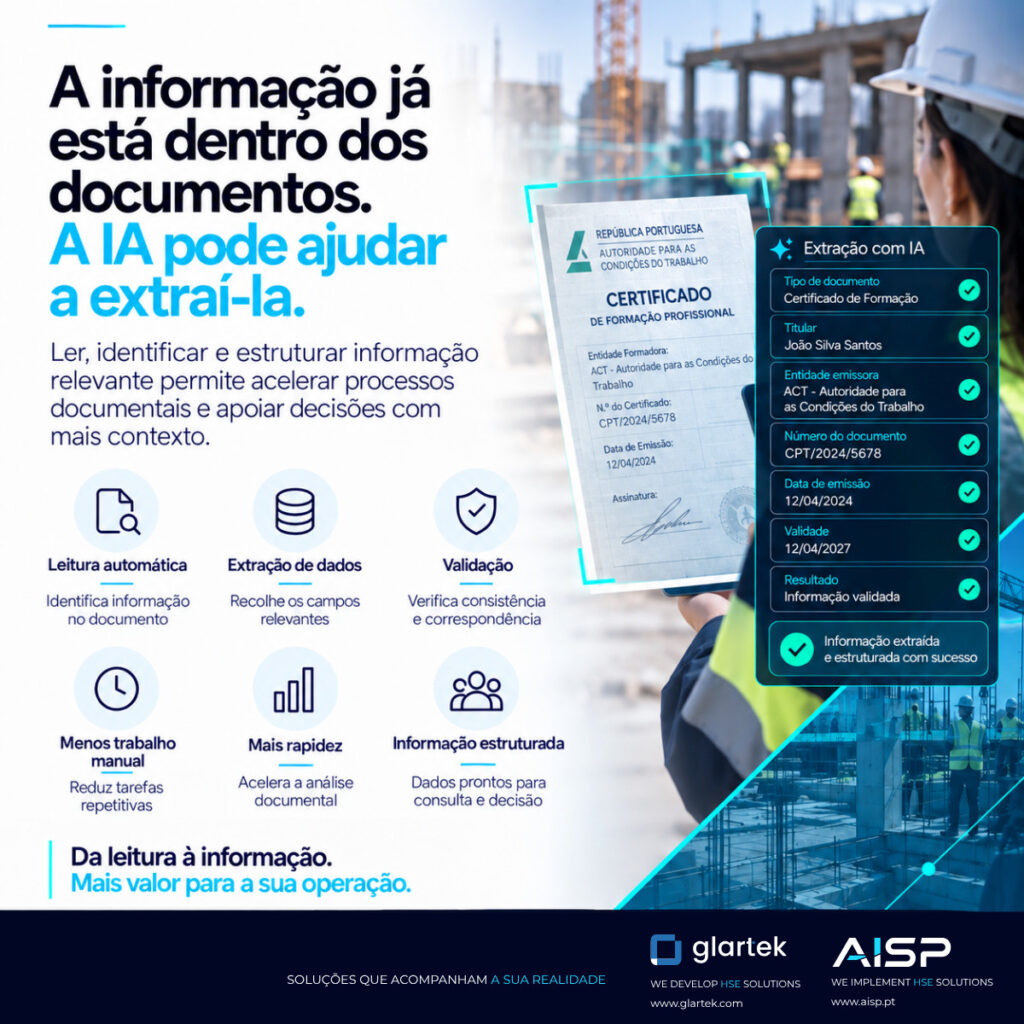
Every day, organisations work with thousands of documents that contain essential information for operations: training certificates, medical fitness certificates, insurance policies, declarations, inspection reports, equipment certificates, technical data sheets, licences, authorisations, maintenance records or supplier documentation. AI data extraction makes it possible to make better use of that information.
In fact, in most cases, the information needed already exists.
However, the problem is that it remains trapped inside the files.
To use that data, someone has to open the document, interpret the content, find the relevant fields, confirm they are consistent and re-enter the information into a platform, a spreadsheet or another system.
When teams repeat this process hundreds or thousands of times, it stops being a simple administrative task.
It therefore becomes a problem of efficiency, traceability and operational control.
This is precisely where artificial intelligence applied to document management starts to create value.
In other words, the question is no longer just digitising documents.
It is about turning unstructured documentation into structured, searchable information that the organisation’s processes can use.
From digital files to usable information
In fact, having documents in digital format does not necessarily mean having digital information.
For example, a PDF may sit on a platform and still work exactly as a sheet of paper did.
As a result, the team still has to:
- open the document;
- look for the relevant data;
- interpret the content;
- confirm dates and names;
- copy information into fields;
- check requirements;
- decide whether to approve the document.
In other words, the file is digital, but the process remains largely manual.
The real transformation begins when the platform can identify and structure the information in the document automatically.
In this way, a certificate is no longer just a file called certificate.pdf.
It can start to provide data such as:
Document type: training certificate
Holder: João Silva
Issuing body: identified training provider
Issue date: 12/04/2026
Expiry date: 12/04/2029
Training: work at height
Certificate number: reference identified in the document
In addition, the other processes on the platform can then use this data.
This is where the document really starts to become operational information.
What does AI data extraction mean?
AI data extraction combines different technologies.
Depending on the solution and the type of document, the process may involve optical character recognition, structure recognition, language models, document classification, entity identification and specific business rules.
Put simply, the flow looks like this:
Document → Reading → Identification → Extraction → Structuring → Validation → Decision
Each stage has a distinct function.
1. Reading the document
The first step is to turn the content of the file into a representation that a system can process.
For example, in a digital PDF, much of the text may already be available.
However, with a scanned document or a photograph, you may need OCR (optical character recognition) to recognise the text in the image.
But recognising characters is only the beginning.
Knowing that the characters “12/04/2026” appear on a page does not yet mean understanding what that date represents.
2. Identifying the document type
Before extracting information, you often need to understand which document you are analysing.
Is it a certificate?
A medical fitness certificate?
An insurance policy?
Or a declaration of conformity?
An inspection report?
A work permit?
Document classification matters because different document types require different information.
For example, on a training certificate, the relevant items may be:
- trainee’s name;
- training completed;
- training provider;
- date;
- duration;
- validity.
On an insurance policy, by contrast, the relevant fields will be different.
On a medical fitness certificate, they will be different again.
That is why a smart document solution should not treat all documents as if they had the same structure.
3. AI data extraction: The relevant fields
Once it has identified the document, the AI can then look for the information it needs.
For example:
- holder;
- company;
- issuing body;
- document number;
- issue date;
- expiry date;
- equipment identification;
- type of training;
- role;
- result;
- signature;
- contract reference;
- location;
- registration plate;
- serial number.
However, the goal should not be to extract all the text indiscriminately.
It should be to identify the information that particular document process needs.
This distinction is therefore important.
In fact, extracting a lot of information does not necessarily produce more value.
In a B2B process, the value lies in extracting the right data and linking it to the right rules.
Extracting data and validating documents are not the same thing
This is one of the most important distinctions when we talk about AI applied to document management.
For example, a system may correctly identify that a certificate contains:
“Work at height training”
and that its validity ends on a certain date.
But that does not automatically mean the document is compliant.
Therefore, you still need to answer other questions:
- Does the certificate belong to the right worker?
- Does the training match the one required for the activity?
- Is the issuing body suitable?
- Does the document contain the mandatory elements?
- Is the certificate still valid?
- Does the training cover the specific risk?
- Are there any restrictions?
- Does the project have additional requirements?
Therefore:
Data extraction ≠ compliance decision
AI data extraction provides information.
Validation, on the other hand, uses that information to analyse requirements.
From extracted information to business rules
This is where a document management platform starts to stand out from a simple automatic reading tool.
Thus, after extracting the data, you need to link it to the rules configured for each process.
Imagine, for example, that a company requires the following for a given role:
- work at height training;
- valid medical fitness;
- specific safety training;
- identification documents;
- project authorisation.
In this way, the platform must be able to assess each piece of evidence individually and then relate it to the role and the activity.
The analysis may involve questions such as:
Did the worker submit the right document?
Does the holder match?
Is the expiry date within the defined limits?
Does the stated training match the required one?
Does the document come from an accepted issuing body?
Are all the mandatory elements present?
It is this link between extracted data + configured requirements + operational context that turns AI into a truly useful part of document management.
The importance of context
One of the most common mistakes in document digitalisation is to treat compliance as an isolated property of the document.
But a document may be perfectly valid and still not be enough for a particular situation.
For example, imagine a worker with two planned activities:
- electrical maintenance;
- work at height.
Their medical fitness certificate may confirm fitness for one activity but not provide enough evidence for the other.
In other words, the document is not necessarily invalid.
It simply may not be enough to authorise all activities automatically.
This example shows why document analysis needs context.
That is why an advanced platform must be able to relate:
Document + person + requirement + role + activity + risk + project
Only after making this connection can the platform produce a truly useful operational decision.
The role of the issuing body
In addition, another relevant example is identifying the entity that produced the document.
For instance, a certificate may have a valid date and correctly identify the worker.
But you may still need to determine:
- who issued it;
- whether that entity is acceptable;
- whether it matches the document type;
- and whether any client or project-specific rule applies.
Identifying the issuing body is therefore no longer just an administrative field.
It also becomes part of the analysis of the evidence itself.
With AI, data extraction makes it possible to identify this information while reading the document and use it later in the validation rules.
AI and multilingual validation
In international operations, there is another challenge: documents may arrive in different languages.
For example, an organisation may receive certificates in Portuguese, Spanish, French, English, German or Italian on the same project.
In a traditional process, this diversity can therefore increase review time significantly.
However, AI can support:
- language identification;
- information extraction;
- recognition of equivalent concepts;
- structuring of common fields;
- standardisation of information.
Even so, this does not mean the platform should handle different languages without control.
In fact, terms that seem similar may have different meanings depending on the legislation, the context or the type of document.
That is why the process must still rely on rules and requirements defined in advance.
Automating does not mean removing human checks
A robust document system should not try to automate every decision.
After all, there will always be ambiguous situations.
For example, a document may:
- be partly illegible;
- show contradictory information;
- not clearly identify the holder;
- contain a signature that is hard to verify;
- show similar training that does not exactly match the requirement;
- be incomplete;
- show restrictions;
- use unrecognised terminology.
In these situations, the platform must assume that there is not enough evidence for an automatic decision.
So the correct answer may be:
Manual check required.
This principle is therefore essential.
In other words, AI should reduce repetitive work, not turn uncertainty into approval.
The concept of confidence in extraction
Not all the information the AI identifies will have the same degree of certainty.
For example, a field the AI clearly recognises as:
Expiry date: 15/09/2027
may have high confidence.
By contrast, a date found in a barely legible document may have lower confidence.
You can therefore use this information to define different behaviours.
For example:
High confidence + clear requirement
→ automatic processing.
Medium confidence
→ additional validation.
Finally, low confidence or contradictory information
→ human review.
This type of architecture helps increase automation without compromising the quality of decisions.
From AI data extraction to automatic alerts
When dates no longer exist only inside documents and become structured information, new processes become possible.
In this way, the platform can automatically identify:
- documents that expire in the next 30 days;
- certificates whose validity ends before a project finishes;
- documentation that has already expired;
- affected workers;
- suppliers missing critical documentation.
In other words, control no longer depends on someone opening the document and checking the date.
The information is already available to generate alerts.
Structured data enables useful dashboards
The same logic also applies to indicators.
When documents are just files, producing indicators requires extra work.
When the information has a structure, you can view:
- percentage of compliant documentation;
- pending documents;
- expired documentation;
- documents to renew;
- suppliers with the most non-conformities;
- workers with incomplete requirements;
- equipment with pending documentation;
- average validation times;
- document volume by project.
Documentation thus starts to produce management data.
Less manual data entry also means fewer errors
Manual data entry is a repetitive task.
The greater the document volume, the higher the likelihood of errors such as:
- incorrect dates;
- misspelt names;
- incomplete certificate numbers;
- links to the wrong worker;
- incorrect document classification;
- forgotten fields.
Automating AI data extraction does not eliminate every error.
But it can significantly reduce the amount of information that someone needs to type again.
As a result, the team focuses more on analysing exceptions and less on transcribing information.
Traceability remains fundamental
Whenever a platform uses AI to support a document decision, it must be possible to understand where the information came from.
For example, in a robust process, you should be able to know:
- which document a given field came from;
- what information the system identified;
- which rule it applied;
- what the result was;
- whether there was a manual validation;
- who made the final decision;
- when that decision took place.
That is why automation should not reduce traceability.
On the contrary, it should ideally increase it.
Security and access control
Moreover, using AI does not remove the traditional requirements of document management.
In fact, sensitive information still requires control.
Therefore, organisations should consider:
- access profiles;
- permissions;
- activity logs;
- document retention;
- change history;
- information security;
- internal data protection policies.
The goal is not simply to make documents more accessible.
It is to make information accessible to the right people, for the right processes and with appropriate levels of control.
Integration: When information starts to flow
Another important benefit arises when extracted data can feed other systems.
Through APIs and integrations, the platform can make certain information available to:
- HSE systems;
- ERP;
- supplier management platforms;
- access control systems;
- operational applications;
- corporate dashboards;
- human resources systems;
- Business Intelligence tools.
For example, imagine that a worker no longer meets a critical document requirement.
That information then no longer has to exist only inside the document module.
It can also directly influence other operational processes.
This is the moment when document management definitively stops being an isolated system.
A practical example
Consider a supplier that uploads a training certificate to a platform.
In a traditional process:
- the supplier submits the document;
- a technician opens the file;
- identifies the worker;
- looks for the training;
- checks the expiry date;
- enters the data;
- compares it with the requirements;
- makes a decision.
However, in an AI-supported process, part of this flow can be different.
The system can:
- receive the document;
- identify the document type;
- recognise the worker;
- identify the issuing body;
- extract dates;
- identify the training;
- structure the information;
- compare the data with configured requirements;
- flag inconsistencies;
- send only the exceptions for review.
In this way, the technician no longer works mainly as a transcription operator.
Instead, they can focus on the cases that really require knowledge and judgement.
The goal is not to replace the document
Even in a highly automated process, the document remains important.
It is the original evidence.
The difference lies in how you use the information in that evidence.
Before:
file → manual consultation
After:
file → structured information → rules → context → decision
It is this evolution that can transform document management.
Where is the real return?
You should not measure the benefit of using AI in document management only by the number of documents it processes automatically.
On the contrary, the analysis should be broader.
For example, it may include:
Less administrative time
Fewer reading and manual data entry tasks.
Greater consistency
More uniform application of the defined rules.
Greater speed
Faster document processing.
Better traceability
Structured information on every decision.
Better indicators
Data available for management and reporting.
More capacity to scale
Higher document volumes without a proportional increase in manual work.
More focused teams
Technicians can concentrate on exceptions and critical situations.
Technology only works well when the process is well defined
There is, however, an essential condition.
AI does not replace the definition of the document process.
Therefore, before automating, you need to know:
- which documents exist;
- which fields are relevant;
- the requirements to meet;
- which evidence is acceptable;
- what exceptions exist;
- the decisions that can be automatic;
- which situations require human intervention.
If these rules are not clear, automating simply makes a poorly structured process faster.
An effective implementation therefore starts with process design.
After that, technology can help scale it.
From reading to information. From information to decision.
The evolution of document management means no longer treating documents only as stored files.
In fact, the information already exists.
It is in the certificates, reports, licences, declarations, policies and records that organisations receive every day.
Thus, artificial intelligence can help:
read, identify, extract, structure and relate that information.
But the real value appears when data is no longer isolated and starts to work within the context of the process.
When document information feeds rules.
Also when the platform links requirements to workers, companies, equipment and activities.
When data generates alerts and indicators.
And when the system routes a decision it cannot make safely to human review.
This is the point at which document management stops being just a repository.
It becomes an information infrastructure that supports operations.
The information is already inside the documents.
AI can help extract it, structure it and turn it into value for the organisation.
Read also: Identifying the issuing body: Why this is no longer just an administrative matter and The future of document management: From document repository to intelligent platform.
To learn about the European guidelines on artificial intelligence, see the European Commission.