
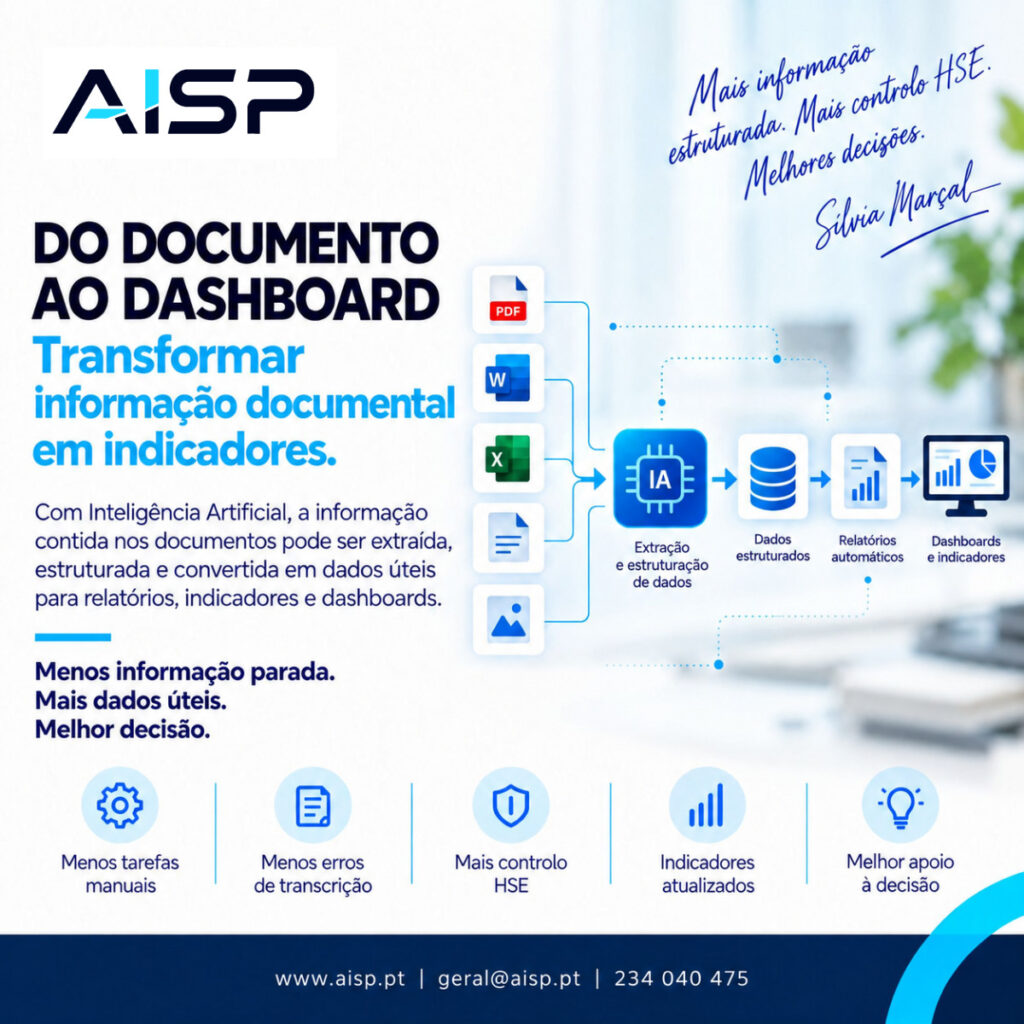
Documents contain information that matters to operations and is essential for document reports and indicators.
However, this information often remains dispersed, unstructured and hard to use.
On the other hand, artificial intelligence and automation make it possible to change this reality.
In other words, teams can extract, organise and convert the information in documents into data. That data then feeds document reports and indicators, as well as dashboards.
In practice, this means:
- Automatically extracting relevant data
- Structuring document information
- Updating databases and reports
- Feeding performance indicators
- Reducing manual tasks and transcription errors
- Improving visibility over operations
- Supporting decisions with faster, more consistent information
For HSE teams, for example, this can mean turning certificates, reports, data sheets, records and evidence into usable information. That information then supports monitoring and decisions.
As a result, a document is no longer just a file. In fact, it starts to feed document reports and indicators.
Finally, that is where document management takes on a new dimension:
less idle information. More useful data. More control. Better decisions.
See also: Documents should not end up in an archive. They should become useful information and The dashboard is not the goal: Turning HSE data into operational decisions.
In addition, the European Commission publishes guidance on data and artificial intelligence as part of the European digital strategy.