
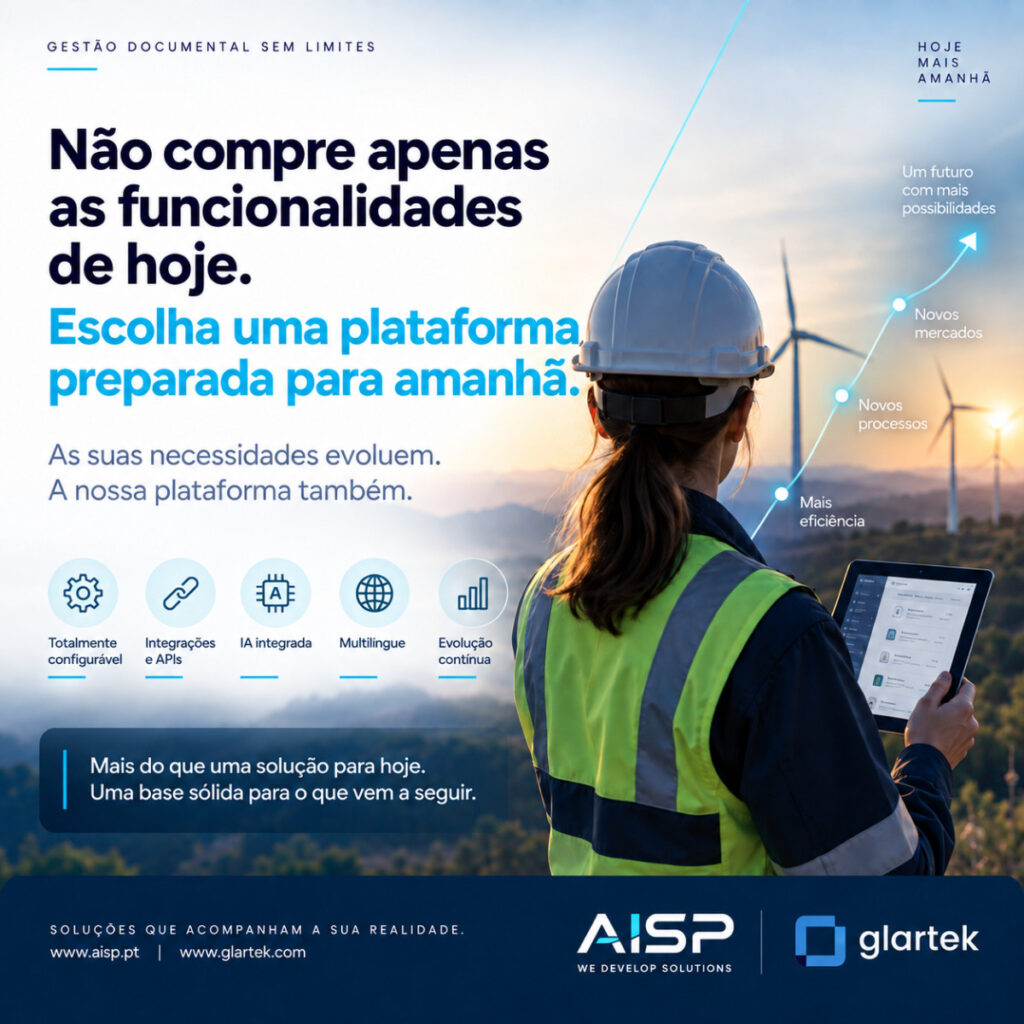
Choosing a document management platform is a decision that organisations tend to base on their current needs, rather than on the value of an evolving platform.
Which documents do we need to manage?
Which workflows do we want to implement?
Who will work on the platform?
Which reports do we need?
And which processes do we want to digitise?
These are important questions.
But they are not enough.
Besides asking “Does it have the features we need today?”, you also need to ask: “Will it be able to keep up with the organisation in three, five or more years?”
Organisations do not usually choose a document management platform to use for just a few months. In fact, it is infrastructure that may support the organisation for many years.
Therefore, the ability to evolve should be one of the main decision criteria.
Today’s needs will not be tomorrow’s needs
Organisations change all the time.
For example, they may grow, enter new markets, create new business units, work with new suppliers or start operating in different geographies.
Internal and external requirements also evolve.
In addition, new HSE and OSH processes, new client demands, new approval circuits or new reporting needs may emerge.
At the same time, technology keeps moving forward.
Artificial intelligence is transforming the way we can read, classify, analyse and use documents.
Likewise, integrations between systems are becoming increasingly relevant.
Finally, information no longer stays locked in a single application.
Thus, a future-ready platform must be able to keep up with this evolution.
Configurability: Adapting an evolving platform without rebuilding it
One of the most important features of a platform built to evolve is its configurability.
Fields, forms, statuses, workflows, rules, permissions, requirements and reports should not permanently depend on new development work.
For example, a no-code approach lets you make many of these changes faster and more independently.
In this way, it reduces technical dependency and brings the platform closer to the organisation’s operational reality.
Integration and interoperability
No platform should work like an island.
Organisations use ERP, human resources, maintenance, Business Intelligence, operational systems and HSE platforms, among many other applications.
Document management must therefore be ready to communicate with that ecosystem.
APIs, integrations and interoperability allow data, documents and processes to flow between different systems.
As a result, you reduce duplicate information, manual tasks and parallel processes.
Artificial intelligence as an evolving platform capability
Document management is also changing through artificial intelligence.
In fact, a document no longer has to be just a file you look up.
You can extract the information it contains, structure it and use it in other processes.
Dates, values, entities, requirements, statuses or references can feed databases, reports, indicators or validation mechanisms.
Therefore, assessing a platform only on its traditional archive, search and approval features is no longer enough.
It is important to understand how far it is ready to take on new ways of using information.
Ready for different languages and geographies
As organisations grow internationally, the diversity of their documents also increases.
Suppliers, teams and projects may work in different languages and jurisdictions.
So a platform built to evolve must be able to follow that reality without turning each new market into a new technology problem.
HSE and OSH: From document to operational process
In HSE and OSH, documentation often goes hand in hand with operations.
Contractors, workers, equipment, substances, inspections, audits, non-conformities and action plans are part of an interconnected reality.
Consequently, the natural evolution of document management means bringing it ever closer to these processes.
In other words, the document is no longer the end point.
It becomes part of a wider operational ecosystem.
The real cost of not choosing an evolving platform
The cost of a platform is not just the price of the licence or the implementation.
It is also the future cost of its lack of flexibility.
A solution that struggles to evolve can lead to:
- new development work;
- technical dependency;
- parallel tools;
- duplicate information;
- manual processes;
- premature migrations;
- loss of efficiency.
The ability to evolve is not a feature. It is a structural characteristic of technology.
That is why choosing a platform should also be a decision about its ability to evolve.
Choosing an evolving platform for tomorrow
Choosing an evolving document management platform means looking for a solution that combines:
- Configurability
- No-code
- Artificial intelligence
- Integrations
- Interoperability
- Multilingual capability
- Integrated HSE and OSH processes
- Continuous evolution
Therefore, at AISP-GEDOC, in partnership with Glartek, this is precisely the vision we champion for the new generation of document management.
Not just creating a platform that can meet today’s needs.
But creating a solution ready to keep up with what organisations will need in the future.
Because choosing technology is not only about solving the present.
It is about preparing for the future.
See also: Selecting document management platforms: Process and criteria and Challenges in implementing a document management platform.
To follow the European strategy for artificial intelligence and interoperability, visit the European Commission portal.