
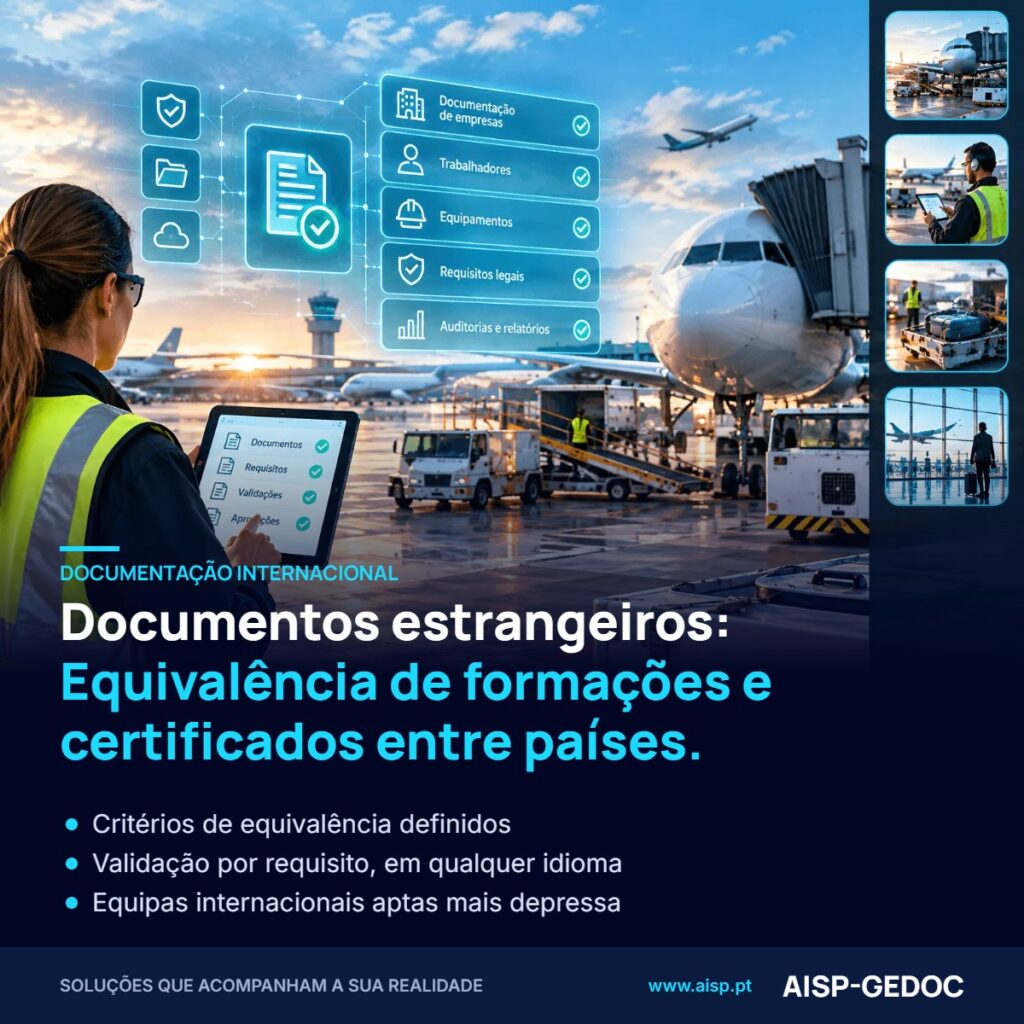
Foreign documents: Equivalence of training and certificates between countries
Foreign document equivalence is now a daily issue in projects with international teams. For example, a training certificate or a medical fitness record may be valid in the country of origin and yet not comply with the law of the country where the work takes place.
Moreover, translating the document is only the first step. The main question is whether its content meets the local requirement.
Criteria for foreign document equivalence
To decide consistently, therefore, your team should:
- Identify the issuing body and, above all, confirm that the country of origin recognises it;
- Compare content, training hours and expiry dates with the local requirement;
- Define equivalence rules by document type and by country, instead of deciding case by case;
- Record the criterion applied in each approval, to ensure traceability in audits;
- Plan alternatives, such as additional training, when equivalence is not possible.
As a result, assessing foreign document equivalence no longer depends on each reviewer’s interpretation. In this way, the process becomes predictable for clients and contractors.
In practice, a multilingual platform helps a great deal. First, it reads documents in several languages. Then, it applies the defined equivalence rules. Finally, it shows the reviewer the right criterion for each case.
AISP-GEDOC supports operations in different regions by assessing foreign document equivalence and structuring requirements by country.
In addition, the equivalence decision has a direct impact on planning. When the team knows in advance that a certificate will not be accepted, it can schedule additional training in time. Consequently, the worker arrives on site ready to work and the project avoids unnecessary delays.
Finally, clear rules also protect the organisation during inspections and audits, because every decision is justified and documented.
Further reading: Contractor and subcontractor management: A complete guide.
Read also: multilingual document management and Working internationally should not mean multiplying platforms and processes.
Contact us and set clear equivalence rules for your international teams.